


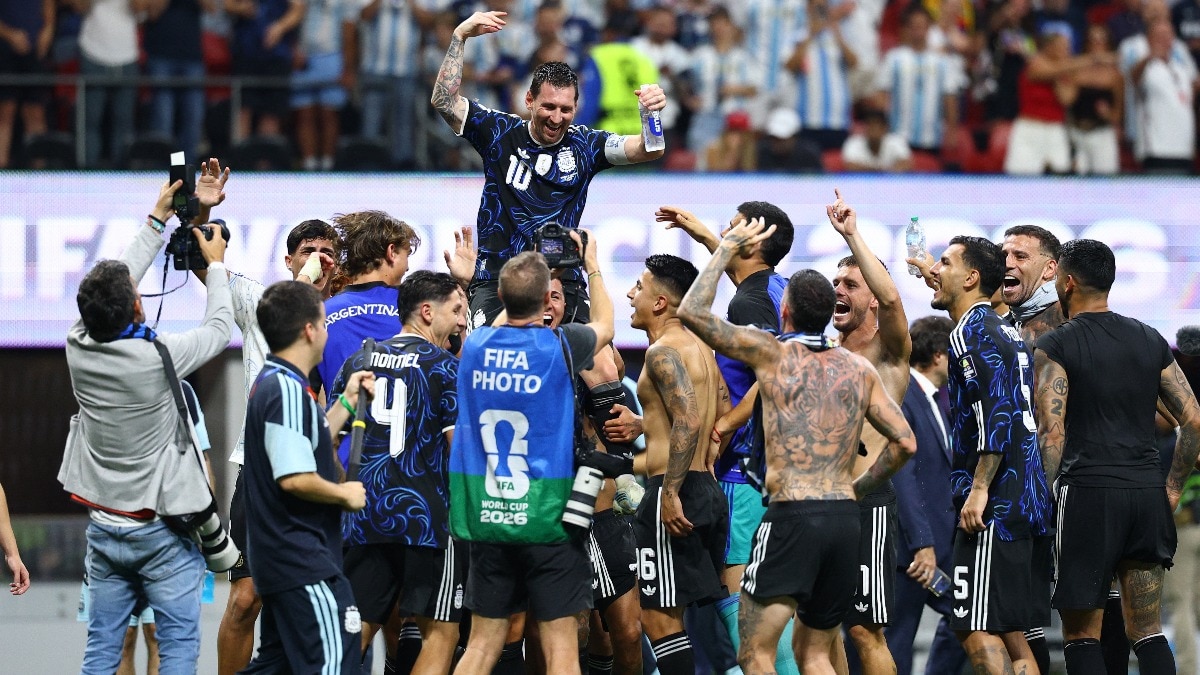
Argentina have made a habit of breaking the hearts of opposition players and their supporters by arriving fashionably late. On Wednesday in Atlanta, England became the latest casualty on that list, as Argentina’s win stretched their unbeaten run in World Cup football to 13 matches, the longest such streak in the tournament’s history, one better than Italy’s old record.
For an hour, the World Cup semi-final against the Three Lions refused to catch fire. The first half was goalless, tight and cagey, two heavyweight sides sizing each other up rather than swinging. England looked the more composed of the two, and the breakthrough arrived on the hour mark. Anthony Gordon turned home a Morgan Rogers cross in the 55th minute to send the English end of Atlanta Stadium into raptures. For a while, it looked enough. England sat in, shape intact, dreaming of a first final since 1966.
Then, as if on cue, Argentina found the extra gear that had defined their entire tournament. They upped the tempo, camped inside England’s half and simply would not let up. In the 68th minute, substitute Nico Gonzalez met a Messi cross with a header that Jordan Pickford somehow kept out. Eight minutes later, Alexis Mac Allister crashed a header against the post from a Rodrigo De Paul cross, agonisingly close. England were being pinned back wave after wave, and the goal always felt like a matter of when, not if.
It duly arrived in the 85th minute. Enzo Fernandez levelled with a bending strike off a pass from Messi, the ball flying in off the far post before Pickford could react. Seven minutes later, deep into stoppage time, Lautaro Martinez rose highest to head home another Messi cross.
Final score: 2-1.
Argentina, somehow, again, are through to another World Cup final. England, meanwhile, are left to pick itself up for a third-place playoff against France, replaying the same last fifteen minutes in their heads.
BETTER LATE THAN NEVER
This was not even Argentina’s first heist of the fortnight. Nine days earlier, they were staring at a 2-0 deficit against Egypt in the round of 16. Messi had just seen a penalty saved, and the exit door was wide open. Cristian Romero, Messi and Fernandez then scored three times in the final eleven minutes and stoppage time to complete one of the most dramatic comebacks in World Cup history. In the quarter-final against Switzerland, Argentina needed extra time before Julian Alvarez and Martinez sealed it deep into the additional half hour.
Three knockout games, three sweated-out finishes, all settled after the 79th minute. Argentina arrive late, but they arrive with the finishing touches intact. Cometh the hour, cometh the champion.
BEYOND MESSI: ARGENTINA’S OTHER HEROES SHOW UP
The most striking part of this run is how little of the actual finishing has come from Messi himself. Across the last three knockout games, Argentina have scored eight goals, and only one of them, the equaliser against Egypt, has had Messi’s own name on the scoresheet. Romero headed in the goal that started the fightback against Egypt. Mac Allister, Alvarez and Martinez did the damage against Switzerland. Fernandez and Martinez did it again against England.
What Messi has done instead is set the goals up. Two assists against England, and carrying the vision and the delivery that turn Argentina’s late pushes into actual chances. Argentina used to be a team that leaned entirely on one man to produce a moment of magic. This version has learnt to produce moments of magic from midfielders and centre-backs too, with Messi orchestrating rather than always finishing. It is arguably what makes this Argentina side more durable than any before it.
THE NUMBERS GAME: MESSI RETAKES THE GOLDEN BOOT LEAD
Strip away the theatrics and the most remarkable part of Argentina’s run is this: Messi did not score in either the Switzerland quarter-final or the England semi-final, and it barely mattered. The defending champions played like champions, even with their talisman in provider mode rather than finisher.
That assist haul has a knock-on effect that will matter on Sunday too. Messi went into the semi-final level with Kylian Mbappe at eight goals apiece in the race for the Golden Boot, with Mbappe ahead on the first tiebreaker of assists. Messi’s two assists against England pushed his own tally past Mbappe’s, handing Argentina’s No.10 the lead in the race for an individual prize that has eluded him at every previous World Cup.
SCALONI ATTACKS, TUCHEL RETREATS
The contrast in the dugouts told its own story. As the game tightened up, Lionel Scaloni went for the throat, throwing on Nico Gonzalez and eventually Martinez to add fresh legs in attack. Thomas Tuchel, protecting a 1-0 lead, pulled England back into a five-man defence and invited the siege that eventually cost him the game. One manager backed his team to win it. The other set his team up not to lose it. Only one approach survived the final fifteen minutes.
THE TUCHEL-BELLINGHAM UNDERCURRENT
This was not the first time England’s dressing room mood had been tested this tournament. Days earlier, after a laboured 2-1 extra-time win over Norway in the quarter-final, Tuchel had been openly critical of his own side, calling the performance sloppy and saying England had been lucky to get through. Jude Bellingham, whose double had actually won that game, was unimpressed when the comments were put to him, brushing them off with a one-word “Whatever.” It was a small crack in the mood heading into the biggest match of England’s summer, and Wednesday’s collapse will only invite more scrutiny of Tuchel’s tactical caution under pressure.
CHOKERS AGAIN? ENGLAND’S BELIEF PROBLEM
There is a particular flavour of heartbreak reserved for England at World Cups, and Wednesday had all the notes of 2018 in Moscow, when Kieran Trippier’s early free kick had them dreaming before Croatia ground them down in extra time. Different opponent, same ending. Despite housing the Premier League, arguably the best-funded, most-watched football competition on the planet, England have not won the World Cup since 1966. Fifty-nine years and counting, and Wednesday did nothing to shorten that wait.
Every tournament, the same song plays. ‘It’s coming home,’ English fans sing, half in hope and half in irony, and every tournament it doesn’t. The pattern now goes beyond bad luck. England keep arriving at the business end of major tournaments with the talent to win it, and keep finding a way to talk themselves out of the finish. Wednesday looked less like a team beaten by a better side in the moment, and more like a team that, deep down, was not entirely sure if it believed it could get over the line. It is the tag that follows English football everywhere it goes: brilliant for eighty minutes, then strangely allergic to seeing games out.
Captain Harry Kane summed it up himself. England had played well for large parts of the game, he said, but once they went 1-0 up, they had simply tried to hold on, adding that “at this level, that is not enough.” It is as honest an admission as any of what has gone wrong for England, again, on the biggest stage.
EURO CHAMPIONS VS DEFENDING CHAMPIONS
Argentina are through to Sunday’s final in New Jersey, chasing a fourth star and back-to-back titles, a feat only Italy and Brazil have managed before them. Whether Scaloni’s side can keep finding late goals when it matters most on the biggest stage of all remains to be seen. But if this World Cup has taught anyone anything, it is that writing off Argentina before the final whistle is a losing bet. England, and Egypt, and Switzerland could all tell you that.
FIFA World Cup | FIFA World Cup Schedule | FIFA World Cup Points Table | Football News
– Ends



