


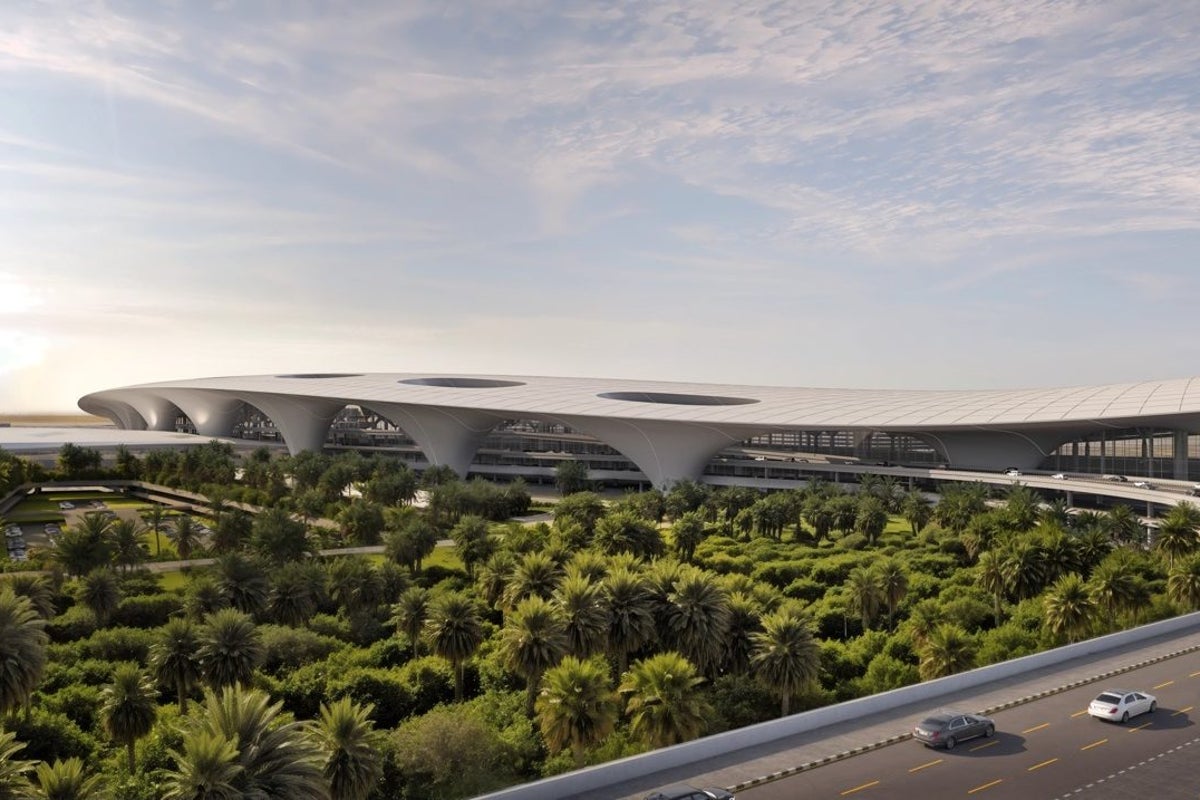
Dubai’s plan to operate the world’s largest airport is one step closer to reality as the emirate says it will open to passengers by 2032.
Al Maktoum International airport will become the world’s largest aviation hub with an annual capacity of 260 million passengers.
Plans show the airport having five runways, two terminals and more than 430 plane stands, as well as shuttle service around the site connecting passengers to gates and transport links.
The Dubai Government said earlier this month that work on the first phase of the new airport is proceeding in line with timelines for the project, remaining on course to start running flights in 2032.
Work started over a year ago on the airport’s runway infrastructure and the initial structural foundations for passenger terminals and gates.
The project has been allocated a budget of AED16 billion (over £3bn).
The next phase of work will focus on building the Western Passenger Terminal, a fourth aircraft concourse building, an automated shuttle and the baggage handling system.
Khalifa Al Zaffin, executive chairman of Dubai Aviation City Corporation, said that Al Maktoum International airport will allow Dubai to serve more travellers as the country anticipates growth in passenger and cargo traffic over the coming decade.
“Al Maktoum International airport is far more than an expansion of aviation infrastructure; it is a fully integrated global platform that will redefine the future of travel and logistics,” he explained.
“The airport is being designed to deliver a seamless, intelligent, and customer-centric experience powered by advanced technologies, integrated automation, operational intelligence, and seamless connectivity across airport systems and transport networks.”
Dubai’s current main airport, Dubai International (DXB) is a key travel hub for people travelling to the emirate and for stopovers between Europe and Asia.
It held the status of the second busiest airport in the world in 2025, with 95.2 million passengers passing through.
Yet after conflict broke out in the Middle East, passenger numbers plummeted to 2.5 million in March, down 65.7 per cent year on year.
After the UAE lifted restrictions on airspace, Dubai Airports said it has entered a recovery phase by increasing daily flights and enabling airlines to restore schedules as much as neighbouring airspaces allow.
Read more: Is it safe to travel to Dubai and Abu Dhabi? Foreign Office issues new UAE travel advisory



