


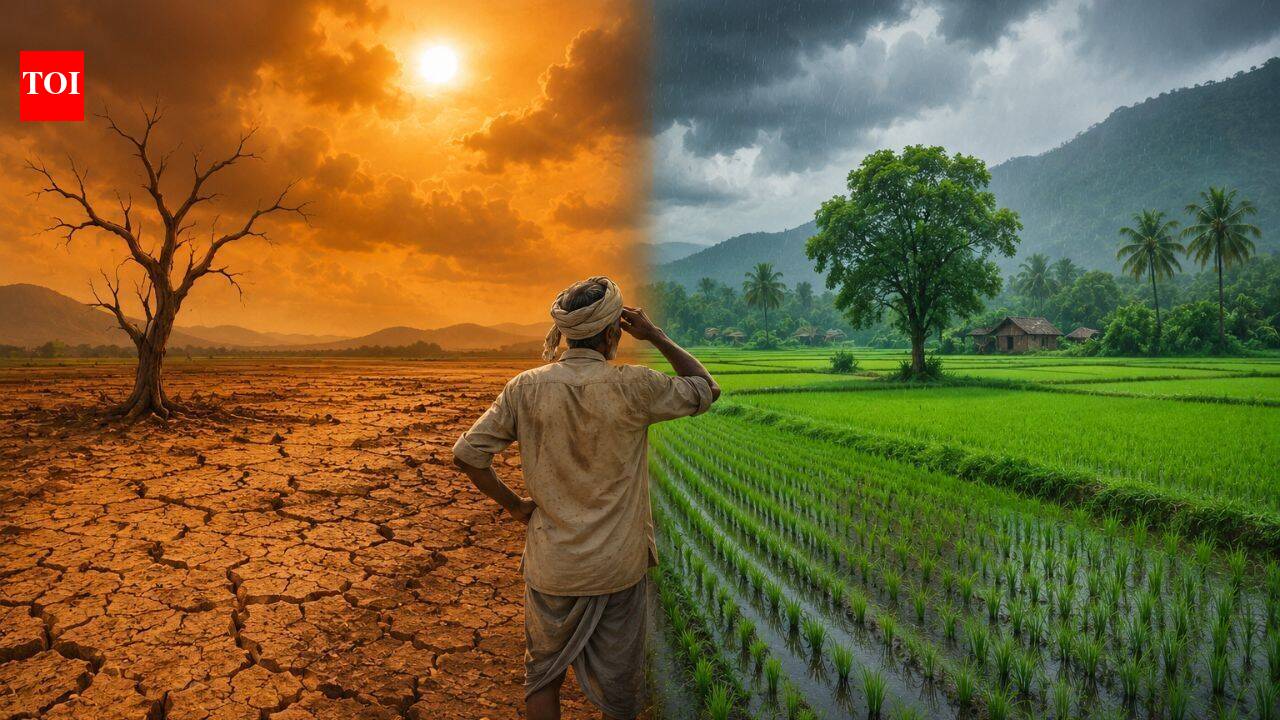
There was a time when the monsoon meant paper boats floating through rain-filled lanes, steaming cups of tea and plates of pakoras, and the comforting thought that school could wait another day. For millions of Indians, the rains were a season of nostalgia rather than nervousness. But today, the arrival of the monsoon is watched with a different emotion called anxiety.A delayed or weak monsoon no longer affects only farmers. It influences food prices, electricity bills, incomes, inflation, and even decisions taken by the Reserve Bank of India. And with scientists warning that El Nino conditions are developing over the Pacific Ocean, concerns are growing that the weather phenomenon could evolve into a much broader economic challenge.India is facing one of its most difficult monsoon seasons in more than a decade. A severe heatwave has already strained farms, power grids and daily life.Now, with the India Meteorological Department (IMD) projecting rainfall at just 90 per cent of the Long Period Average (LPA), the country could witness its first below-normal monsoon in three years and the weakest rainfall forecast since 2015.So what exactly is El Nino? Why does it matter so much to India? And how does a warming ocean thousands of kilometres away affect household budgets in India?
Why the weather matters
India’s concerns over the monsoon have intensified as rainfall remains significantly below normal and El Nino risks continue to build. The southwest monsoon has stalled over southern Maharashtra, leading to a sharp rainfall deficit across large parts of the country.According to India Meteorological Department (IMD) data, the country received only 42.6 mm of rainfall between June 4 and June 18 against the normal 72.2 mm, leaving India with a 41 per cent shortfall.Central India has been hit particularly hard, recording a deficit of 67 per cent, while east and northeast India are down by 42 per cent. The southern peninsula has received 22 per cent less rainfall than normal and northwest India remains 6 per cent below average.The IMD has projected seasonal rainfall at 90 per cent of the Long Period Average, down from its earlier forecast of 92 per cent. Meanwhile, the World Meteorological Organization (WMO) estimates an 80 per cent probability of El Nino developing between June and August and a 90 per cent chance thereafter.
According to the agriculture ministry, the impact could be relatively severe in twelve states, including Uttar Pradesh and Tamil Nadu. For a country where agriculture still employs nearly 46 per cent of the workforce, according to the latest Periodic Labour Force Survey, weather remains deeply intertwined with economic activity.
What is El Nino?
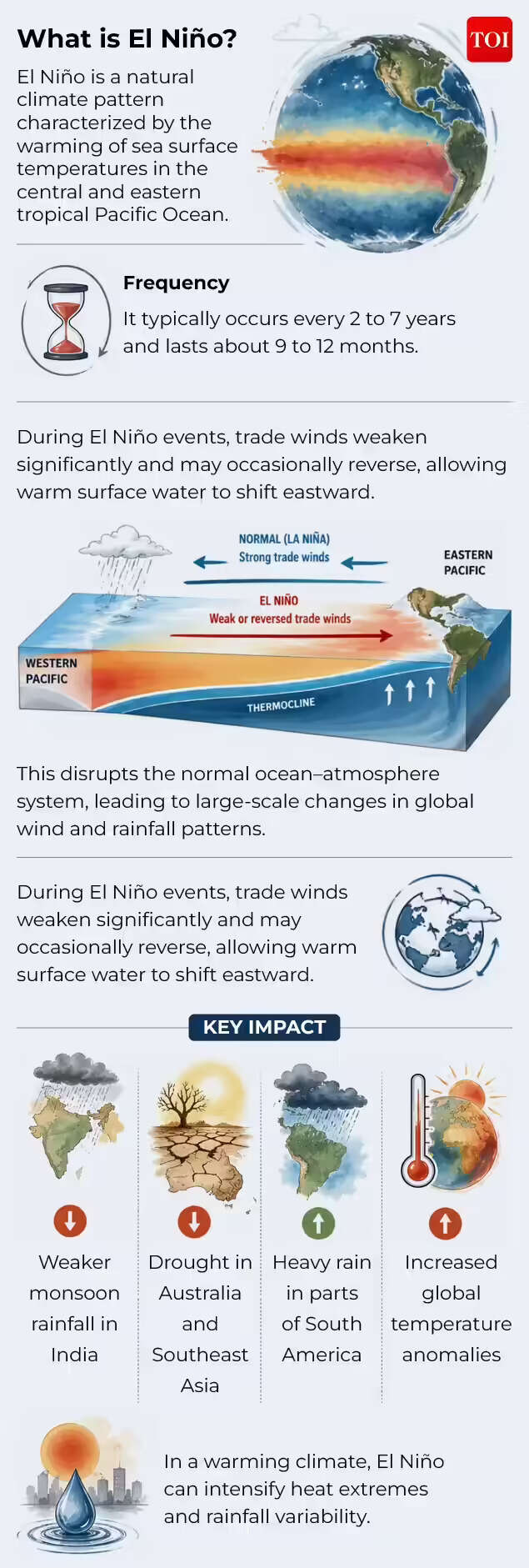
El Nino is a naturally occurring climate phenomenon in which sea surface temperatures in the central and eastern Pacific Ocean become warmer than normal.Under normal conditions, trade winds push warm surface water westward towards Asia and Australia. But during an El Nino event, these winds weaken or reverse, causing warm water to shift eastward and disrupting global atmospheric circulation.The phenomenon is part of the El Nino-Southern Oscillation (ENSO), which has three phases:
- El Nino
- La Nina
- Neutral conditions
El Nino generally occurs every two to seven years and lasts nine to twelve months. Its impacts vary around the world. It can bring drought to Australia, Indonesia and parts of South Asia while causing excessive rainfall in South America and East Africa. For India, however, El Nino has historically meant weaker monsoons.
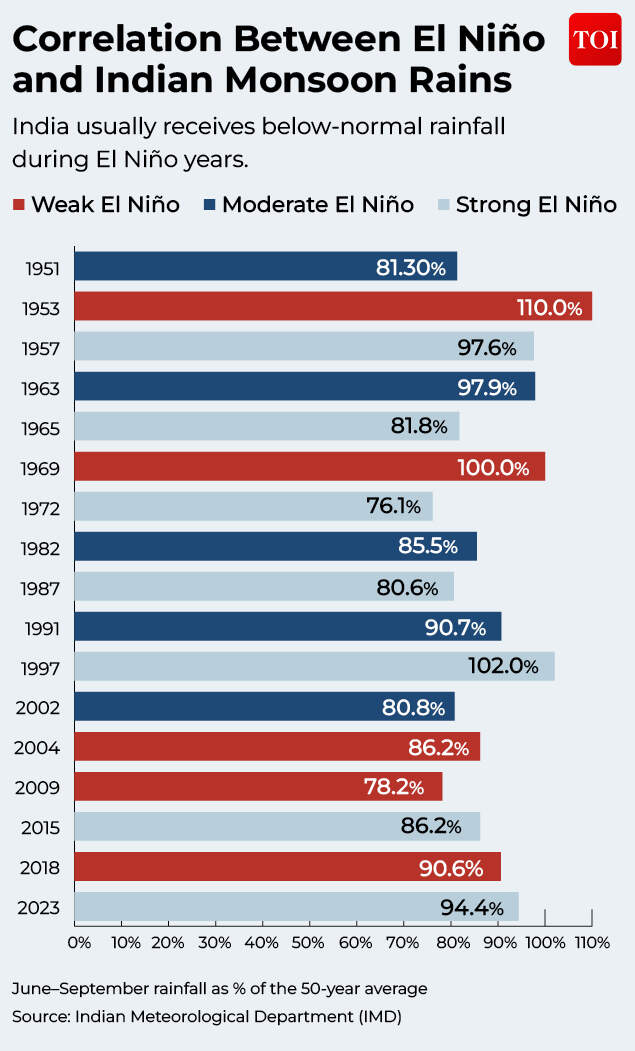
Correlation Between El Niño and Indian Monsoon Rains
A familiar but dangerous relationship?
India’s monsoon and El Nino have shared a long and uneasy relationship. The ministry of earth sciences notes that since 1950, India has witnessed 16 El Nino years, and seven of those saw below-normal monsoon rainfall.What makes the current situation more worrying is that these natural cycles are unfolding against the backdrop of global warming, amplifying temperature extremes and rainfall variability.Scientists are even discussing the possibility of a “super El Nino.” According to the US National Oceanic and Atmospheric Administration (NOAA), there is roughly a one-in-four chance that a particularly strong event could emerge later this year.Dr Paul Roundy, professor of atmospheric and environmental sciences at the State University of New York at Albany, recently wrote on X that there is “real potential for the strongest El Nino event in 140 years.”Similarly, Dr Andy Hazelton, associate scientist at the University of Miami, noted that “all models and observations are pointing in the same direction: a very strong El Nino with significant impacts on global climate this year.”
Why the household budget is worried
Inflation fears have shifted from oil to food. According to BNP Paribas, declining crude oil prices have improved the overall inflation outlook, but weather-related disruptions now pose a much larger threat.The brokerage said the possibility of a stronger El Nino raises concerns over agricultural output and food prices.Reflecting these risks, the Reserve Bank of India has raised its FY27 inflation forecast to 5.1 per cent from 4.6 per cent. Higher commodity prices, rupee depreciation and rising fuel prices are also expected to add pressure.Food inflation has already started inching up. Retail inflation measured through the Consumer Price Index rose to 3.9 per cent in May from 3.5 per cent in April.Vegetables, fruits, edible oils and spices have already become costlier. Heatwaves have pushed up prices of tomatoes, chillies and cabbages. Prices of onions and potatoes, which often contribute to seasonal spikes in inflation, could also face pressure.SBI Research expects tomato prices to rise sharply because of El Nino. Sachchidanand Shukla, Group Chief Economist at Larsen & Toubro, says food-linked commodities are likely to see the biggest price increase.“Among tomatoes, onions and potatoes, SBI Research expects the prices of tomatoes to shoot up due to El Nino. No impact on potato prices is seen, while onion prices tend to trouble the common man even in case of a normal monsoon year,” he told TOI.
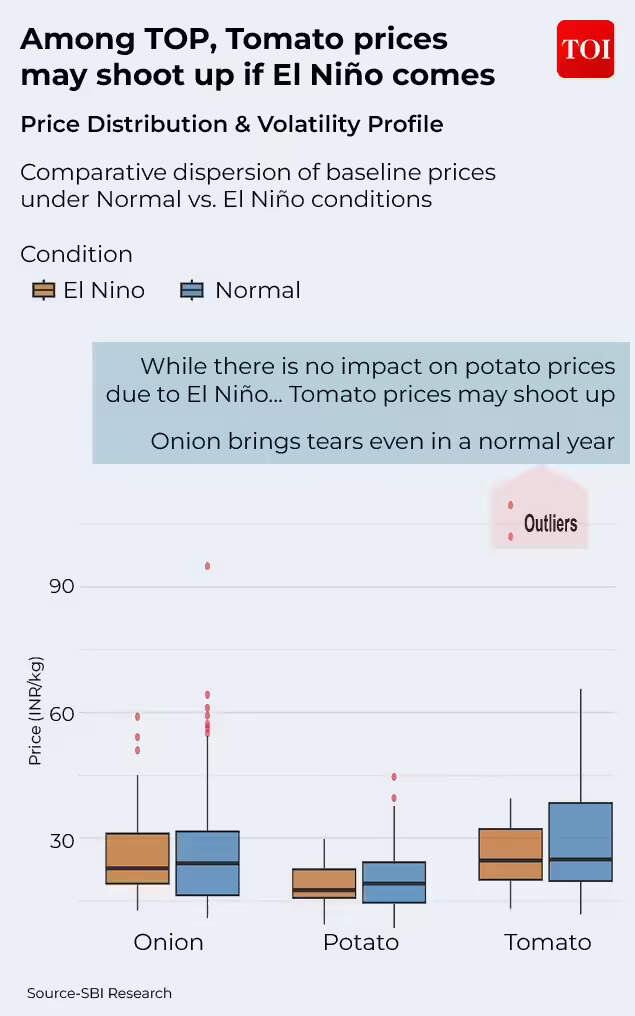
Prices may shoot up
How agriculture gets hit
Agriculture is often the first casualty of a weak monsoon. Nearly half of India’s cultivated land still depends on rainfall, making crop output highly sensitive to weather conditions. Poor rains reduce soil moisture, delay sowing and affect the productivity of key kharif crops such as rice, pulses, cotton and sugarcane. To compensate for the lack of rainfall, farmers are forced to rely more heavily on groundwater, increasing their spending on electricity and diesel. Lower yields coupled with higher input costs squeeze farm incomes and deepen stress in rural areas.The impact is already becoming visible. According to 360 ONE Capital Research, delayed monsoon progress has begun to affect kharif sowing. As of June 12, the total area sown under kharif crops stood at 84.6 lakh hectares, down 3.9 per cent from the same period last year. Pulses and cotton have been hit the hardest, with acreage declining by 43.2 per cent and 28 per cent respectively. Rice has been a notable exception, with sowing rising 28.4 per cent year-on-year, though from a relatively low base.Despite the weak start to the monsoon, reservoir levels offer some relief. According to 360 ONE Capital, live reservoir storage as of June 11 stood at 28.3 per cent of total capacity, about 16 per cent above the ten-year average. Healthy water reserves could provide a crucial buffer for irrigation if rainfall remains patchy in the weeks ahead.The research firm said the monsoon’s progress needs to be closely monitored because of its implications for agricultural production, rural incomes and food inflation.
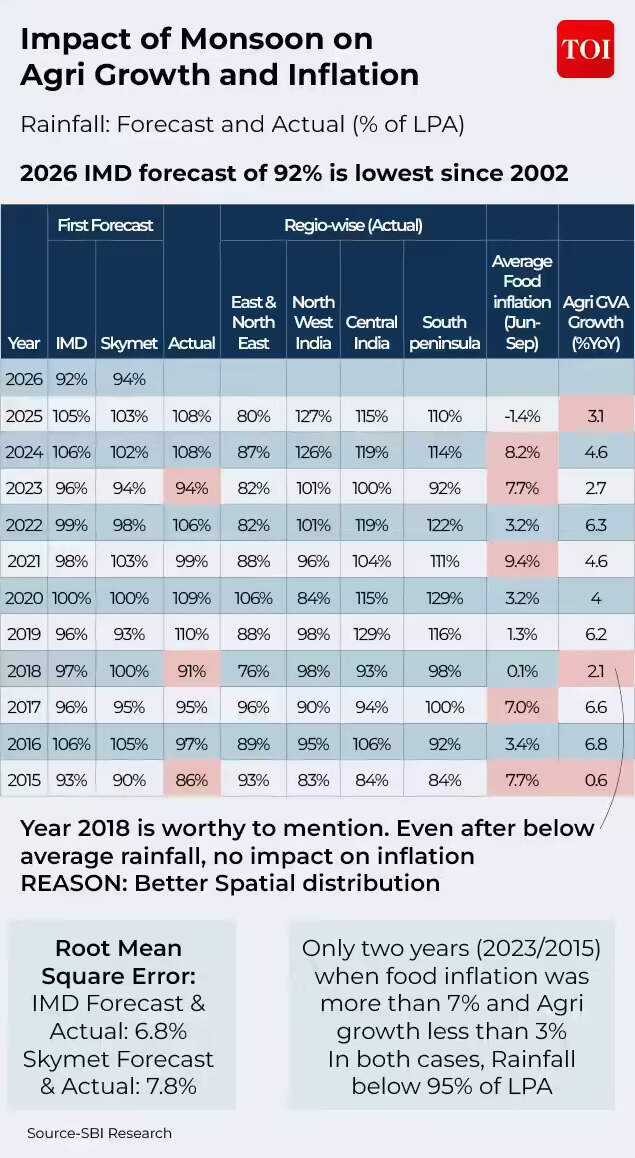
Much will depend on rainfall during July and August, which account for the bulk of India’s seasonal precipitation. A recovery in rainfall during these crucial months could support crop output, but a prolonged shortfall would increase pressure on food prices and weigh on rural economic activity.The effects of a weak monsoon extend well beyond the farm sector. Lower agricultural incomes reduce spending in villages and small towns, affecting industries dependent on rural demand. BNP Paribas noted that several rural indicators have already shown signs of weakness, with slower tractor sales, lower government spending and rising food inflation hurting sentiment. Data from the Centre for Monitoring Indian Economy (CMIE) show that personal and home-care companies recorded average revenue growth of 8.6 per cent during El Nino years, compared with 12.2 per cent in non-El Nino years. At the same time, hotter weather associated with El Nino tends to boost demand for cooling appliances.
Can India handle a weak monsoon better?
Economists believe India is better placed to withstand a weak monsoon than it was a decade ago. Agricultural output is less dependent on rainfall due to expanding irrigation coverage and healthier water reserves.According to Barclays chief India economist Aastha Gudwani, around 55 per cent of India’s gross cropped area is now irrigated, up from 40 per cent in 2010-11. Reservoir storage levels are also stronger, currently standing nearly 29 per cent above the ten-year average, aided by abundant rainfall last year.According to Reuters, HSBC economists argue that reservoir levels have become more important for food production and inflation than rainfall alone. However, they caution that rising temperatures could pose a greater threat.HSBC chief India economist Pranjul Bhandari said, “We find that the probability of high temperatures is stronger than the probability of low rains, and the quantum of rise in temperatures during El Nino years is rising.”Bhandari added that fruits and vegetables are likely to remain the most vulnerable to extreme heat and erratic weather conditions. While stronger irrigation networks and healthy reservoirs have improved India’s resilience, economists say the coming weeks will be crucial.
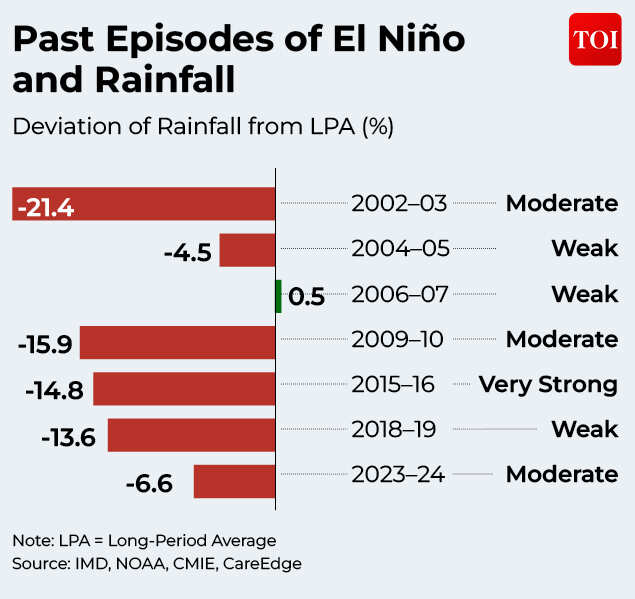
Past episodes of El Niño
Heat: The invisible economic shock
Heatwaves are emerging as a major threat alongside rainfall deficits. According to the Lancet Countdown on Health and Climate Change, Indians experienced an average of 19.8 heatwave days in 2024, the warmest year on record.The study estimates income losses of nearly $194 billion due to heat-related reductions in labour productivity. Outdoor workers, including farmers, construction labourers, delivery workers, street vendors and rickshaw pullers bear the brunt.Research by Piyush Narang and Ashok Gadgil of the India Energy and Climate Centre at the University of California, Berkeley, found that one day of extreme heat could lead to 3,400 excess deaths nationwide, while a five-day heatwave could cause almost 30,000 deaths.The dairy sector is also worried. Milk prices had already risen by 2-3 per cent in May. Industry executives say another increase could come in July or August if deficient rainfall affects fodder availability.
The larger economic risk
According to the NSE, “For 2026, the key challenge is the emergence of El Nino risk.” The exchange noted a 60 per cent probability of deficient rainfall and a further 24 per cent probability of below-normal rainfall. India’s monsoon and El Nino have shared a long and uneasy relationship. Several drought years, including 1987, 2002, 2009 and 2015, coincided with El Nino events, with poor rainfall hurting crop production and pushing up food prices. Historically, weak monsoons have disrupted kharif sowing, lowered reservoir levels, affected rabi output and fuelled food inflation, creating ripple effects across the broader economy.El Nino is not merely about warmer waters in the Pacific Ocean. For India, it is about the price of tomatoes and milk, the cost of electricity, farm incomes, inflation and economic growth. It affects workers labouring under the sun and commuters navigating heat-stressed cities. It shapes RBI forecasts and government spending decisions.That is why the progress of the rains in July and August will be watched closely. Because in India, the monsoon may still evoke memories of paper boats and evening tea, but in an economy where climate and consumption remain closely intertwined, every delayed shower now carries consequences far beyond the clouds. This year, the story of El Nino is not just about weather. It is about inflation, incomes and the household budget.



