


For more than a decade and a half, Ravindra Jadeja has been the ultimate security blanket for Indian cricket. At 37, he remains a multi-format monster, the kind of foundational player who single-handedly balances an entire starting XI.
But logic dictates that the clock is ticking, and India’s team management is staring down a massive, existential headache: who actually replaces him?
For years, the blueprint for life after Jadeja seemed simple: Axar Patel. A like-for-like clone down to electric fielding and sharp left-arm orthodox angles. Axar was the natural heir, yet, succession plans rarely survive the reality of form and time. Axar himself is now 32, and a largely forgettable Indian Premier League campaign has exposed the fragility of relying on a single contingency plan.
The future, it turns out, needs to be built now.
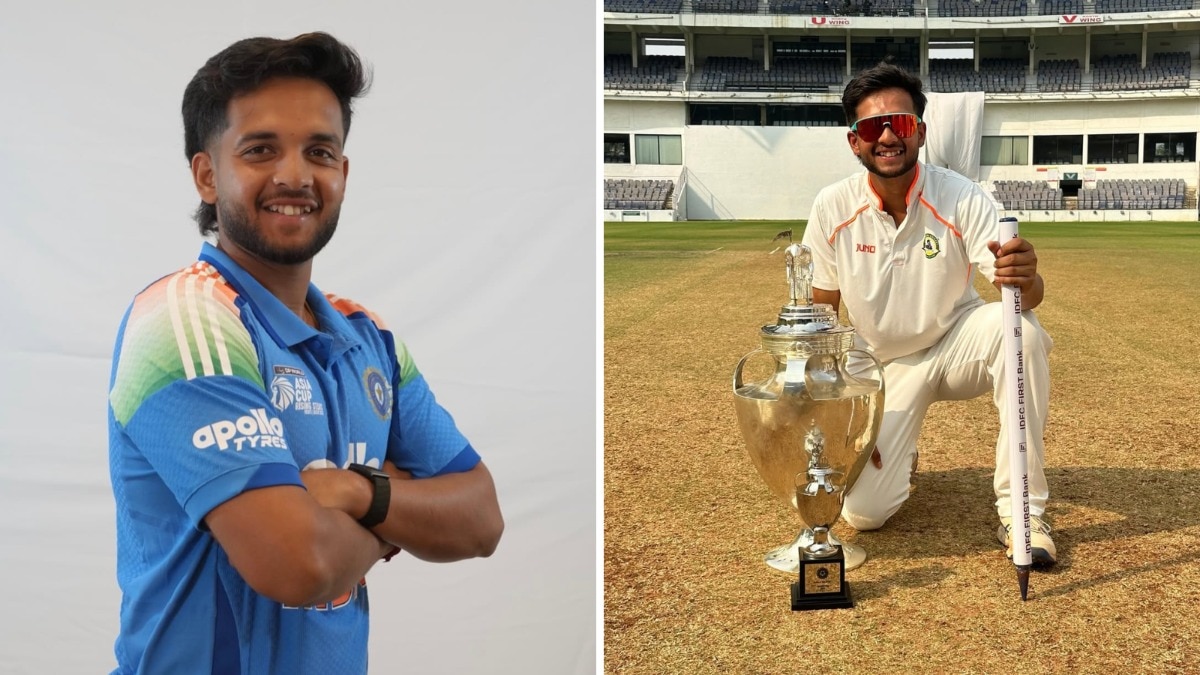
Enter Harsh Dubey.
In a decisive move to test the true depth of the domestic circuit, selectors have called up the 23-year-old talent from Nagpur for both the one-off Test and the three-match ODI series against Afghanistan.
“I am very confident he can fill Ravindra Jadeja’s boots,” Usman Ghani, head coach of the Vidarbha senior men’s cricket team, told India Today. “He has done it for Vidarbha, and he could surely do it for India. What sets him apart isn’t just his skill set, but his mentality. He is incredibly strong mentally, and he has been proving that across multiple formats in the domestic circuit.”
THE BREAKOUT
Ghani’s unwavering faith is rooted in hard data. When Vidarbha lost veteran spinner Aditya Sarwate to Kerala in 2024, a massive vacuum opened at the heart of their bowling attack. A young Dubey was thrust into the role of spearhead.
“He was required to step into giant shoes, and he did a splendid job,” Ghani says.
That statement understates what was actually a historic breakout. In the 2024–25 Ranji Trophy season, Dubey tore through batting lineups to claim a staggering 69 wickets in just 10 matches. The haul shattered the record for the most wickets in a single Ranji season, remarkably placing him ahead of legendary figures like Bishan Singh Bedi, Jaydev Unadkat, and Dodda Ganesh.
A classical left-arm orthodox spinner, Dubey relies on exceptional control, traditional flight, and an innate ability to extract steep bounce and sharp turn from standard surfaces.
His bowling masterclass dragged Vidarbha all the way to the Ranji final that year. Though they ultimately faltered against domestic heavyweights Mumbai, Dubey refused to bow out quietly, registering defiant match figures of 3/62 and 5/144 in the final.
BLIND LIGHTS AND BIG SCALPS
His rise through the ranks from the U14 level has been defined by this relentless upward trajectory. In 2025, the Indian Premier League took notice, with Sunrisers Hyderabad drafting him as an injury replacement. Dubey didn’t blink under the bright lights, trapping Mitchell Marsh on debut. In his very next outing, he outsmarted the master of white-ball chases, Virat Kohli.
But to view Dubey as a one-dimensional, reactive bowler is to misread his utility. Much like Jadeja, he is a genuine dual threat.
During a crucial Ranji Trophy group game against Hyderabad this season, Vidarbha’s top order collapsed to a disastrous 70 for 7. Walking out into a crisis, Dubey played a counter-attacking innings to rescue the team, dragging the total to 180. He finished the match with half-centuries in both innings alongside an eight-wicket match haul.
This acute understanding of game situations and tactical maturity earned him Vidarbha’s white-ball captaincy for the 2025–26 season. The dividend was immediate: the 23-year-old guided his state to their maiden Vijay Hazare Trophy title, leading comprehensively with both bat and ball.
“Despite being a young captain, his discipline earned him the immediate respect of the seniors,” Ghani reflects. “He is a deep thinker who always wants to stay a step ahead of the opposition.”
This is far from a mere experimental whim to fill out a squad sheet; Dubey’s inclusion in the Indian squad represents a tactical insurance policy — a calculated look at the man who might just inherit the crown when India’s legendary all-rounders finally hang up their boots.
“He never loudly proclaimed where he wanted to be; he simply believed that his time would come,” Ghani says. “I have never seen him crib or complain over a selection snub. His attitude is entirely focused on acting on the things he can control.”
BUILT ON SACRIFICE
Behind the tactical acumen and record-breaking statistics lies a narrative of profound familial sacrifice.
To ensure Dubey could chase his cricketing dream, his father resigned from a secure position in the Central Industrial Security Force (CISF). With both parents working demanding schedules, they anchored their lives around his career, tag-teaming to drop off and pick up a young Harsh from gruelling daily practice sessions.
“Dubey wasn’t always the fittest; during his junior days, he was on the heavier side. But he put in an immense amount of work to get where he wanted to be. He is a tough and a highly decisive guy,” Ghani added.
This awareness of what his family surrendered has shaped Dubey into an unusually grounded athlete. With an international debut now on the horizon, the ultimate test awaits.
“I had a talk with him after he got his India-A call-up, and I told him that this was just the beginning,” Ghani says with a note of pride in his voice. “I couldn’t speak to him today because he was in transit for his next IPL game. But I did congratulate his father, he was absolutely exuberant.”
Replicating the output of a generational cricketer like Ravindra Jadeja is an existential challenge, but Harsh Dubey possesses the exact blueprint required to try.
– Ends



