


MBW Views is a series of op-eds from eminent music industry people… with something to say. The following MBW op/ed comes from Bill Werde, Director of the Bandier Music Business Program at Syracuse University. Below, he argues that the freemium model championed by YouTube and Spotify may now be holding back growth in the world’s most populous music markets — and that it’s time for the industry to ask whether ‘free’ is still serving it…

I’m in a tiny rowboat, drifting along the Mekong Delta with three of my students and a local tour guide. It is a Sunday in May of 2023, and we’re about 75 kilometers southwest of Ho Chi Minh City.
This is a scheduled off day from the annual Bandier Music Business Program‘s International Immersion trip, for which we take students each spring into the most dynamic emerging markets. As we wind lazily down the river, every hundred yards or so we drift by a small hut. And every fifth or sixth hut, there is a gathering.
“Karaoke!” says our guide, and I perk up. Our days in Vietnam have been filled with meetings with virtually every top music company and executive. But here we were with an opportunity to experience the music business in the literal wild.
“They pay for Karaoke?” I asked. The average income in this region was often less than $200 a month. “No,” said our guide with a bright smile, “YouTube.”
This was one of my early epiphanies in understanding emerging markets. Having led these trips since 2019, including visits to explore the industry in China, Thailand, Vietnam, Singapore, Indonesia, Hong Kong, Colombia, Mexico, and Brazil, the throughline for the music business is clear: trying to convert free users to paid.
This has worked out well in China, and to a lesser (but still impressive) extent in Mexico and Brazil. But the going is slow elsewhere.
The most current IFPI report identifies MENA and Sub-Saharan Africa as the two fastest-growing territories after Latin America. And while their 15% YoY growth rates sound exciting, their respective annual revenues – each under $170 million – are less so.
“There’s a myth that emerging markets have no money to spend on music. They do, they just won’t spend it if they don’t have to.”
Similarly, SE Asia is home to 700 million people, and around 500 million cellphones, but roughly half a billion dollars in annual revenue across the whole region. India (which I will visit with students this spring) remains the thorniest of challenges: a population of nearly 1.5 billion people, but a relatively paltry $367 million in annual recorded music business. And almost all of these markets are overwhelmingly driven by free, ad-supported streaming.
It’s fair to say that, excepting China, virtually none of the places mentioned above would even have had a music business at all if it wasn’t for YouTube, the first major player in most of these markets.
But it’s also fair to ask: might YouTube and (more recently) Spotify‘s freemium model be the very thing now holding these countries back from meaningful growth? Conversations with senior label officials paint a picture of varying degrees of pushback from the DSPs. There’s a myth, based largely on ignorance and stereotypes, that emerging markets have no money to spend on music. But they do have it. They just won’t spend it if they don’t have to.
The Money Is There
Those who want to justify India’s slow music industry growth point to credit card penetration rates of about 5%. But that translates to about 40 million credit card holders in India, and credit cards aren’t even how most Indians pay for things. That would be UPI, the real-time payment system that powers apps like PhonePe and Google Pay, used for QR payments, online checkouts, and P2P transfers. And that has 350 million to 500 million monthly active users, depending on whose stats you use. That’s more than two Americas’ worth of credit card holders.
The reputable Indus Valley annual report in 2025 placed the size of India’s “consumer class” – those with discretionary income – at 10% of the population. That may sound small but that’s 140 million people. For context, America’s middle and upper classes combined sit at around 150 million.
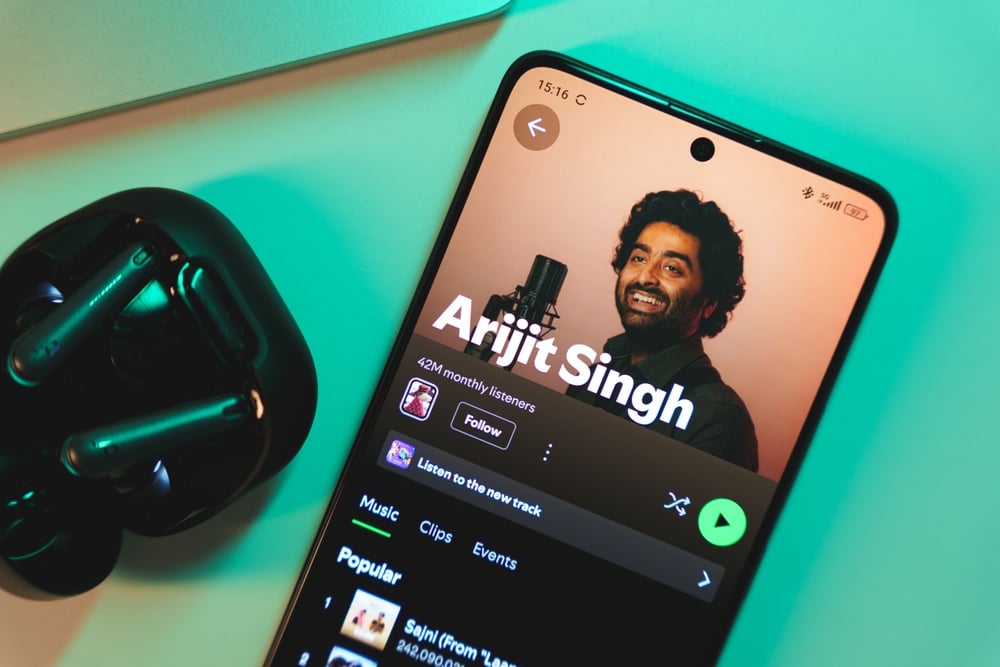
We are simply making it too easy for fans in emerging markets to choose “free.” Label executives tell me that one argument they hear from the DSPs is that there is no evidence that removing free options leads to subscribers.
But that just isn’t true. Recently, Music Business Worldwide published highlights of a joint report from EY and the Federation of Indian Chambers of Commerce and Industry, which showed India added almost 4 million paid music streaming subscribers in 2025, taking the country’s total to 14.4 million, or 37% growth YoY. (It’s worth noting that the recent IFPI report shows growth closer to 25%.)
The same report showed 178 million Indians streamed music online last year, but only 8% paid for it. Yet elsewhere in the report was this critical insight: 64% of surveyed free streamers said they were willing to pay, under certain conditions, if their preferred service eliminated its free tier.
Convert 64% of those free streamers and now you have nearly 120 million paid subscribers. Applying the current ARPU for those 14.4 million paying customers at that scale would yield a nearly billion-dollar annual Indian industry. Your customers are telling you to eliminate free. Will you listen?
From 2021 to 2025, India nearly doubled its market from $194 million to $367 million, according to the IFPI. It’s a good start, but the tantalizing, painful truth is that three-quarters of that revenue is free and ad-supported. India’s streaming revenue grew at about 2% YoY in 2025, and just 0.3% in 2024. As one label exec lamented, “you’d be hard pressed to find any other industry growing at that rate in India.”
What China Proved
There’s another massive hole in the theory that paywalls in emerging markets don’t equal subscribers: China. In 2019, Tencent Music Entertainment – via subsidiaries QQ Music, Kuwo, and Kugou – started to experiment with putting premium content behind paywalls. At the time, China was seen as an impossible nut to crack. People were in no way accustomed to paying for music, and conventional wisdom said they may never.
Yet TME’s paid subs revenue jumped by 56% YoY in 2020, turbocharging China’s journey to becoming a billion-dollar recorded music revenue country for the first time in 2021. At the time, Tencent executives gave paywalls a lot of credit for the rapid growth. Maybe what worked in China won’t work in India, or elsewhere. But how can we not at least try?
YouTube and Spotify combined represent over 50% of global revenue for the biz, and are therefore not easy to push around. The majors may be content to collect their lesser millions in emerging markets in order to not upset the billions in more established ones.
For my money, this echoes one of the greatest crimes of mismanagement perpetrated on the modern music business since the days of Napster. For more than a decade, we watched the DSPs hold steadfast in their belief that the price of a premium music subscription shouldn’t go up – shouldn’t even keep up with inflation.
During this same time, Netflix nearly doubled its premium price. This passivity (or ineffectiveness – you choose) likely cost the global recorded music industry, and the artists and writers it pays, billions of dollars. Let’s not be docile again, pretending that lost opportunity and lost dollars are “just the way it needs to be.”
“Let’s not be docile again, pretending that lost opportunity and lost dollars are ‘just the way it needs to be’.
Traveling through the music industry of so many countries has taught me that they are unique from one another in the most vibrant of ways, each their own specific cultural and economic puzzle to solve. But here’s another throughline: in emerging markets, they pay for everything around music. They just don’t pay for music.
Back in the Vietnamese countryside, they pay Viettel between 50,000 VND (USD $2) and 200,000 VND ($8) per month for data packages. They pay more than $200 for their Samsung Galaxy A16, the most popular phone in rural Vietnam last year. And they easily pay several hundred dollars or more for their favorite loa kéo, the portable, suitcase-like karaoke speakers favored by the discriminating Sunday host. But they don’t pay for music.
The bet here is that they will, eventually, but only if we stop making them offers that are so easy to refuse.
All MBW+ subscribers get digital access to our Music Business Worldwide magazine, with six issues released each year. Music Business Worldwide



