


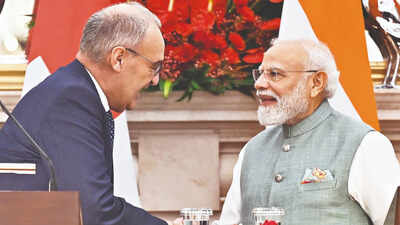
NEW DELHI: India and Switzerland looked to deepen cooperation in trade and investment, technology, defence production and nuclear energy as PM Modi held talks with visiting Swiss President Guy Parmelin. The two countries also signed five agreements, including one for a migration and mobility partnership and another for exchange of young professionals.Identifying innovation, infrastructure and advanced technology as strong pillars of the bilateral partnership, Modi said India and Switzerland were going to give the relationship a new momentum and take it to new heights.The two countries set up a committee to facilitate trade and investment and address trade-related concerns, building upon Trade and Economic Partnership Agreement (TEPA) signed between India and European Free Trade Association (EFTA) countries in 2024. TEPA was India’s first FTA with any economic bloc in Europe, as Modi recalled.“It is also an ambitious blueprint for investment, innovation, jobs, and shared prosperity. Through this, we aim to achieve the targets of $100 billion in investment in India and 1 million direct jobs over the next 15 years,” said Modi in his media statement.Key highlights of TEPA included enhanced market access for Indian goods and services, $100 billion investment commitment over 15 years, creation of 1 million jobs in India and stronger bilateral relations with EFTA nations.The leaders discussed the conflicts in Ukraine and West Asia, with the Swiss President welcoming Modi’s message to Russian President Vladimir Putin to end the war.Modi said India and Switzerland believe in democratic values, the rule of law, dialogue and diplomacy and will continue to work together for global peace and stability.“Whether it is Ukraine or West Asia, India has consistently supported every meaningful effort towards peace,” he said, adding that the leaders also agreed that reforms in global institutions are essential to address the growing global challenges.PM said the mobility agreement will open up many new opportunities in Switzerland for Indian students, researchers, professionals and young people. The agreement provides for multiple-entry visas for up to five years, including stays of up to six months on each visit, and renewable one-year student permits.The two sides also signed another MoU to govern exchange of young professionals taking up temporary employment in the other country to enhance their professional and language skills. According to the Indian govt, the MoU incorporates exchange of 300 persons annually per country, which may increase to 500, and a timeline of 30/90 days for verification of nationality/residency status, among other provisions.Modi said both countries had taken several important decisions to increase market access for Indian exports in Switzerland and further facilitate investment between the two countries.
Share your thoughts in the comments
Be respectful · TOI community guidelines
“This will help increase exports of Indian agricultural products, pharmaceuticals, textiles, and engineering goods to Switzerland. At the same time, we will attract Swiss investments into key sectors, such as biotechnology, life sciences, banking, insurance, food processing, and sustainability,” said Modi.Parmelin said the partnership is mutually beneficial. “India gains from capital, technology transfers, and facilitated access to markets for high-value-added goods. Switzerland, for its part, benefits from exchanges with an immense partner experiencing sustained growth, at a time when global trade has become more exposed and unpredictable,” said Parmelin.


