


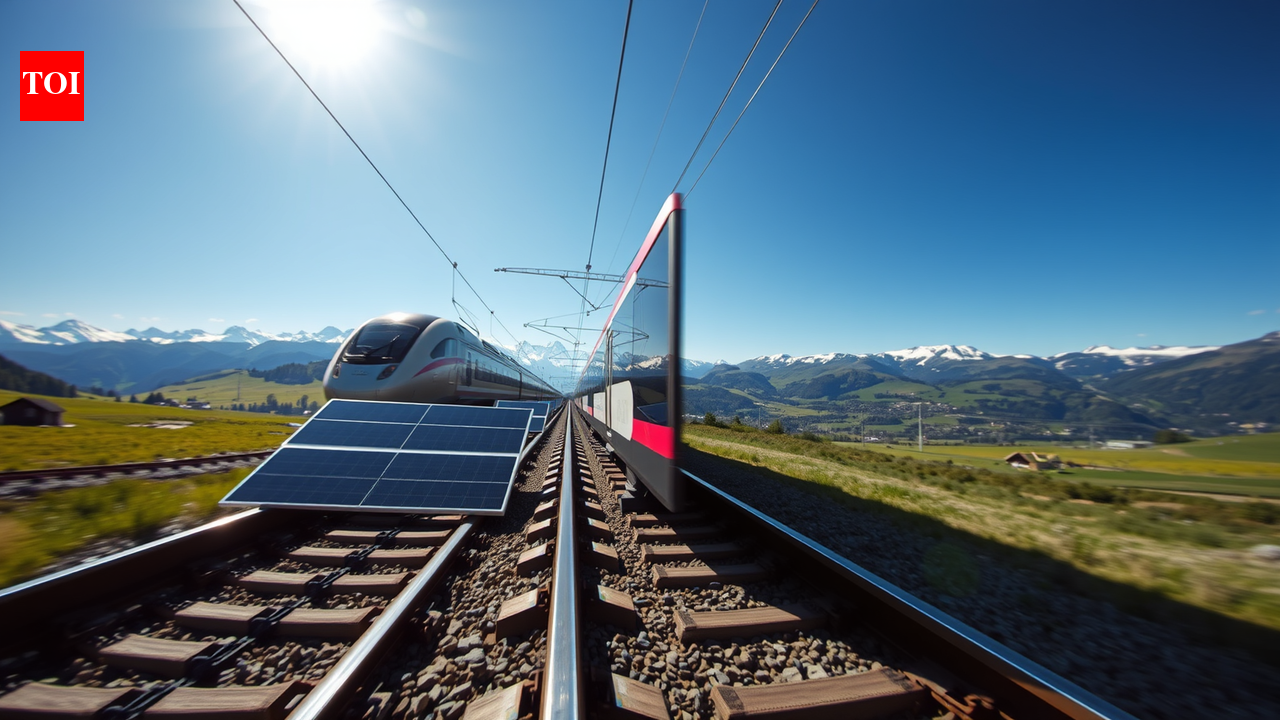
Switzerland has just marked a full year of running trains directly over the world’s first solar power plant built into an active railway line, and the results have been promising enough that Italy could become the next country to try the same idea. The project, developed by the Swiss start up Sun-Ways, involves 48 specially designed solar panels fitted between the sleepers of a hundred metre stretch of track in the village of Buttes, in the canton of Neuchatel. Trains have continued running over the panels exactly as before, with no disruption to services and no incidents of glare distracting drivers, even though the setup was originally approved as just a three year trial. With those early results holding up, Sun-Ways has now signed a collaboration agreement with an Italian partner in contact with the country’s national rail operator, and several other countries are watching closely as well.
How solar panels ended up between railway tracks
The idea behind Sun-Ways is fairly simple, railway corridors represent a huge amount of open, sun exposed land that already exists and is rarely used for anything beyond the tracks themselves, making them an obvious candidate for solar power without needing to buy or clear any new land. The panels sit directly on the sleepers between the rails and were designed to be removable, since maintenance crews regularly need to access the tracks underneath for repairs, grinding and general upkeep. A specially built machine developed by the Swiss maintenance company Scheuchzer can lay or remove close to a thousand square metres of panels in a single day, addressing one of the biggest practical objections that had previously stalled similar solar on rail concepts elsewhere in the world.
Addressing safety concerns from railway regulators
Before the pilot could even begin, Sun-Ways had to answer some pointed safety concerns raised by rail regulators and industry bodies. The International Union of Railways had flagged worries that the panels could develop micro cracks under the constant vibration of passing trains, increase fire risk, or reflect sunlight in a way that could distract drivers. Sun-Ways responded by building panels tougher than standard rooftop versions and fitting them with an anti reflection filter, along with built in sensors to monitor their condition and brushes attached to passing trains that automatically clear dirt off the panel surfaces. According to an update reported by Swiss public broadcaster SWI swissinfo.ch, Swiss authorities had actually rejected the project once before, in 2023, over these same maintenance and safety concerns, before eventually approving a three year pilot once Sun-Ways commissioned an independent engineering study to demonstrate the panels would not interfere with active rail operations.
Why the results after one year look encouraging
One year into what was meant to be a longer trial, Sun-Ways has reported that the installation worked without any issues and required no special maintenance beyond what was originally planned. Electricity generated by the panels is currently fed straight into the local power grid rather than directly into the railway’s own traction system, though the company says it is already working on a version that could eventually power trains directly, moving toward what it describes as a nearly self propelled railway. If the panels were rolled out across the entirety of Switzerland’s roughly 5,300 kilometre railway network, excluding tunnels and poorly sunlit stretches, Sun-Ways estimates the system could generate around one terawatt hour of electricity annually, enough to power approximately 300,000 households and cover close to two percent of the country’s total electricity consumption.
The physics behind why tilt angle actually matters
One technical limitation of laying solar panels flat between railway tracks is that they cannot be angled toward the sun the way rooftop panels usually are, which naturally reduces how efficiently they capture sunlight over the course of a year. According to a study published in the journal Sustainable Energy Technologies and Assessments, researchers analysing photovoltaic systems across the Iberian Peninsula found that a fixed tilt angle of around 34 degrees kept annual production losses below one percent compared to a panel perfectly angled for each specific location throughout the year, since the ideal tilt angle does not vary dramatically enough across most of a single region to meaningfully affect overall output. Sun-Ways has separately estimated that the complete lack of any incline on its railway mounted panels costs around ten percent of potential output compared to an optimally tilted rooftop system, a manageable trade off given how much unused space the design opens up in exchange.
Why Italy and other countries are taking notice
Following the positive results in Switzerland, Sun-Ways has signed a collaboration contract with an Italian business partner already in contact with Rete Ferroviaria Italiana, the company that manages the country’s national railway infrastructure, with plans for an Italian pilot project expected to be announced in the coming months. Italy is far from alone in showing interest, Sun-Ways has also received government approval for a similar installation in South Korea, while discussions are reportedly underway with companies and rail authorities in France, the Netherlands, China, India and Singapore. France’s national rail operator SNCF, which describes itself as the country’s biggest electricity consumer and second biggest landowner, has already signed its own cooperation agreement with the Swiss company as it works toward a target of meeting one fifth of its energy consumption through solar power by 2030.
What still needs to be proven before wider rollout
Despite the encouraging early data, Sun-Ways and outside observers agree that plenty of testing remains before solar railways can be considered a proven, scalable technology rather than a promising experiment. Regulatory approval itself has proven slow, with Sun-Ways founder Joseph Scuderi noting that securing clearance in Switzerland alone took roughly three years, and he has called for regulators to create a dedicated sandbox that would let similarly innovative infrastructure projects be tested more quickly while formal rules catch up. Countries like Japan and Indonesia have said they are watching the Swiss trial closely but want more long term data on maintenance costs and safety before committing to projects of their own, a cautious approach that suggests the real test for solar railways will be less about whether the technology works, and more about whether it can be scaled up affordably across the vastly larger and more heavily used rail networks found elsewhere in the world.



