


London:
There is a particular species of candour that only surfaces in the moment before an apology, the brief interval in which an institution forgets itself and says, quite plainly, what it actually believes.
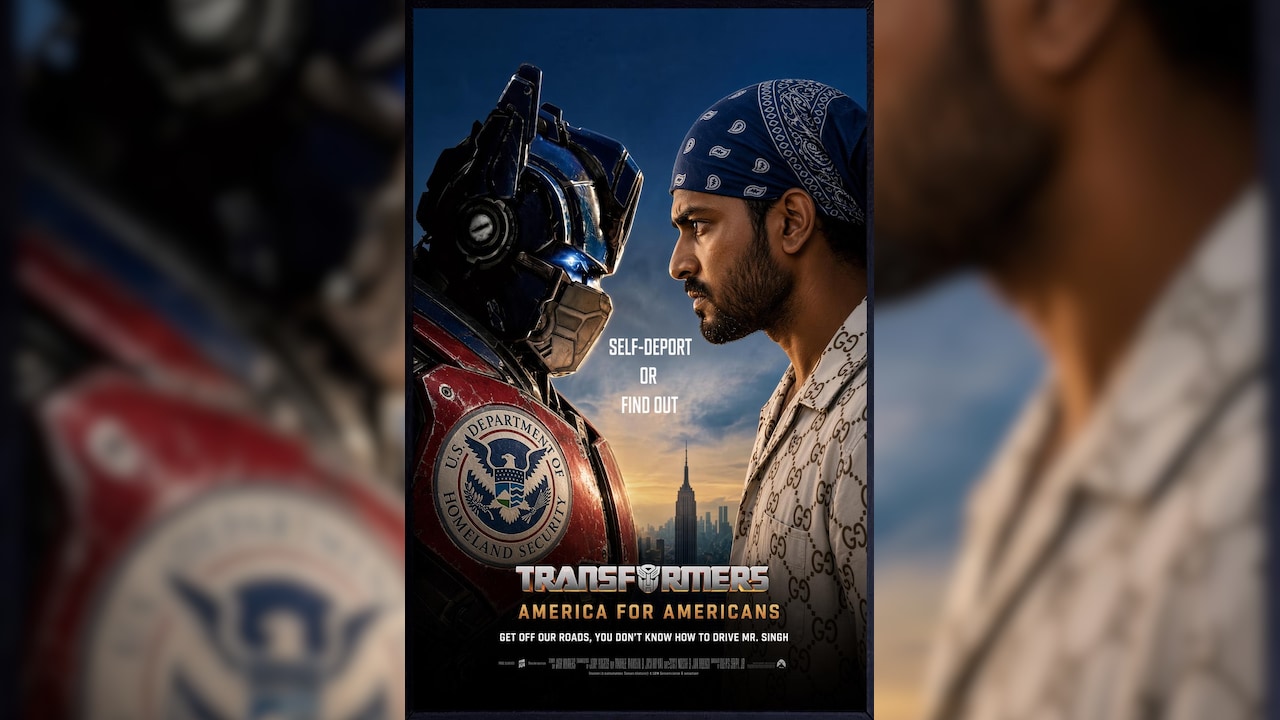
That is what happened last week when the United States Department of Homeland Security posted, and then hastily deleted, an image of Optimus Prime confronting a bearded man in a bandana with the words “self-deport or find out”, alongside a comment jeering at a man it called “Mr Singh” for not knowing how to drive.
As a Sikh living and working in Britain, I found the images crude in the way official communications can be careless and unembarrassed until the embarrassment became unavoidable.
My first reaction was the one most Sikhs abroad will recognise instantly: a weary, almost bodily recognition of a name being made to carry one man’s sins and hand them to a whole community.
Harjinder Singh, the driver at the centre of a tragedy that inspired the poster, is an Indian-born truck driver who was accused of making an illegal U-turn on a Florida highway in August 2025, causing a crash that killed three people.
The DHS says he was in the country illegally and had been issued a commercial driver’s licence by California.
This may be the laziest lie you’ve ever told and that’s saying something. https://t.co/JHl5nYZ9il pic.twitter.com/hU783FJsb9
— Homeland Security (@DHSgov) September 11, 2026
Singh is also the surname borne by tens of millions who have never driven a lorry, who teach in universities, serve in parliaments, and run corner shops in Southall and hospitals in Toronto.
To collapse the two into a punchline is a choice, made somewhere along a chain of approval that presumably involves designers, communications officers, and at least one government appointee who signed off on the final ‘artwork’.
Read | “Disgusting”: US Removes Racist ‘Mr Singh’ Self-Deport Ad After Backlash
This is the part that troubles me more than the poster itself.
A democratically-elected government does not stumble into a campaign like this.
Such material passes through layers of review before it reaches an official account with massive following.
Somebody drafted it. Somebody approved the tone. Somebody decided that a federal department could mock an ethnic and religious surname and expect no consequence worse than a mildly awkward morning.
The rollback, when it eventually came in the muted form of a quiet, unannounced deletion, changed none of that.
The instinct behind the poster survives it.
Removing the image restores the department’s composure and nothing else.
This is why I find myself, somewhat against the grain of the outrage, inclined to say, let it stand.
Its withdrawal was never a correction.
Instead, it was public relations management, the equivalent of a man who insults a stranger at a dinner party and then, on noticing the silence around the table, claims he was misheard. The insult was heard perfectly well.
What we should attend to is the untidy sentiment it briefly let slip into daylight, because that sentiment has a home, and it is not confined to Washington.
The Big Picture
Consider the wider pattern surrounding this single incident.
In Germany, the Alternative fur Deutschland has moved from the political margins to genuine electoral contention.
An anti-immigration party founded in 2013, AfD has hardened over a decade into a movement built on German nationalism and open hostility to Islam. Its resounding victory this month in a regional election is being seen as heralding a fiercely divisive era in Germany.
In Britain, Reform, the party Nigel Farage rebuilt from the old Brexit Party and now leads on a platform of strict immigration control and tougher policing, has reshaped the terms on which mainstream parties discuss borders and belonging, dragging the centre of debate rightward with each cycle.
Video | Trump Admin Targets Indian & Sikh Drivers In Massive Outrage
In the United States, a security department felt able, if only briefly, to use a cartoon robot to threaten a religious minority with menace dressed as humour, brazen enough that Hasbro, which owns the character, issued a statement distancing itself from the imagery.
These are three regional expressions of a single current running through the Anglosphere and its European neighbours, a normalising of contempt for the visibly foreign, particularly those who wear their difference on their bodies instead of hiding it in an accent that fades with a generation.
For a Sikh migrant, visibility is not optional. A turban and an uncut beard cannot be set aside for border crossing.
This is precisely why such communities function as an early instrument for measuring where a policy climate is heading.
When a state department feels comfortable enough to mock a Sikh name for mere engagement, it discloses, however briefly, its working assumptions about who belongs and who is merely tolerated.
That disclosure is more honest than any white paper.
None of this calls for panic. It calls for attentiveness, and for migrants of colour across these countries to stop treating each such episode as an isolated embarrassment to be waited out.
The poster will be forgotten within a fortnight. The conditions that produced it will remain long after the image itself has gone, visible in electoral returns across Germany, in polling in Britain, and now in the casual cruelty of an American federal agency’s marketing department.
(The writer is a career journalist currently serving as Communications and Advocacy Director at UNITED SIKHS in the UK, a charity registered in England and Wales)


