




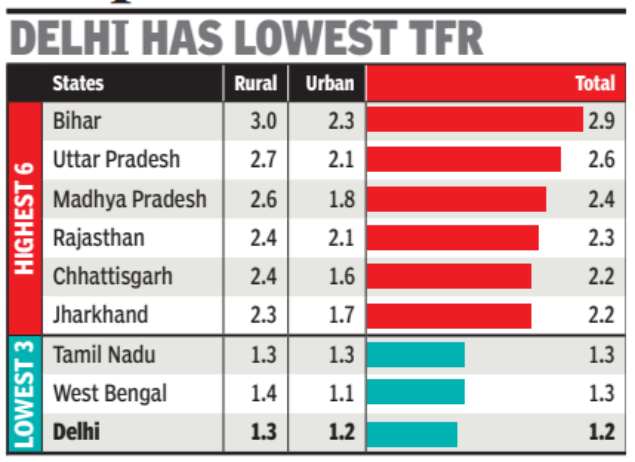
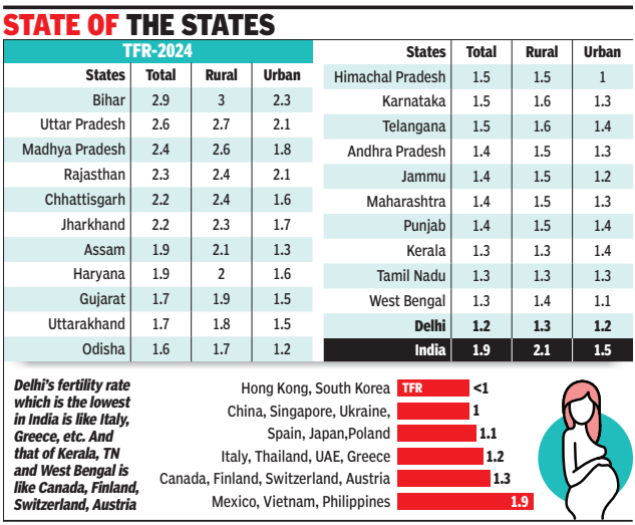
India’s total fertility rate (TFR), or the average number of children a woman would have, has fallen even further to 1.9 from 2.1, according to the latest sample registration system (SRS) report of 2024. Barring six states – Bihar, Uttar Pradesh, Madhya Pradesh, Rajasthan, Chhattisgarh and Jharkhand, in that order – the TFR has fallen below the replacement level for all other states. Delhi (1.2) has the lowest, followed by Kerala, Tamil Nadu and West Bengal with TFR of 1.3.When TFR is 2.1, it is called replacement level because a woman having about 2.1 children over her lifetime would, on average, replace herself and her spouse. When fertility stays below this level over time, population growth slows and can eventually turn negative, depending on the population’s age profile and gains in life expectancy.A look at the percentage change in the one decade before the report shows that Bihar has seen the least reduction in TFR, a mere 9.4% reduction from a TFR of 3.2 in 2012-14 to 2.9 in 2022-24. Chhattisgarh and Assam too are two high-TFR states that have shown relatively lesser reduction of 11.5% and 13% reduction respectively. In the same period, Delhi and Tamil Nadu, which already had a very low TFR of 1.7, fell by 29.4% and 23.5% respectively. States where the average number of children born to a woman fell below replacement level more than a decade back, also have the smallest proportion of the 0-14 age group in their total population.
Working popn growing despite fertility decline In Tamil Nadu the 0-14 age group is just 18% of the population compared to 31.5% in Bihar. In Andhra Pradesh, Jammu and Kashmir and Punjab the proportion is about 19%. About one in four persons in India (24%) is in the 0-14 age group.India’s working age population (15-59 years) is still growing even in states with very low fertility indicating that the demographic window for India has still not closed. The 15-60 age group constitutes 66.4% of India’s population (up from 64% in 2014) compared to the dependent population of 0-14 years (24%) and those above 60 years, less than 10%.However, the window is expected to close soon with the working-age population peaking as can be seen in states like Tamil Nadu where the proportion of working age population has increased by barely 0.6 percentage points in the decade before this report, from 67.2% to 67.8%.The proportion of those over 60 has gone up from 8.6% to 9.7% in India and it has increased in all states. The state with the highest proportion is Kerala (15%) and the state that has seen the highest jump in the proportion of 60+ population between 2014 and 2024 is Tamil Nadu-from 10.6% to 14.2%. Assam has the lowest proportion, 7.6%.
“We can expect an acceleration in the decline in fertility and we still have high mortality, especially infant mortality, and our overall mortality is comparatively high too. But we are far from reaching zero population growth or stabilising of population because of a very large population of young people still in the reproductive age group. Hence despite falling fertility rates we will continue to see considerable growth due to this momentum,” said Prof Arokiasamy Perianayagam, a fertility and population expert.



, or the average number of children a woman would have, has fallen even further to 1.9 from 2.1, according to the la.)