



Prime Minister Research Chair Scheme: The Government of India’s Prime Minister Research Chair (PMRC) Scheme aims to strengthen the country’s research and development ecosystem by bringing top Indian-origin researchers, scientists, and professionals back to Indian institutions.
Designed to accelerate cutting-edge research across strategic domains, the scheme will place distinguished global talent in premier government higher education institutions and national research laboratories to drive high-impact innovation aligned with national priorities.
Focus on priority research sectors
The PMRC Scheme is structured around 13 broadly defined thematic domains covering areas critical to India’s scientific and technological growth. These include advanced materials and critical minerals, energy and climate change, agriculture and food technologies, semiconductors, advanced computing (including AI, supercomputing, and quantum technologies), healthcare and medtech, space and defence, quantum communication, cybersecurity, manufacturing and Industry 4.0, biotechnology, atomic energy, blue economy, and other national mission-aligned projects.
These thematic areas will guide research design and implementation and will be reviewed periodically to remain aligned with evolving national and global scientific priorities.
Three-pillar structure for implementation
The scheme will operate through a three-tier framework comprising Lead Institutions, Host Institutions, and PMRC Fellows.
An Empowered Committee, chaired by the Principal Scientific Advisor to the Government of India, will identify participating institutions. For each thematic area, one Lead Institution will be designated to provide strategic direction, ensure coherence, and maintain research quality.
These institutions will also assess and approve the suitability of Host Institutions within their respective domains.
Eligibility for host institutions
Eligible host institutions include government higher education institutions ranked among the top 100 in the NIRF Overall and Engineering categories, and the top 50 in the NIRF Research category. National laboratories and research institutes under bodies such as DBT, DST, CSIR, and ICMR are also eligible.
Institutions must demonstrate strong research and innovation capacity, industry linkages, patent commercialisation experience, and institutional research support. They are also expected to provide in-kind support such as access to laboratories, computational infrastructure, libraries, and support for publications and patenting.
Engagement of PMRC Fellows
Selected PMRC Fellows will work on approved research projects at Host Institutions and contribute to India’s broader vision of Atmanirbhar Bharat and Viksit Bharat 2047.
The scheme categorises fellows into three groups based on experience:
Young Research Fellows (YRF): Up to 5 years of post-PhD experience abroad
Senior Fellows (SF): 5 to less than 10 years of post-PhD experience abroad
Research Chairs (RC): 10 or more years of post-PhD experience abroad
Over a five-year period (2026-27 to 2030-31), the scheme aims to engage at least 120 researchers across these categories.
Fellows will be expected to conduct high-impact research, contribute to teaching and curriculum design, mentor students and researchers, facilitate global collaborations, engage with industry, and help translate research outcomes into commercially viable technologies, including patents and products.
Financial support structure
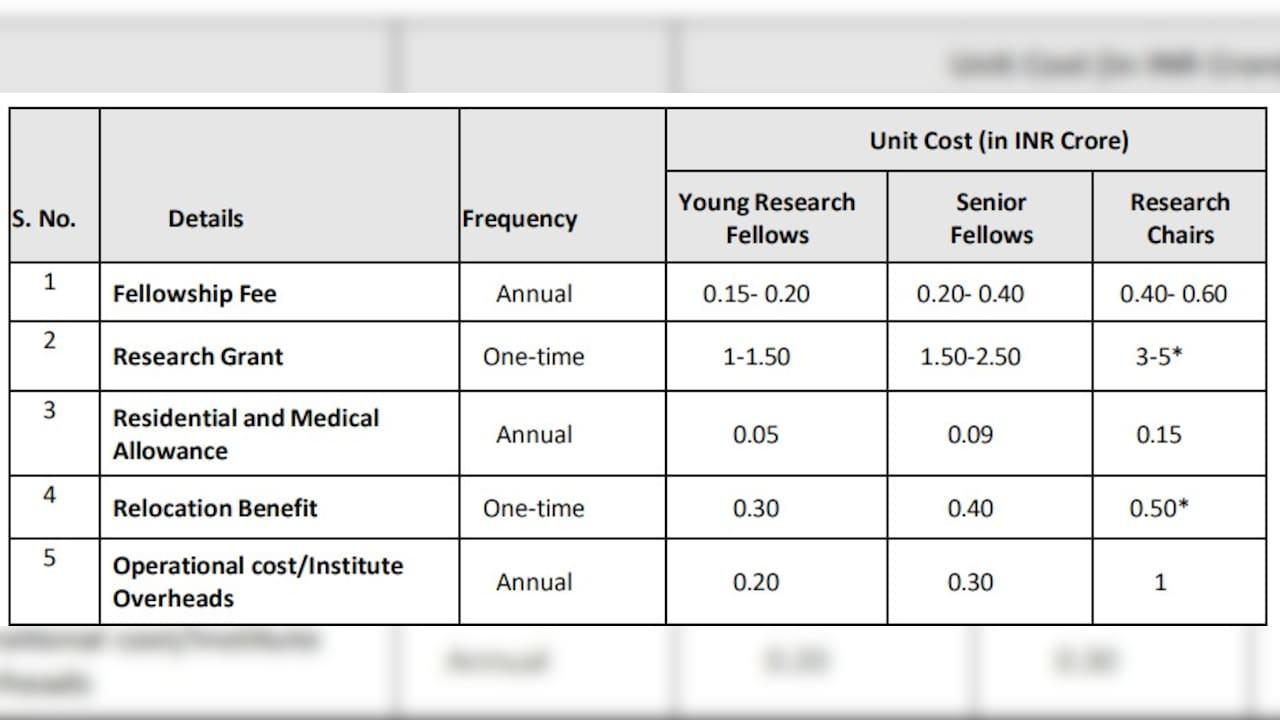
The scheme provides structured financial assistance covering fellowship fees, research grants, relocation support, medical and residential allowances, and institutional overheads.
The following financial table provides the unit costs of budget line items across categories:
Application process
Host institutions must submit detailed project proposals through the official PMRC portal, including research plans, infrastructure details, institutional strengths, and potential fellow recommendations.
Fellows must apply with comprehensive academic and professional records, including publications, patents, awards, international experience, and preferred host institution details.
The Empowered Committee may also directly recommend exceptional candidates with outstanding research credentials.
Expected outcomes
The scheme is expected to strengthen academia-industry collaboration, improve research output in Indian institutions, enrich academic curricula, boost patent generation, and enhance India’s global standing in research and innovation rankings.



