


In the last few days, the grand old party of India seems to have finally stumbled on the fact that the beating heart of India is not the granite of the new Parliament – it’s the sand of the streets and bylanes.
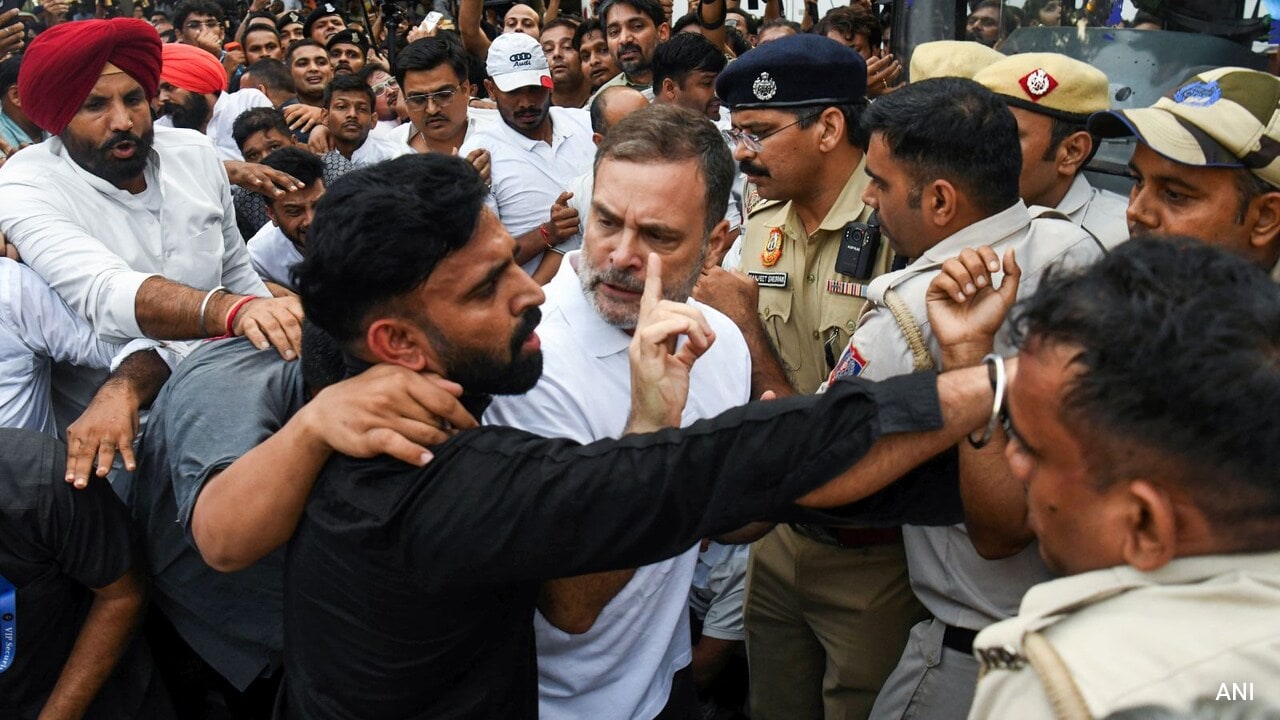
The viral videos of two days of Congress protests, the Rahul-Priyanka brother-sister duo down on the streets, eating meals on the footpath, climbing up gates of government buildings, pushing police personnel, and getting pushed by them, send a potent signal. After 12 years, the Congress party is out to get its political compass not through speeches in Parliament, press conferences, or public meetings; the party that has lost political ground is battling on the ground, using elements from the playbook of a one-time satirical platform that brought down a central minister in July. Its tactics seem to be inspired by those adopted by the unpredictable and unconventional motley gathering of youth at Delhi’s Jantar Mantar.
The change and the newness of it are there to be seen. To read that, just for a moment, stop analysing the ‘whys’ or the end game of the Congress protests. The videos showing the Leader of the Opposition in India’s lower house, Rahul Gandhi, out of desperation, sitting on the stomach of a protester being dragged by policemen, or Priyanka Gandhi Vadra elbowing a policewoman, make the duo in their 50s look like determined novices or newcomers to the art of street demonstrationa. Those who arrived late at it in life. Ordinary Congress enthusiasts usually start jostling with cops and getting detained while participating in demonstrations in their NSUI or Youth Congress days, between the ages of 19 and 25.
The Congress expects that the on-display grit of the two leaders and the body blows they have taken will galvanise Congress workers.
Party insiders say it may seem that Rahul Gandhi is using the shattered halo of the Election Commission, like the Rafale deal in 2019, to deliver a knockout political punch to PM Narendra Modi through “instagrammable” outings and acts. But they add, “The Congress desperately needs an organisational rebuild. Despite Rahul Gandhi’s attempts over the years, deficiencies refuse to go, and electoral successes have been too scant. And that’s why a new playbook is on display. The ‘inconsistent leader’ barb has been factored in, and now it’s clear that Rahul is out for a long haul on the EC issue. The party hopes this will not just motivate a sense of confidence among the cadres but also appeal to a new set of young voters ready to knock on the doors of polling booths, with little memory of how Indian politics was before 2014.”
The Congress has crafted the protests with a plan. The first criterion is that the party should not cede the space of principal opposition and prime alternative to the BJP. The opposition is being rallied, and the party stands in front of it.
Leaders like TMC boss Mamata Banerjee had, at one time, refused to accept Rahul as the leader of the opposition pack and were ready to back JD(U)’s Nitish Kumar. That brand of opposition to Rahul is almost history. The aggressive street strategy helps project Rahul Gandhi as the primary and most combative face of the opposition, putting pressure on the Narendra Modi-led government.
The effort is being tailored around Rahul Gandhi, with eyes mainly on the 2029 Lok Sabha elections. The subplot, however, does include polls for several state assemblies. High-octane visuals – such as flash protests, clashes with police and sit-ins outside government buildings – have prepared the ground for the Congress to put issues like price rises, unemployment, and alleged electoral roll irregularities (SIR/vote theft) at the centre of the national conversation.
Also, the protests have managed to mount a certain amount of pressure on the Election Commission. The EC now knows that a seething agitation is brewing outside its gates and that its functioning is under the lens. Sources say the three Election Commissioners nowadays meet much more regularly than they did before the news broke of dissent in the poll body’s decision-making, as reported in The Indian Express. That reduces the risk of one Gyanesh Kumar having his way and bypassing his two colleagues who make up the institution.
Is The BJP Worried?
The BJP has been rubbishing the Congress protests. Recently, in Varanasi, BJP president Nitin Nabin accused Rahul and other Opposition leaders of trying to “spread poison” and promoting an “anarchist mindset”.
But the BJP has a lot to worry about. Its government in Delhi has anti-incumbency brewing against it as promises haven’t been met and aspirations remain unaddressed. The ‘double and multiple engine Sarkar’ slogan is being dented by failures at the state and municipal levels. Modi’s image may have kept public anger from reaching a boiling point, but its existence is visible. The opposition needs to plug into this anger and start playing. It may not rule 22 states with allies, but it has a presence in all states.
But over the last 12 years, the BJP, as a political machine, has built a knack for creating a silver lining at the edges of dark political clouds. As in the past, the party and its government have embarked on a twin course: one, to improve their connect with the voters, and the second, to work to ensure that the opposition fails to construct a connection with the voters.
Pundits may disagree, but this author has a nagging feeling that the BJP’s ‘don’t let the opposition connect with the voters on real issues’ game plan began around the days when the Cockroach Janata Party (CJP) protests at Jantar Mantar turned violent. Education Minister Dharmendra Pradhan’s resignation was part surrender, part strategy. Many serious issues were biting at its heels. The game plan began with CJP founder Abhijeet Dipke being escorted from the airport to the protest site at Jantar Mantar. The pictures of central ministers negotiating with CJP leaders and the eventual resignation elevated the status of the CJP. This added a new, unconventional player to the space that belonged to the opposition.
Rahul Gandhi’s current campaign has two layers to it. One is that CEC Gyanesh Kumar has to go, as “he is a BJP man” in the supposedly neutral Election Commission. The second is that the mandates secured by the BJP are a case of “vote chori” abetted by the CEC.
The BJP walks on fragile ground here. It can fire indiscriminately at the opposition over the “vote chori” charge but has been cautious in defending the CEC. Its prescription on the latter is that the issue is before the apex court and that his removal can be through an impeachment motion in Parliament, unless he resigns on his own.
Rumblings On The Ground
On the CEC removal issue, the Left parties were off the block first. On October 2, after protests erupted in Delhi and Mumbai, Rahul Gandhi demanded Gyanesh Kumar’s resignation over alleged “vote theft”.
Then came three days of sustained protests by the Congress-led opposition. On day one, Rahul Gandhi, Priyanka Gandhi Vadra, and over 200 opposition MPs marched from Parliament Gate 4 towards the Election Commission of India (ECI) headquarters. Delhi Police had blocked the route and started detaining protesters. While the police assumed Rahul Gandhi would leave in his car, he adopted the ‘AIM’ formula (aggression, innovation and mobilisation), which was the hallmark of the CJP protest in July. He moved briskly and somehow entered the Air India radio complex. A major drama ensued, after which the police forcibly put Rahul Gandhi onto a bus. Videos showing the police forcing Gandhi onto a bus and him trying to climb out of the bus window subsequently went viral.
On day two, after lunch at Delhi’s Sagar Ratna, a confrontation broke out between the Delhi Police and the Gandhis and other Opposition MPs as they were stopped while trying to march towards the Election Commission.
Obstructed by the cops, Priyanka Gandhi Vadra lay on the road with a copy of the Constitution, as Rahul Gandhi guarded her. “This is my sister,” shouted the LoP at the Delhi Police officers who were trying to remove her from the spot. A brief tussle ensued between CRPF personnel responsible for Rahul Gandhi’s security and the Delhi Police.
On day three, the opposition leaders were scheduled to meet President Droupadi Murmu. That night, the Congress chose to register a protest with a sit-in at Rajghat.
The Congress celebrated. As the protests shared news headlines with the BJP’s celebrations of PM Modi’s 25 years in power as Gujarat Chief Minister and Prime Minister, its top leaders were consistently fighting on the ground, and the party seemed to have emerged as the leader of the opposition pack.
But this is where the BJP was finding its safety valve. A top BJP leader said, “Rahul Gandhi’s aggression on the issue is a welcome sign. It has the potential to drive the political narrative in a more manageable direction for us.”
The BJP’s assessment involves a lot of ifs and buts. Still, some of the elements seem to be coming true.
Congress vs CJP?
The anti-NEET protests in July had one clear stakeholder: the CJP. The Congress was late to the scene. Rahul Gandhi tried to make his party a player by attempting a sit-in outside the PM’s official residence.
But on the CEC issue, the Congress has firmly thrown its hat in the ring before the CJP could start its protests. Also, the Congress, as a political party, has solid locus standi in the election process compared to the CJP. While Rahul Gandhi was leading the opposition in staging high-octane protests, the CJP announced an ‘us-too’ plan to hold a protest at Jantar Mantar until Gyanesh Kumar resigns and the integrity of voter lists is restored.
For the BJP, this competitive jostling between the Congress and the CJP over the issue wasn’t bad news.
Why?
One, the Congress was yet again putting its weight behind an issue that wasn’t part of the middle-class, ‘aam aadmi’ vocabulary. The BJP felt Rahul Gandhi’s ‘weakened institutions, election manipulation and crackdown on dissent’ narrative was not close to the public. “Yet again, Rahul Gandhi has chosen to create a complaint. It may seem he is battling for the people and their rights. But eventually, he is up with yet another grievance while the voter expects solutions. His style of protest may impact social media ratings for a while, but not enthuse the voter,” said a top BJP leader.
The BJP in 2011 battled a similar dilemma. It was pushing corruption and weak governance charges against the UPA, and its antics made news. But there was no trickle-down.
Another clear indication is that the BJP prefers to have a ‘Congress vs BJP’ slugfest on the issue compared to a ‘CJP vs BJP’ contest. The reason is not hard to understand. The BJP’s campaign against Rahul and his party, by invoking the failures of Nehru, Indira, and Rajiv, is old and may have lost its novelty value. In the coming elections, the voters will judge the party on how its governments have performed in the last 12 years, not on how the Congress ruled before that. The Congress’s current obsession with the CEC issue, however, gives the BJP much-needed time to correct its game on grassroots issues.
Also, data from around 47 assembly and three Lok Sabha polls in the last 12 years show that, for the BJP, defeating the Congress with a Modi vs Rahul narrative has been a more assured result.
For the BJP, the CJP is a more volatile entity. It has no visible political stakes or tainted past to target. There is no dynasty narrative it can build. In July, it seemed that the CJP had a support base among young voters who may have attained puberty after Modi’s rise and are largely caste- and religion-agnostic. Still, the CJP’s decision to build its own campaign on the CEC issue became an opportunity for the BJP and its government.
The voters became familiar with the CJP when it stood up to fight for the students. Many who joined the protests at Jantar Mantar qualified as “past and prospective victims” of a broken education system. There were families of students who had committed suicide or suffered setbacks. Importantly, the supporters of the agitation included the BJP’s core vote bank – the upper caste.
Then the sympathy factor came into play. The BJP gave in.
But this time, when the CJP jumped in on the CEC issue with a “Chalo Jantar Mantar” call on October 10, it was clearly aiming to create a flashpoint. Like a duck out of water, it moved from a justice-for-students platform to one deploying agitational muscle for yet another resignation.
The BJP knew the CJP was an unconventional beast. But the majority of Modi supporters don’t have reasons to agree with the ‘vote chori’ narrative. Second, the CJP lacks cadres and a clearly defined leadership beyond the top four: Abhijeet Dipke, Ajinkya Shinde, Saurav Dass, and Ashutosh Ranka.
So, after crafting a Congress vs BJP contest on the CEC issue, the government’s second step was to go out and crush the CJP’s protests. It denied permission to the CJP to stage its protest at Jantar Mantar. Delhi was turned into a fortress. Jantar Mantar became a “trespass and get detained zone”. Metro stations were closed. Trains that could have brought supporters to Delhi were cancelled. The CJP’s July protests had left behind an ugly template of police brutality. Cops this time were moving with body cams. They were given clever dos and don’ts. Independent content creators armed with mobiles had decimated the BJP’s social media counter in July. This time, pro-BJP creators outnumbered others.
Dipke, Ranka, and Dass were picked up from their seats on Air India’s Mumbai-Delhi flight. The CJP had roped in top social media influencers like Dhruv Rathee to attract young followers. He was also detained. In all, four ex-Chief Ministers and 7,000 protesters were detained in an unprecedented citywide lockdown in the capital, not seen in decades. With no credible leadership to guide them, protesters who arrived at Jantar Mantar battled confusion and cops.
Rahul Gandhi and the Congress criticised the crackdown but, to protect their claim to the “CEC must go” turf, kept their distance from the CJP. The city remains tense, but the October 10 protest call didn’t succeed. The CJP’s top trio is out of detention on a ‘we will not foment trouble for one year’ legal bond.
So, what’s the net result? The anti-government narrative on the CEC issue now has a split and no clear ownership.
INDIA Bloc’s Fault Lines
Observers note that making the protests a ‘Rahul Gandhi show’ risks overshadowing partner parties or creating friction, such as conflicting approaches from allies like the Samajwadi Party.
The BJP had been claiming that the CJP is a proxy entity of the Aam Aadmi Party and Arvind Kejriwal, who has added to this perception by staying away from Rahul Gandhi-led protests.
On day one of the opposition protests, the Left parties disagreed with Rahul Gandhi. They didn’t want to meet the CEC. “Meeting the CEC to submit a memorandum will validate the position of a person we are challenging,” CPI’s D Raja said. The DMK stayed away.
Then Samajwadi Party boss Akhilesh Yadav left the protest venue before Rahul Gandhi staged a dramatic entry into the AIR complex. SP sources expressed frustration over a lack of prior consultation regarding surprise protests and leadership optics. This friction contributed to the SP skipping an INDIA bloc lunch hosted by Congress president Mallikarjun Kharge at Sagar Ratna restaurant.
Akhilesh has been unhappy with the Congress ahead of his much-awaited seat-sharing pact with the Congress for the Uttar Pradesh Assembly polls as the party didn’t back his protests against the SIR in the state.
There is also no unanimity in the INDIA bloc over how hard to press the accelerator on the Gyanesh and SIR issue.
In the Bihar elections late last year, Rahul Gandhi was keen on building the campaign around the SIR issue. He, along with RJD’s Tejashwi Yadav, took out a “Vote Adhikar Yatra”. But Tejashwi realised that the issues on the ground were unemployment and a lack of opportunities in Bihar. So, he took out a separate “Bihar Adhikar Yatra”.
The picture hasn’t changed much. Ahead of the Uttar Pradesh polls, the SP feels Akhilesh Yadav’s PDA and issues like “Chanda Chori” (donation theft at Ram Temple) should be the central talking points. That’s why, on the day Rahul and Priyanka were battling the police on the streets, Akhilesh Yadav was visiting Ayodhya.
Akhilesh Yadav had earlier distanced his party from dramatic protests staged by the Indian Youth Congress (such as shirtless demonstrations at global venues like the India AI Impact Summit), emphasising that political contests should not create negative optics for the country internationally.
The Congress, led by Rahul Gandhi, is buoyant that the ongoing protest mode will help the party’s revival. For them, Rahul Gandhi is now the strongest contender for the INDIA bloc’s Prime Ministerial face. The game plan can be helpful for the Congress in states where the electoral contest is binary between the BJP and the Congress.
But the assessment that the party’s bargaining power in seat-sharing negotiations has improved threatens the unity index of the opposition. This muscular posturing by the Congress is increasing the wariness among most regional members of the INDIA bloc. The BJP is relishing this power play and the fissures within the INDIA bloc.
Great Assumptions
The BJP is relying heavily on an assessment that the SIR and ‘vote chori’ issues aren’t game changers. With the opposition populating its campaign with these campaigns, political attention is off the issues that matter to the common person.
But there exists a rider. What if the Supreme Court does flag that all was not well in the EC? What if anger over other issues catapults voters into accepting SIR as an issue?
For the voters, too, there is a note of caution. The opposition’s political protests and the ruling party’s chess manoeuvres will continue. But the integrity of the Election Commission is the holy grail of our democracy. And that must remain the top priority for them.
(The author is Consulting Editor, NDTV)
Disclaimer: These are the personal opinions of the author


