


In March 2021, Rahul Gandhi called a group of students at a college in Kerala’s Kochi onto the stage and taught them a principle from aikido, the Japanese martial art in which he holds a black belt. Strength depends less on force, more on where and how one stands, he said. He also mentioned what he called “a secret men would never tell”: that “women are much more powerful”.
On Monday, October 12, during the final stretch of the Opposition’s protest march to the Supreme Court, the Leader of the Opposition positioned himself a step behind two women, a hand resting on each of their shoulders. On his left was his sister, Congress general secretary Priyanka Gandhi Vadra. The one on the right was Neha Bora, president of the All India Students’ Association (AISA), a theatre artist, whose craft teaches that where you stand decides where the audience looks.
Advertisement – Scroll to continue
Nobody watching that march that day was in any doubt about where to look.
Chief Justice of India Surya Kant had already declined to meet the delegation, and a petition against Chief Election Commissioner Gyanesh Kumar was filed as he had suggested instead.
But that picture with Rahul in the centre-background became a story with many meanings.
The many meanings gained weight on Tuesday, when Bora was at Rahul’s residence for a meeting of INDIA bloc leaders, Opposition MPs, student organisations and civil society representatives, and addressed the press after it. Congress president Mallikarjun Kharge asked her to, after Rahul made her leave the backstage and be upfront.
Advertisement – Scroll to continue
But Rahul can walk too fast at times.
So let’s slow down and take this analysis one step at a time.
Riding Gen-Z Momentum, With Or Without CJP
For months now, the Congress has had the issues, be it paper leaks or the Special Intensive Revision of electoral rolls. It has an organisation that can fill a road, and a leader willing to be bundled into a police bus. What it has lacked is the right momentum. That came from a meme page that grew into a pressure group.
Bora, who leads the student wing of Congress ally CPI(ML)-Liberation, has been a bridge between the principal Opposition party and the Cockroach Janta Party (CJP).
Rahul appears to have now reeled the bridge in, and the CJP has responded by making a bit of a leap from its “apolitical” position. Wednesday closed the gap between the two parallel protests. Police arrested CJP leaders Saurav Das and Ashutosh Ranka, who were later sent to judicial custody for five days for trespassing at Jantar Mantar, the historic site denotified as a protest venue on Monday.
Rahul spoke up for them on X. CJP founder Abhijeet Dipke, who once dismissed Rahul’s Bharat Jodo Yatra as a “travel vlog”, replied to thank him.
READ | In First Show Of Support, Rahul Gandhi Backs CJP Leaders Jailed For Protest
This came after the CJP leaders’ personal absence from the streets received attention online. They chose not to be at the Rahul-led Monday march too.
Neha Bora was there, as she was on a parallel stage at the June-July protest. She is now the best-known young face of the protests, and the one who moves most easily between the groups behind them. In the past week alone, she has been detained at protests called by the Left, the INDIA bloc, and the CJP. She posts videos from inside detention centres, cheekily asking for ‘chai’ in one, angrily putting her point across in another.
Butterflies painted on a flyover wall in the background, her picture of running from the cops is viral — a motif. “Sometimes imagination can be the forerunner of reality. Imagine there are no barricades and young Indians can run freely on the roads,” read CPI(ML) chief Dipankar Bhattacharya’s caption for it.
This is not AI. A snapshot of a moment of freedom in an otherwise fortified, barricaded, almost miliatrised Delhi. Sometimes imagination can be the forerunner of reality. Imagine there are no barricades and young Indians can run freely on the roads. https://t.co/BdhktzeP32
— Dipankar (@Dipankar_cpiml) October 11, 2026
Hand On The Shoulder
Speaking of visuals, a hand on the shoulder can mean more than one thing. The kind reading is that a 56-year-old Leader of the Opposition was telling a student leader, 29, that he has her back.
The other reading is that it is the hand of a cynical politician resting on a youth movement that he cannot lead. BJP president Nitin Nabin has said the CJP and the Congress were “competing on who can spread more anarchy”.
The two movements did compete on which one has wider acceptance. Weeks before the CJP began its protest at Jantar Mantar in June, Rahul had launched the party’s own student campaign, ‘Chhatron ki Goonj’, from Kota in Rajasthan. When the CJP later came up — riffing on the word ‘cockroach’ used by Chief Justice Surya Kant during a hearing — it grew at a pace that Insta-speak would describe as “cray-cray”.
Writer-academician Purushottam Agrawal sought to explain the difference in why one picked up pace faster than the other. He argued that the CJP-led Gen-Z protesters’ relentless, boundless use of humour gave it extra momentum. He also noted that Rahul stayed away from the CJP’s Jantar Mantar site to deflect the charge of politicising the protest.
READ | SIR Stay, Action Against Officials: Rahul Gandhi’s 10 Requests To Top Court
On the day that Dharmendra Pradhan announced his resignation on July 25, Rahul had marched to Prime Minister Narendra Modi’s residence separately, though a Congress representative went and met the CJP at Jantar Mantar.
Earlier that day, Neha Bora stood next to Rahul as they held a press conference to decry the July 20 police crackdown on the CJP’s march to Parliament. When Rahul was finished, saying, “These young people are the future of this country. Narendra Modi is the past. The past cannot fight the future,” Neha asked to speak. He stepped aside. She argued that the fight was far bigger than one demand. This week, she did not have to ask to speak. Rahul asked her to.
“Neha Bora, trained in the Left tradition of protesting and pursuing causes even when cameras are not on them, has emerged as a more thoughtful individual than the savvy young leadership of CJP,” Harjeshwar Pal Singh, historian and political commentator, told NDTV.
On Rahul’s choice to walk behind her, he said, “Clearly, he wants to show the youth shall lead, and he is ready to back them with political power that he possesses as the leader of the largest Opposition party.”
This sits rather easily with Rahul’s temperament, he noted.
Running Motif In Rahul Gandhi’s Politics
For two decades, the most common complaint about him has been that he would not take the front row that he was essentially born into as part of the Nehru-Gandhi dynasty. On the day he became Congress vice-president in 2013, he spoke of his mother’s warning that “power is poison”. When he resigned as party president after the 2019 defeat, he walked the path of “sacrifice” that his mother made when she declined the PM’s post in 2004, Harjeshwar remembered.
Rahul called his Bharat Jodo Yatra of 2022-23, where he walked right in the centre, a “tapasya”. “I wanted an element of suffering for myself,” he told reporters in October 2022.
Social scientist Shiv Visvanathan noticed this streak early, writing in 2010 that the kind of waiting Rahul was doing “teaches you the art of listening“. Rahul had not taken a ministerial position in Manmohan Singh’s government of 10 years despite being a power centre unto himself.
“He has been pitching himself as different from the more aggressive, centralised Brand Modi, in how Brand Rahul stands for a slower but surer pace, willing to stand in the centre but also walk with, or behind,” said Harjeshwar Pal.
READ | Opinion: Rahul Gandhi Has Found The Streets Again. And The BJP, An Unexpected ‘Opening’
Walking behind Neha Bora reflects his more recent political stance too, he added.
Rahul has been raising issues usually associated with the Left, moving the Grand Old Party more towards its post-Independence days as a welfare-focused, more socialist position a la the viral mayor of New York City, Zohran Mamdani, seeking to license the counter-space to global right-wing surge.
He has pressed for a caste census under the slogan ‘jitni abaadi, utna haq’, calling for representation in sync with numbers, and even called for universal basic income.
The student agenda that brought Neha Bora to Jantar Mantar, on a stage parallel to the CJP, was rooted in a demand for public education and social justice.
Where The Road Forks
There are limits to the common ground; even Neha Bora’s AISA has acknowledged it. AISA’s website lists the Congress’s student wing NSUI alongside the BJP-RSS’s ABVP as “anti-student, anti-people” and “right-wing” organisations. It even lists other Left bodies like SFI among them. But Neha Bora has said the singular agenda right now is to “remove the BJP”. AISA’s parent party CPI(ML)’s Dipankar Bhattacharya has said, “The revival of the Congress is a very good omen for Opposition unity.”
“Rahul clearly wants to harness a new set of leaders on the Left-liberal side, now that the old guard is out, and his hold on the party and its ideology is complete,” Harjeshwar Pal said.
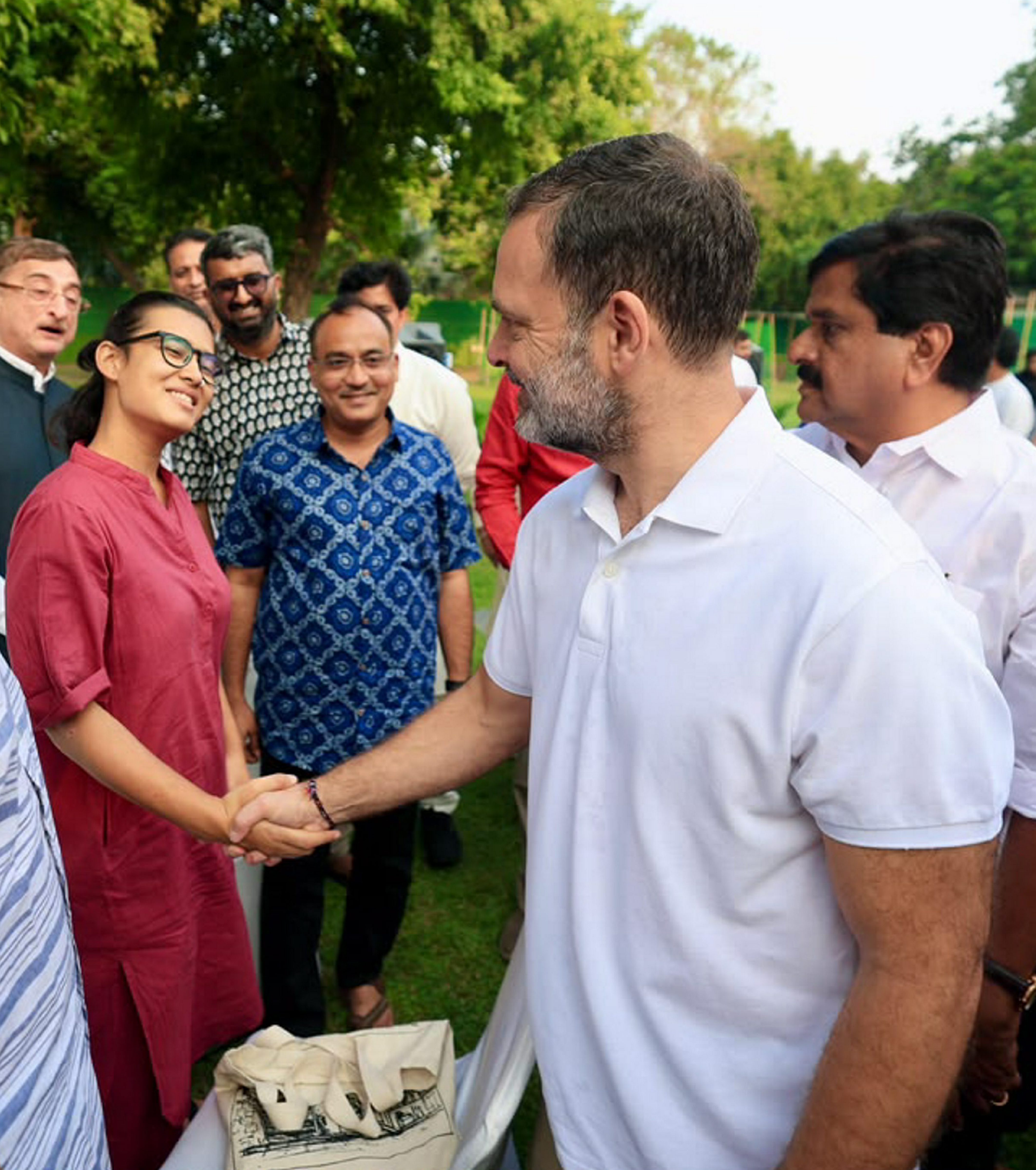
Rahul Gandhi greets Neha Bora during a high tea organised for INDIA bloc leaders at his residence to discuss the strategy for joint protests against “vote chori”.
Photo: PTI
Student leaders from Jawaharlal Nehru University (JNU), where Bora is a PhD candidate, have walked this road before, and it has ended on divergent paths.
Shehla Rashid, vice-president of the JNU student union and elected from AISA, is one of them from the 2016 controversy over a campus event. As a Kashmiri Muslim, she has since gone 180 degrees, praising Modi by claiming that the human rights record in the region had improved.
Yet another Muslim among the faces of 2016, Umar Khalid remains in jail, without trial, accused in the Delhi riots that followed massive protests over an allegedly exclusionary amendment to the citizenship law. Neha Bora is privileged on that count, being a Hindu, analysts have noted. She has acknowledged that privilege and spoken for Khalid. The Congress has avoided taking that up directly.
READ | The Bail Question: Conflicting Court Views On Umar Khalid Bring UAPA Under Lens Again
Then there’s Kanhaiya Kumar, the face of the 2016 protests, who shifted from the CPI to the Congress in 2021, calling it “the big ship”. The Bihar native was later put in charge of the NSUI, which last month failed to win a single post in the Delhi University student elections. He was not seen at Monday’s march, and has lately been a peripheral presence anyway.
Neha Bora walked in the front. For now.


