


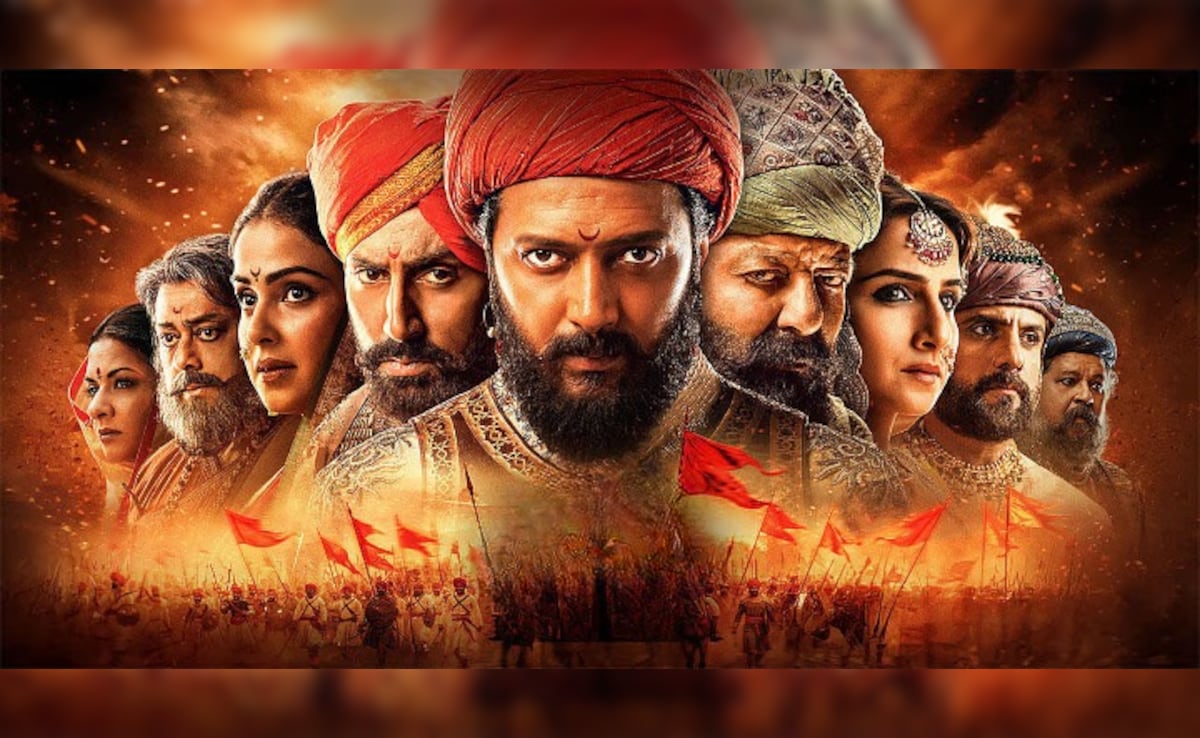
The chapter of Maratha history that Raja Shivaji, a Marathi-Hindi bilingual written and directed by lead actor and co-producer Riteish Deshmukh, brings to the big screen is far more momentous than what Tanhaji – The Unsung Warrior and Chhaava have done.
Both films drew elements gleaned from our school textbooks and served them up heated and heightened for an easy-to-sway mass audience to lap up. Not that Raja Shivaji does not intend to be a crowd-pleaser – it definitely does – but its many narrative flourishes, elaborate battle scenes and bloody duels are not as in-your-face as the ones that were mounted in Tanhaji and Chhaava.
Tanhaji and Chhava dealt with tales of secondary importance. This one, an action-packed, three-hour-plus epic, tackles a phase that is far more central to the Maratha story – the emergence in the 17th century of Chhatrapati Shivaji Maharaj at the helm of a “Hindavi Swarajya” that took on the might of the Mughal Empire.
The film spans from 1629, a year before Shivaji’s birth, to 1659, the year Afzal Khan died. Before the tale begins, a long disclaimer makes it clear that there is much in Raja Shivaji that should not be deemed as an accurate representation of events. But isn’t that exactly what all made-in-Mumbai historical dramas do? They take liberties and we are perfectly all right with it as long as matters do not go overly haywire.
Raja Shivaji is expectedly replete with gore and high drama but in this respect, too, the film exercises a studied degree of restraint. It does not seek to turn a revered warrior into a superhero stuntman. The film has scenes in which the eponymous protagonist breathes, behaves and talks like a flesh-and-blood human although a divine aura is bestowed upon him.
He is a brother, a son, a husband and a ruler who encounters personal tragedies and challenges as he tries to garner support for his cause – the cause of independence from powers that are determined to beat the Marathas into submission – and mobilise his men to fight fearlessly with an eye on changing the course of history.
Shivaji’s bete noire is Afzal Khan (Sanjay Dutt), the brutal Bijapur army commander who plots incessantly to stop the Maratha warrior-prince in his tracks, but Deshmukh’s script mercifully does not mutate into an out-and-out Islamophobic diatribe.
Raja Shivaji does not harp on the religious identity of the tyrants who unleash a reign of terror, but upon the nature and extent of the atrocities that they commit in pursuit of power.
Among his foes are people who are from his own faith, including a vassal of Mohammad Adil Shah placed as the ruler of Jawali. This man gives refuge to a molester, also a Hindu, and Raja Shivaji and his soldiers invade the kingdom to dispense justice.
The victims of the brutal oppression perpetrated by Afzal Khan are the common people of the land. Shivaji vows to rid them of their shackles. He fights for the freedom of his people and the land that they till, the language that they speak and the beliefs that they hold dear. His mission is Swarajya and he knows exactly who his enemies are, the Mughals and the Adilshahis as well as the principalities that side with the tormenters.
Neither Mohammad Adil Shah (Amole Gupte), an effete ruler who exasperates his Begum, Khadija Sultana (Vidya Balan), no end, nor Emperor Shah Jahan (Fardeen Khan in a cameo), who frets more about completing the construction of the Taj Mahal than about confronting the Marathas, are accorded much significance.
The spotlight never shifts away from the marauding, menacing Afzal Khan. Sanjay Dutt does his very best to make the ‘villain’ what he is meant to be in order to make the central face-off work – a figure who towers over everybody else. It is a tough call but he gets there. Well, almost.
The build-up to the final showdown between Shivaji and Afzal is compelling enough with the editor imparting the requisite momentum to the most crucial part of the film with the aid of staccato, back-and-forth cutting. It creates moments that are intriguing and gripping enough for the stretched-out narrative not to weigh unduly heavy on the audience.
In this long-drawn-out climactic passage, three fine actors – Sachin Khedekar (who has an extended role as Shivaji’s father), Jitendra Joshi and Mohit Takalkar – corner some of the limelight. Joshi plays Shivaji’s negotiator Pantaji Gopinath while Takalkar portrays Afzal Khan’s emissary Krushnaji Bhaskar. The two men go back and forth between their leaders to agree meet each other – it constitutes the film’s climax.
Lensed by Santosh Sivan (this is the veteran cinematographer’s Marathi cinema debut), Raja Shivaji has its no dearth of visual flair. But it also has share of drawbacks. It does not flow in a smooth, coherent arc. It has moments that feel a touch stilted and the dialogues – this critic watched the Hindi version of the film – do not always hit home.
Parts of the film are marred somewhat by a certain amount of huffing and puffing as they seek to establish the enormity of the obstacles that lie in the path of Shivaji (played with a combination of restraint and intensity by Riteish Deshmukh) and his impulsive and free-spirited elder brother Sambhaji Shahaji Raje Bhosale (Abhishek Bachchan).
One might quibble that the two actors are miscast but to their credit they turn in convincing performances that not only hold the core of the film together but also stay in sync with the demands of the screenplay, which eschews hollering and hectoring in favour of modulation.
In that respect, Raja Shivaji, for all its sweep and scale, does the unthinkable – go in for measured strokes rather than adopt massy methods in its emotive moments. It does not always work but the attempt itself is noteworthy.
The women in Raja Shivaji aren’t nonentities like they usually are in hyper-masculine historicals. Apart from the sharp-witted character essayed by Vidya Balan, both Jijabai (Bhagyashree), Shivaji’s mother, and Saibai (Genelia Deshmukh), his first wife, have things to say and do, which, of course, is no deviation from what history tells us about the roles that they performed in the making of Chhatrapati Shivaji Maharaj.
Raja Shivaji isn’t always as sharp as the wagh nakh (tiger’s claws) that the protagonist employs in battle but it does have its moments. It isn’t for those who are looking to be swept off their feet.
It is the sort of film that holds its horses until it is absolutely necessary to let them loose and fires its cannons and wields its swords and daggers in a controlled way. The question is: does the audience have any patience for such fare anymore?



