


New Delhi:
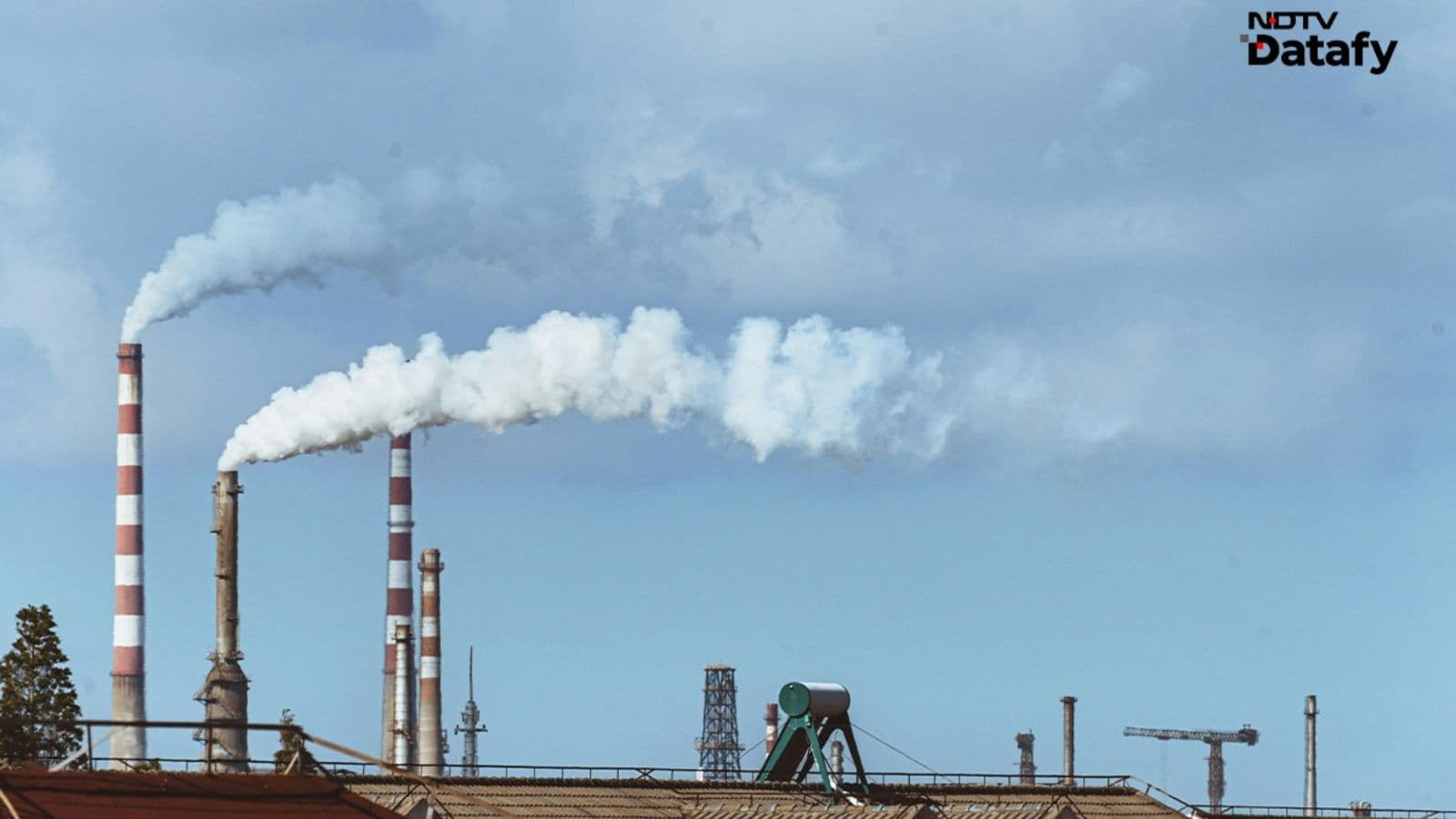
Many manufacturing units in some of India’s biggest industrial clusters operated below capacity as they faced disruptions linked to the war in the Middle East, industrial emission data suggests.
Remote sensing data analysed through OSINT (Open Source Intelligence) research by NDTV Datafy shows reduced emissions of nitrogen dioxide (NO2) in at least four industrial clusters – Surat and Morbi in Gujarat, Navi Mumbai in Maharashtra, and Kanpur in Uttar Pradesh – during March-May. This trend is consistent with reports in local media and accounts of industry insiders.
NO2 emissions are considered a reliable proxy for tracking industrial activity through remote sensing because the gas remains relatively concentrated near its source in the short term and is directly indicative of combustion process, according to a World Bank Policy Research Paper.
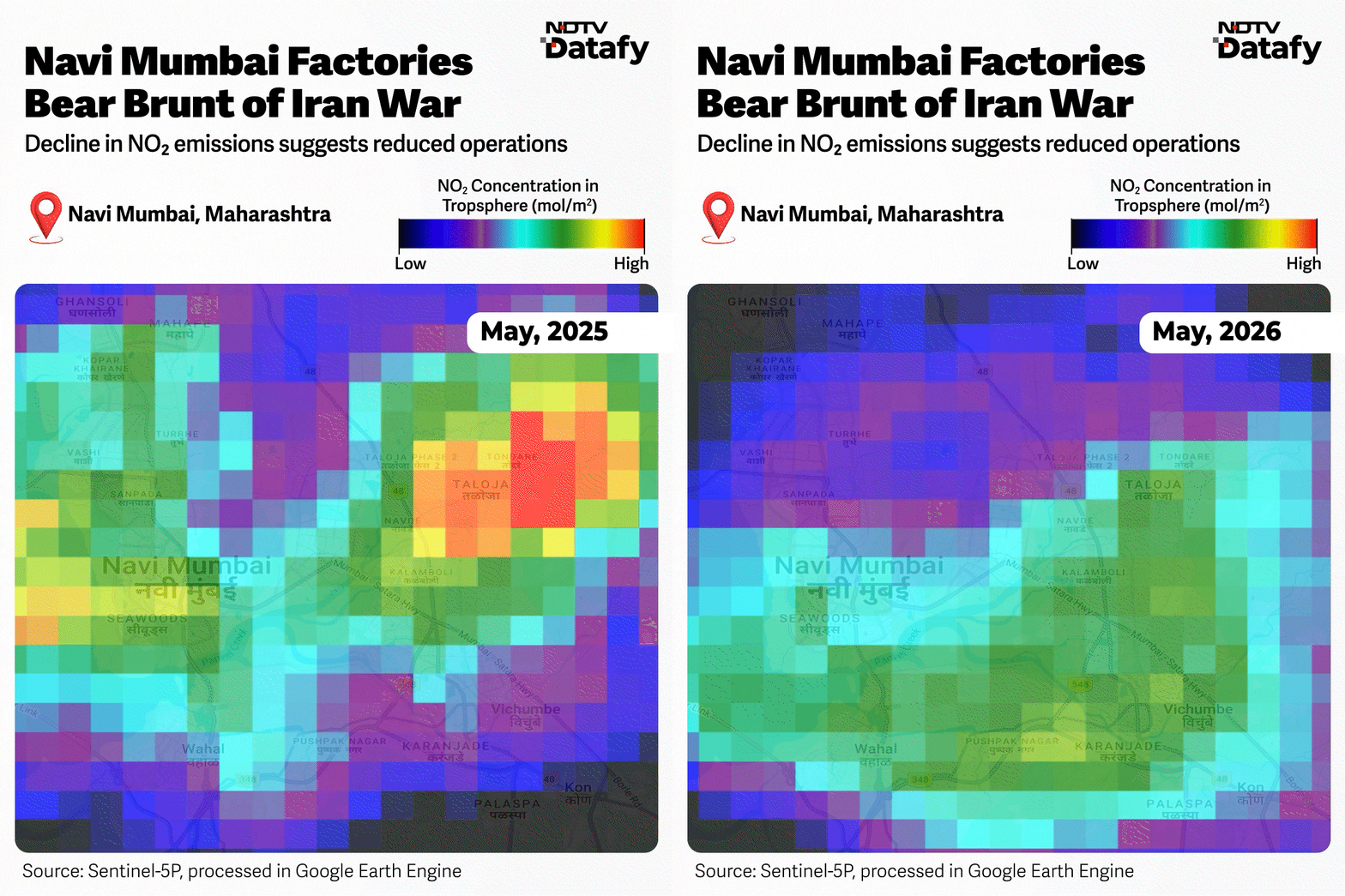
Notice how red pixels disappear in the map for May 2026.
For our research, we used satellite data recorded by the European Space Agency’s Sentinel-5P, which passes over any place on earth in an interval of two days. Emissions data for March, April, and May were compared with the same months last year to ensure similar weather conditions.
Factories emit nitrogen dioxide gas when they burn fossil fuels. It is also produced at high temperatures when nitrogen and oxygen in the air react inside industrial furnaces and boilers.
Industrial clusters in Gujarat appear to have been particularly affected. On April 7, the state government said over 1,200 industrial units had shut down due to sustainability concerns, while more than 28,500 units were operating at reduced capacity.
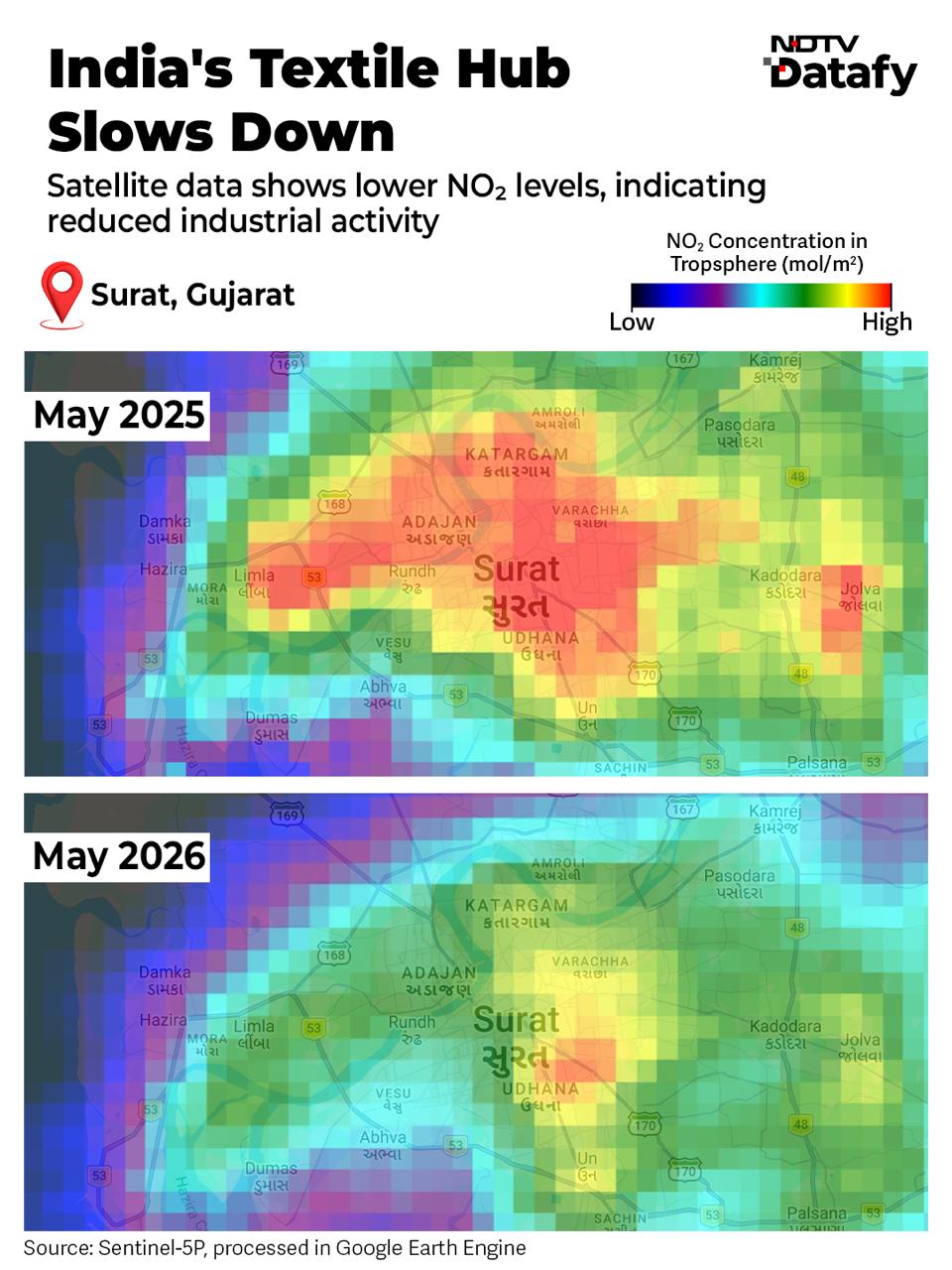
In the textile manufacturing hub of Surat, NO2 emissions in March and May remained significantly low compared to the same months last year. In April 2026, however, emissions were slightly higher than April 2025, indicating a volatile situation as industrialists rushed to make up for earlier losses.
Jitendra P Vakharia, president of the South Gujarat Textile Processors Association, says higher input costs, disruption in the supply of high-grade coal, export challenges, and lower demand have forced many owners to reduce production. “The situation worsened towards March-end and gradually deteriorated, but it seems to be gradually improving now,” he told NDTV.
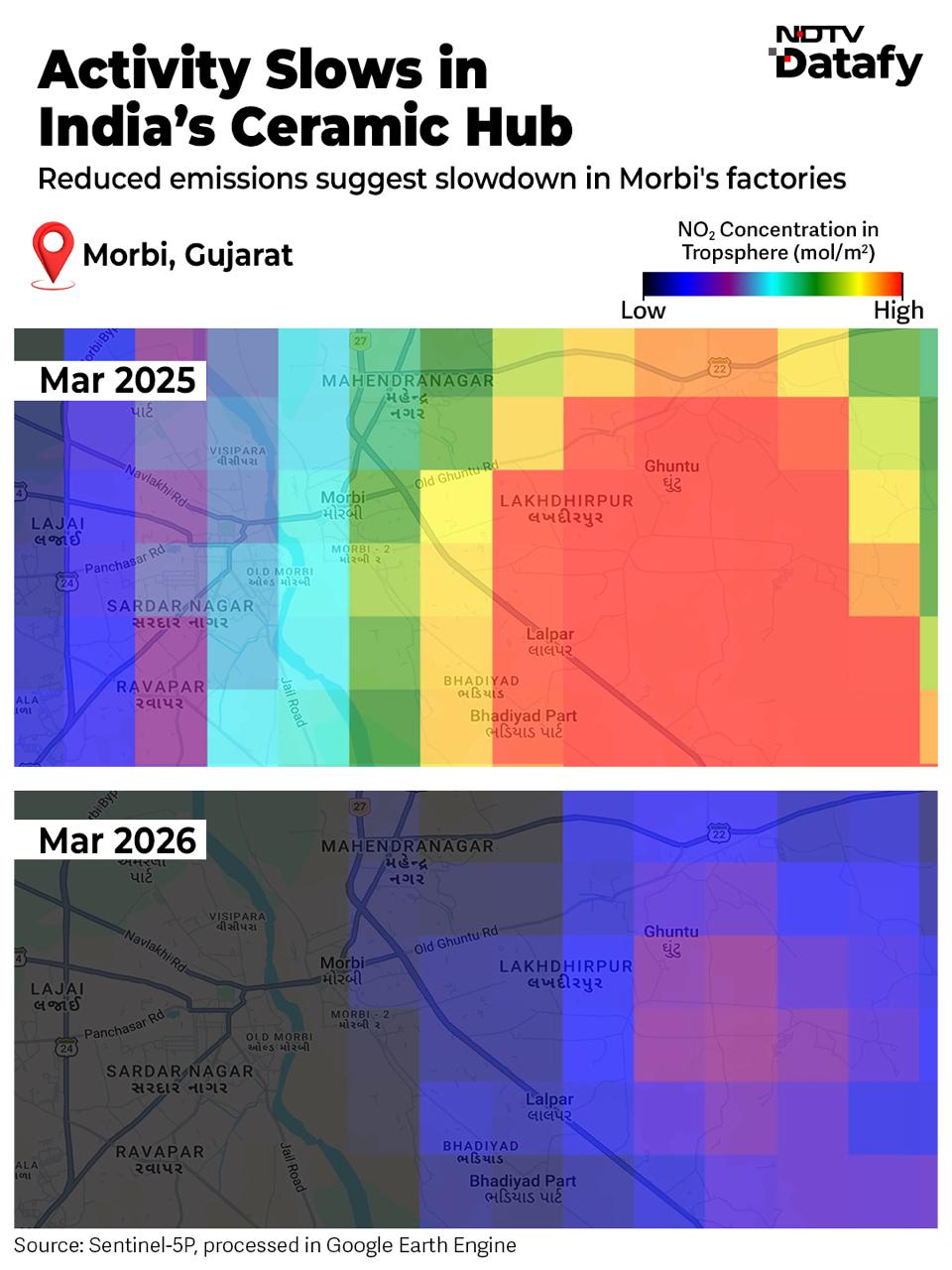
India’s ceramic production hub in Morbi near Rajkot appears to have been severely impacted. As per reports, more than 400 of around 700 units suspended operations for around a month beginning mid-March due to disruptions in propane and natural gas supplies.
Production has since improved, but it is yet to recover fully, says KJ Kundariya, former president of Morbi Ceramic Association. “Factories are still not operating at their normal capacity because input cost is not sustainable and demand is significantly lower,” he said over the phone, adding that buyers have almost halved their usual orders.
Kundariya added that while fuel gases are available, albeit at higher prices, transporting goods was a major challenge, with diesel availability for trucks still a struggle.
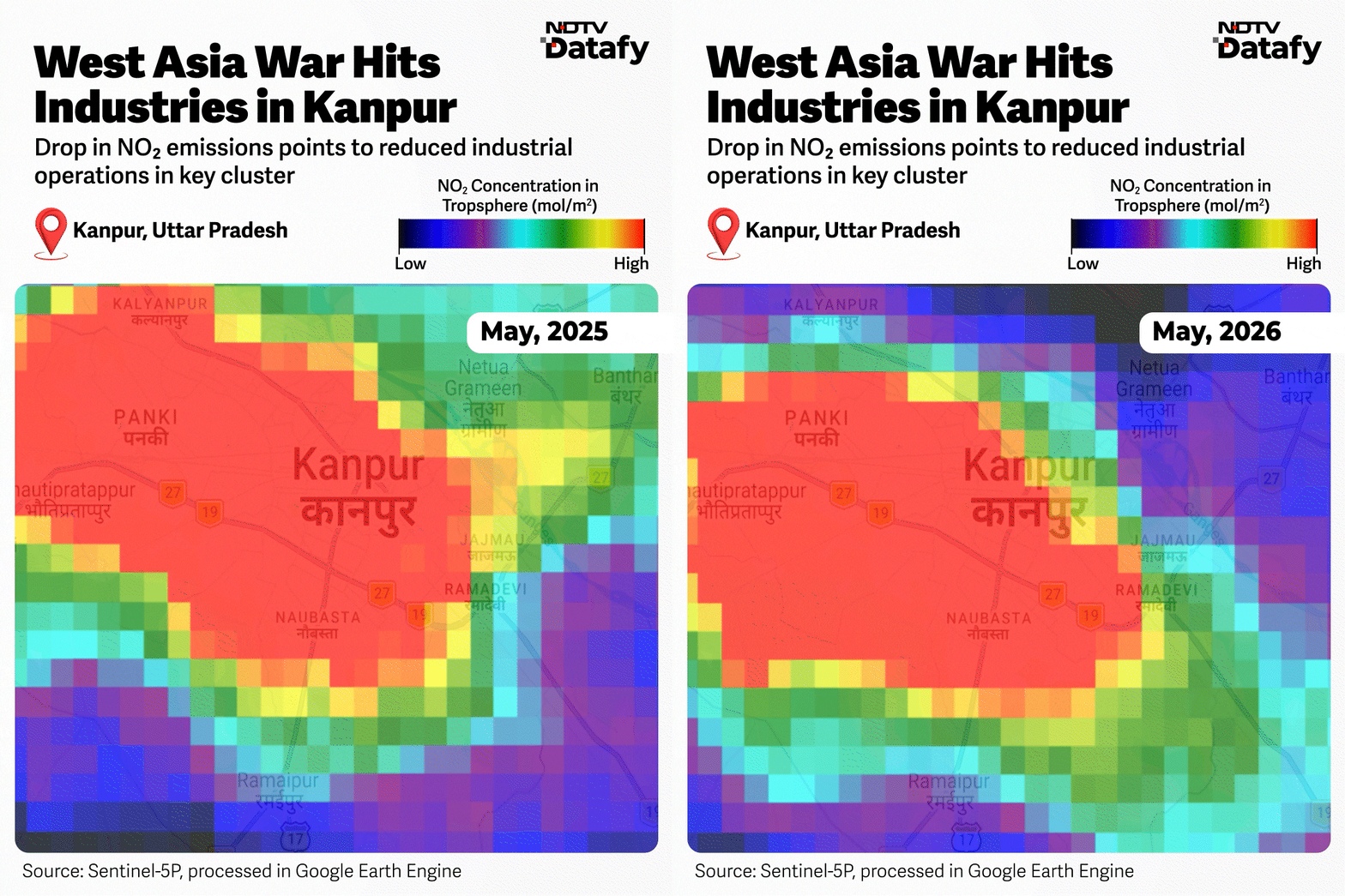
The story is almost similar for industries in Kanpur, popularly called the “Manchester of North India”.
NO2 emissions data suggest concentrations were lower in March and May 2026 compared to the same months last year. Speaking to NDTV, Vijay Kapoor, president of Kanpur’s Dada Nagar Cooperative Industrial Estate, confirmed a decline in production due to issues linked to the Middle East war.
“The cost of raw materials and fuel has jumped significantly. Exports have been hit, and domestic demand is low. Taking these factors into account, factories have reduced their production by up to 50 per cent,” he said.
In an address to the Parliament in late March, Prime Minister Narendra Modi said the impact of the Middle East conflict could persist for a long time and urged citizens to remain prepared. He also said that the government was working on short, medium, and long-term strategies to manage the fallout.



 in at least four industrial clusters.)