


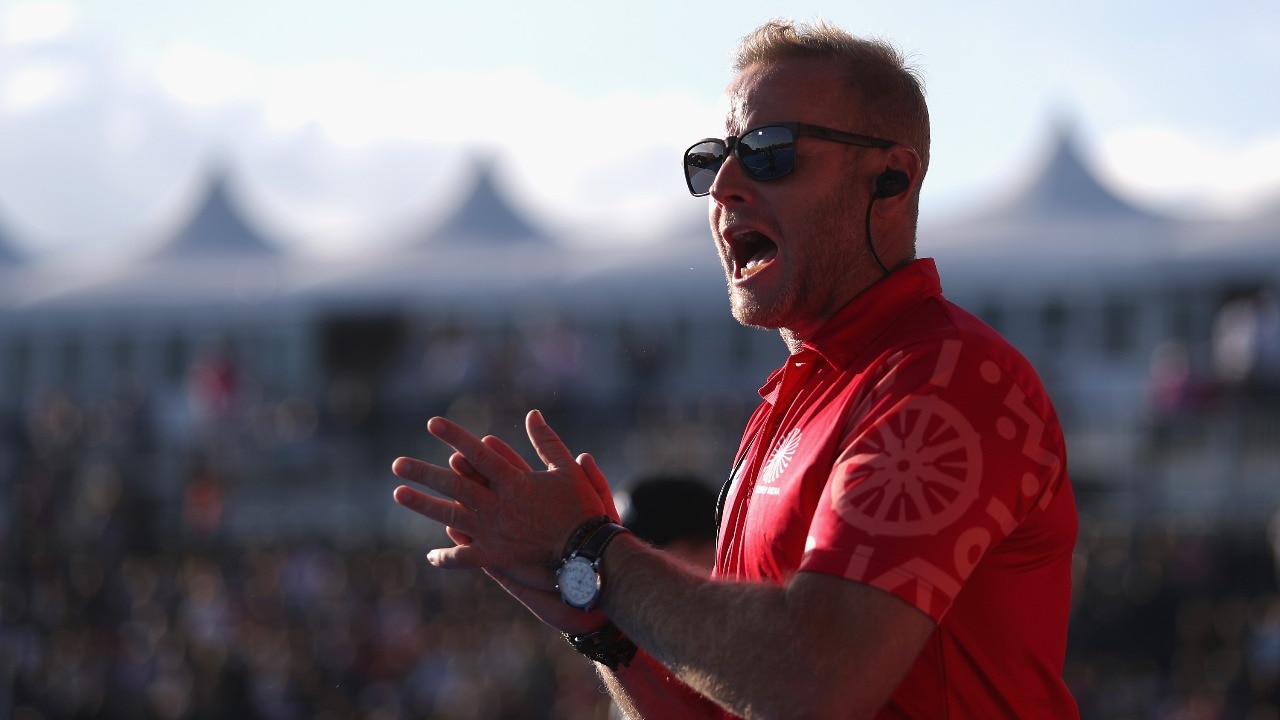
Has Indian women’s hockey team coach Sjoerd Marijne watched the Chak De! India movie? It may sound like an unusual question at a press conference, but for Indian women’s hockey, the film and reality have often mirrored each other.
After all, the Dutchman was behind one of Indian women’s hockey’s greatest modern-day moments when the team stunned the world to secure a fourth-place finish at the Tokyo Olympics.
Marijne was more than happy to hear the question and revealed that watching the movie was among the first things he did after taking charge of the Indian team for the first time in 2017.
“Of course I am aware of the Chak De India movie. That’s the first thing I did in 2017, to watch that movie. Then we created our own Chak De India story,” said Marijne to India Today during an interaction arranged by the Sports Authority of India.
The reason behind the question was simple. Much like the hero of the blockbuster film, Marijne once again finds himself tasked with rebuilding belief in Indian women’s hockey during his second stint.
During his first stint, apart from the memorable Tokyo Olympics campaign, Marijne also guided India to their best World Cup result in decades when the team reached the quarterfinals in 2018.
But since Marijne walked away after the Olympics, Indian women’s hockey has struggled to rediscover that same spark.
In 2022, the side finished ninth at the World Cup and also failed to qualify for the Paris Olympics. Since then, both Janneke Schopman and Harendra Singh have tried their hand at the job before moving on.
Now, Marijne returns to a side without former captain Rani Rampal, struggling with penalty corner conversion and battling injuries at key moments.
CAN INDIA DREAM AGAIN?
The signs, however, suggest there could still be another Chak De moment waiting around the corner.
After securing qualification for the World Cup, the Indian women travelled to face world No. 2 Argentina in a four-match series. Against one of the strongest teams in the world, India managed to pull off impressive results, including a win and a draw.
Now comes the defining stretch of the season. Before the FIH Nations Cup in June, India will head to Australia for an exposure tour.
Then come the two tournaments that could shape the future of this team — the World Cup in August and the Asian Games in September, with the latter offering a pathway to the LA Olympics in 2028.
And Marijne believes the changes are already visible, not just in the team, but in the entire ecosystem around it.
“If you see the improvement from when I left till now, you see more younger girls involved in the program and making the step to the seniors. I think we now have five girls or even more, who made that step. That’s a big improvement.”
“Another improvement is a bigger staff. In the past, I had five or six people; now we are almost 10, 11, 12 with specialist coaches. I think that really helps us reach the potential of the players.”
“We are really focused on making every individual better. I can’t do that by myself, so we have a good team around the players,” said Marijne.
But can this Indian side truly script another Chak De moment? Marijne remained realistic in his assessment, even if the belief inside him was clear.
“What can we reach? It’s always difficult to say because teams like Netherlands, Argentina, Belgium, the whole top seven in the world, they are also developing. Everybody is developing their game.”
“If you saw in 2020, not many women’s teams played high balls. Now everybody plays the high ball. Everybody is developing.”
“It will be close matches. We have China in the pool, England, teams that are really good. But do I think we have the potential to come far? Yes, I am really positive about that.”
“The girls are working really hard. They understand more and more what we want. I really believe we can achieve it,” said Marijne.
THE SAME DEMANDING MARIJNE
If the words of captain Salima Tete are anything to go by, not much has changed about Marijne in his second stint.
The Indian skipper said the Dutchman remains the same demanding coach who expects the team to operate at the highest standards every single day. And for the players, that mentality has slowly become the culture of the squad itself.
“First of all, there is not much difference in the coach from before. One thing about him is that he is demanding. The coach expects us to perform at our level and that is something we have to deliver on. Whatever his demands are, we need to fulfil them. At the level we are playing hockey now, these are the things we should be doing.”
“If I play my natural game freely, the coach also feels that this player is working hard. So whatever standards he demands from us, we have to meet them. And on the ground, we have to work hard — there is simply no other option,” said Salima.
For Marijne, though, the second stint is not about recreating the past. It is about building consistency.
That process has already seen legendary dragflicker Taeke Taekema come in to work with the team, especially on penalty corners, while sports science and specialist coaching have become a major focus behind the scenes.
“I want to improve everything because everything can be improved. Of course, we want to improve the PC attacking, but it’s in general what I said. For me, it’s more about behaviour, showing the same behaviour every time.”
“Our habits have to get normal, what we want to see, because I think a good structure leads at the end to winning matches, and not the other way around.”
Marijne believes every tournament and every tour is another small step towards building that identity.
“You want to make that topic perfect. And that’s also what we want to do in Australia. Using the matches from Australia to be really good at the Nations Cup.”
“A Nations Cup is something you play for the Pro League. So if you play for something, there’s always also stress and tension. And I think that is something good to create,” said Marijne.
The road ahead remains difficult. The world’s best teams continue to evolve and India still have plenty of areas to improve.
But for the first time in a while, Indian women’s hockey once again feels like a team building towards something special.
A familiar coach is back. A younger squad is slowly finding belief. And somewhere in the distance, another Chak De moment may just be waiting.
– Ends



