


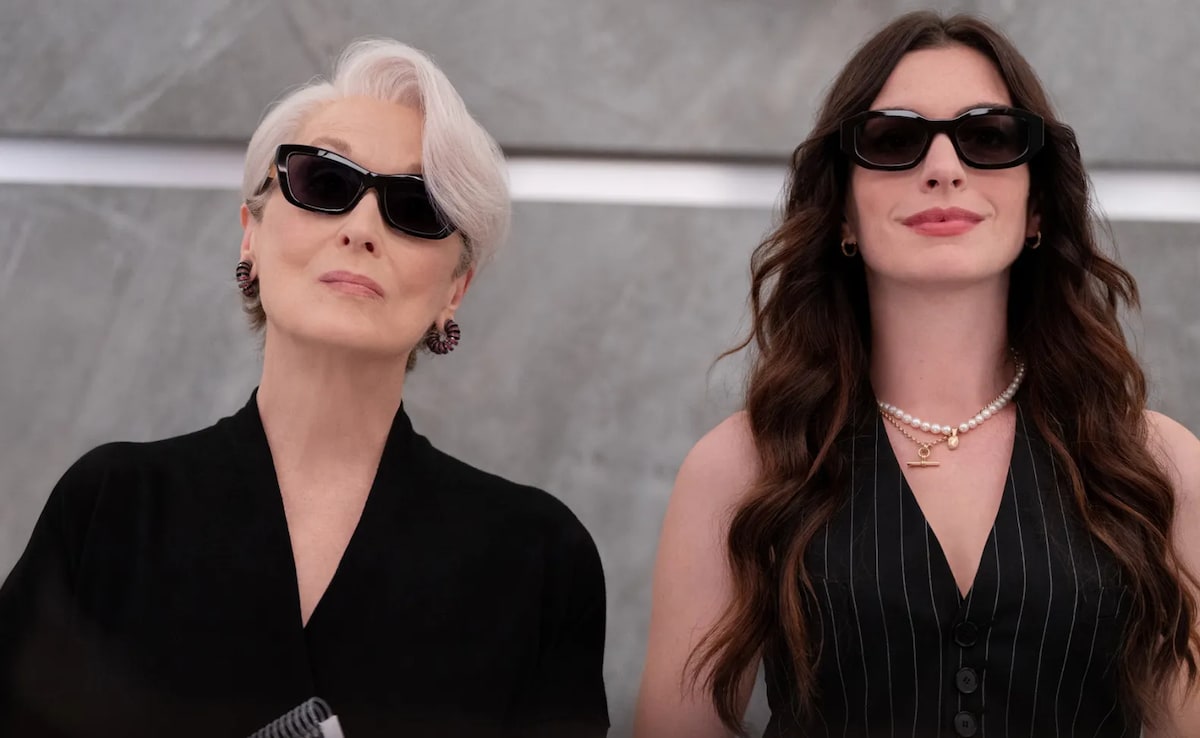
There was a time when the clack of heels across a polished office floor meant power, when a single raised eyebrow could rewrite careers, and when fashion magazines didn’t just reflect culture, they dictated it.
That world, like many others, hasn’t disappeared so much as it has thinned out, stretched across glowing screens and shrinking attention spans.
And into that altered landscape walks The Devil Wears Prada 2, a sequel that knows exactly what it’s up against: not just nostalgia, but obsolescence.
Reuniting Meryl Streep, Anne Hathaway, Emily Blunt, and Stanley Tucci, the film doesn’t attempt to reinvent its sharply tailored identity so much as adjust its seams.
Miranda Priestly remains as commanding as ever, though the nature of her authority feels subtly, intriguingly altered.
Streep slips back into the role with unnerving ease, proving once again that restraint can be more cutting than any outburst.
Her Miranda still speaks in clipped silences and surgical put-downs, but there’s a faint awareness now-not quite vulnerability, but the recognition of a world that no longer bends quite as easily to her will.
Anne Hathaway’s Andy, no longer the wide-eyed outsider, returns with a steadier sense of self, and that shift is both the film’s strength and its quiet limitation. She is more assured, more accomplished, but also less dramatically compelling.
The friction that once powered the story has softened; the stakes feel broader, more systemic, but less personal. It’s a trade-off the film leans into, exploring the precariousness of modern journalism and the uneasy marriage between legacy media and digital disruption.
These themes give the narrative a contemporary pulse, even if they occasionally sit more as backdrop than driving force.
What remains intact, and often delightful, is the ensemble’s chemistry. Emily Blunt’s Emily is still razor-sharp, her wit landing with impeccable timing, while Tucci’s Nigel continues to ground the film with warmth and weary elegance.
Their presence acts as a bridge between what the story was and what it’s trying to become. Around them, the film indulges in its familiar pleasures-couture, cutting dialogue, and a glossy world that invites admiration even as it gestures toward critique.
Yet, for all its polish, the film can’t quite escape a sense of deja vu. It echoes the rhythms of its predecessor so closely that it sometimes feels less like a continuation and more like a carefully staged reprise.
The narrative moves briskly, but without the same emotional urgency; the conflicts, while relevant, rarely bite as sharply as they should.
Even the newer elements-tech billionaires, shifting media economics, the language of “engagement” and “metrics”, feel more observed than deeply interrogated.
Visually, it remains an easy pleasure. The clothes are exquisite, the settings aspirational, and the overall sheen undeniably appealing.
But there’s also a curious flattening, a sense that the film’s world, much like the industry it depicts, has lost a touch of its former vibrancy.
It’s still beautiful, still alluring, but slightly muted, as though aware that its own mythology no longer holds quite the same power.
What ultimately carries the film is its quiet understanding of change. It doesn’t rage against the dying of the light, nor does it fully embrace the new order.
Instead, it lingers in that uneasy in-between space, where relevance must be negotiated, and legacy reconsidered. That makes for a film that is thoughtful and occasionally poignant, even if it stops short of being truly affecting.
The Devil Wears Prada 2 is neither a triumphant comeback nor a misstep.
It’s something more measured: a stylish, self-aware sequel that offers moments of sharp pleasure without ever fully recapturing the bite that made the original linger.
It may not redefine the runway, but it walks it with enough confidence, and just enough attitude, to remind you why you cared in the first place.



