


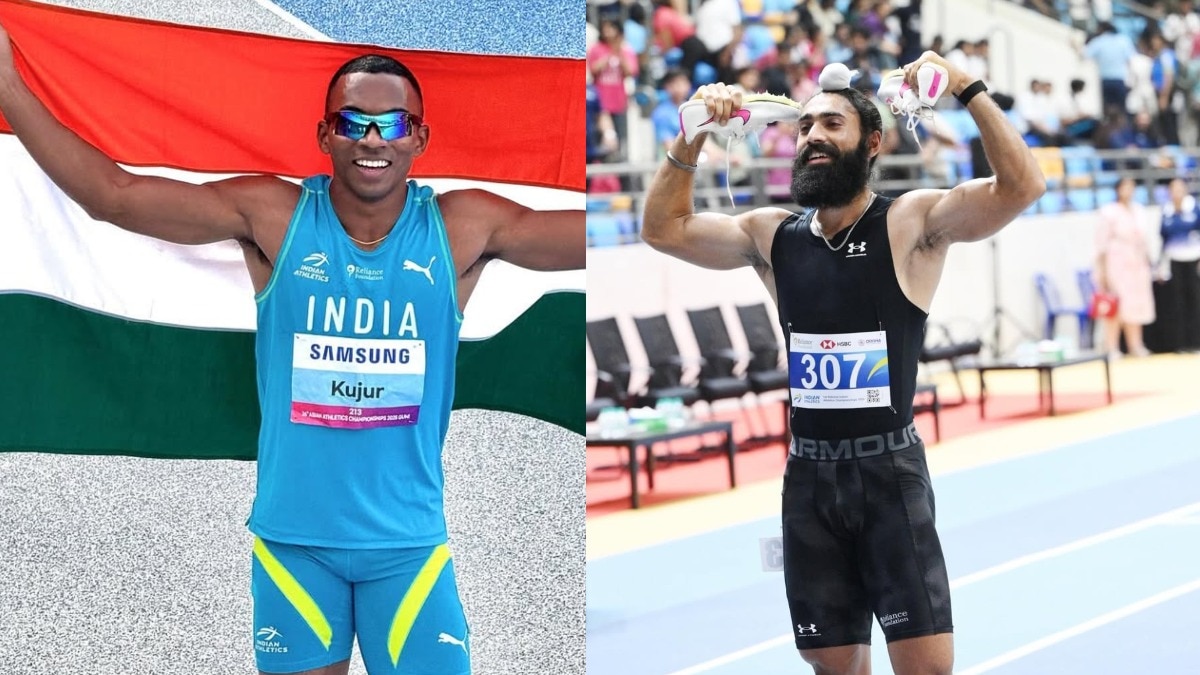
Punjab’s Gurindervir Singh rose to national prominence in May 2026, when he ran the fastest 100m sprint ever recorded by an Indian man. Racing alongside Animesh Kujur, Gurindervir posted a time of 10.09, bettering Animesh’s previously held national record by a considerable margin.
What was perhaps more fascinating was the fact that the national record was traded three times in the space of 24 hours. First, Guri broke Animesh’s 10.18, set last year, by 0.01 seconds in the heats. Animesh rose up to the occasion soon enough and bettered both Guri and his own timing by registering 10.15.
In the final showdown between the two, Guri raced ahead and posted a staggering time of 10.09, becoming the first-ever Indian to dip under 10.10, something that seemed like a distant dream even a few years ago.
But that is not the story that we are telling today. Today’s story is about how Guri, once nearly defeated by illness, found himself back to be the best again.
After winning the 2026 Fed Cup, Gurindervir chucked his spikes hard at the ground, only to pick them up and kiss them moments later. The raw emotions came from a man who had nearly lost his career in 2022.
THE UNMAKING OF INDIA’S FASTEST MAN
Training in National Institute of Sports Patiala, Gurindervir fell sick, which left his stomach lining thinned. Unable to absorb nutrients properly, Gurindervir lost that year to sickness and spent a large part of 2023 recovering from it.
His previous best of 10.27 had come back in 2021, when he was still only 21 years old. But after the illness, Gurindervir struggled to get anywhere close to that level again. Even after making an explosive comeback in 2024, winning both the Federation Cup and the Inter-State Championships, he was still not running as fast as he once had.
The struggle was not just physical. Training at an elite level without seeing the same response from your body can weigh heavily on an athlete. When Gurindervir joined the Reliance Foundation, after the Fed Cup 2024, the intensity of the programme initially left him overwhelmed.
Speaking to ESPN last year, Gurindervir admitted that he went into the National Games with negative thoughts in his head, unsure if he was adapting properly to the level of training around him.
After a hard couple of years, Gurindervir got back to his potential again. He became India’s fastest man in March 2025, posting a timing of 10.20 in the Indian Grand Prix in Bengaluru. That rush of becoming India’s fastest man alive, Guri perhaps did not handle very well.
“I think his mind wasn’t conditioned for what happened after that national record, it just went a bit crazy, and he just wasn’t ready for it. But he’s learnt a lot from that,” Guri’s coach James Hillier told IndiaToday.in in an interview.
Three months later after posting India’s fastest time, Gurindervir lost that tag to rookie Animesh Kujur, who burst onto the scene like few others in Indian sprinting.
“Guri unfortunately wasn’t able to back it up. He had a really hard year,” Hillier said.
Although really good friends on and off the track, neither Guri nor Animesh want to stand in each other’s shadows.
When Animesh was making waves around the country, running in the U23 Diamond League and at the World Athletics Championships alongside some of the best sprinters in the world, Guri quietly got back to work.
GURI’S BODY TRANSFORMATION
“He’s probably worked harder. He’s definitely worked smarter,” Hillier says.
One of the Reliance insiders told India Today that at one point in time, Guri had a body fat percentage of 14, unsurprising for a naturally heavy-built athlete. But he shaved that off and got himself down to seven per cent, transforming his body to beat Kujur.
James Hillier admitted the same, without going into the specifics obviously.
“His body shape has completely changed from last year and particularly the year before he joined me, where he was very big, very strong, but it was a lot of heavy muscle. And now if you look at him, he’s so lean, it’s really good quality muscle, he’s extremely strong in the gym, and his reactive qualities are coming out.”
Hillier says that the most astonishing part of Guri’s body are his tendons, which are stronger than most athletes. When Guri moves, it is akin to a mean bull running at you. Big and strong, he wants to smash everything on his way, unlike Animesh, who like his idol, Usain Bolt, is more fluid in nature, with a devastating top-end speed.
That top-end speed did not matter when Gurindervir, on a balmy evening in Ranchi, simply refused to leak energy at any point in that 100m race.
“He’s been a lot more disciplined with his recovery, his sleep, all that sort of stuff, so all those things have become better. He’s become a far more professional athlete,” Hillier says.
THE RISE OF ANIMESH KUJUR
And a little bit of credit for that also goes to Animesh Kujur.
Kujur trains under Britain’s Martin Owens, a trainer brought in by Hillier himself four years back. Animesh, when he first met Martin, was not a sprinter at all. He was tall and naturally fast, but did not grow up as a track athlete. He wanted to be a footballer instead.
When Animesh got into athletics full time, he met Owens in a U23 competition, who spotted something in him straightaway.
This was around 2022, when Gurindervir was struggling with his health issues. When Guri was sidelined due to illness, Animesh kept getting better and better as an athlete, eventually breaking the national record in June 2025.
Guri woke up to a rude reality the next day. His best simply was not good enough anymore.
“By having two runners that are running and keep breaking the record helps overall sprinting in India because it shows that it can be done. When James first came in, people said Indians can’t sprint, well we’re proving that wrong,” Animesh’s coach Martin Owens told the masthead, speaking in the same interview beside Hillier.
Martin said that Animesh will now go away, delve deep inside himself and find ways to beat Gurindervir. His national record did not even last a year, which will make him think about his position in the Indian sprinting scene once again.
“Nothing hurts more than getting beaten by your training partner,” says Owens.
Hillier chimes in.
“My training partner was one of my best friends and still is, but I still wanted to beat him on the track. That’s just how it is. You can have healthy competition and mutual respect within the ranks. You don’t have to hate your competitors.”
GURINDERVIR’S TURNING POINT
Over the last 12 months, Gurindervir has been setting processes inside his training campaign. He has come to all his training sessions with a clear picture in his mind, a clear expectation of what he wants to achieve on the day.
Hillier said that the turning point for the sprinter was when he saw that his processes were working, after winning the 60m sprint at the first Indoor Nationals held in Odisha earlier this year.
A blistering timing of 6.60 seconds gave Gurindervir the belief that he was on the right path.
“He was just building a foundation really sensibly and trusting himself, and then the indoor national championships became a coming-of-age moment for him,” Hillier said.
This time, Gurindervir applied his hard-earned lesson. Do not get swayed by a national record.
“He got a lot of confidence from that and also showed the maturity to manage that emotionally, not get complacent or distracted from it. That’s been really important, and obviously he’s managed to stay healthy,” Hillier added.
THE RIVALRY PUSHING INDIAN SPRINTING FORWARD
Before the start of the season, the Athletics Federation of India had set a steep selection criteria for the Commonwealth Games in the men’s 100m sprint.
To achieve the cut-off of 10.16 seconds, then India’s fastest man Animesh Kujur had to break his own record.
Not only did Animesh break it, Gurindervir did too, not once, but twice in the space of 24 hours. And if Gurindervir would not have done that, Animesh would not have achieved that either, believe both coaches in the Reliance camp.
As India build for the Commonwealth Games and the Asian Games later this year, these two men are going to remain in focus. Both are young, and are expected to get better with time in the coming years.
In the near future, Guri’s success will be determined by Animesh’s speeds, while Animesh’s timings will depend on how much Guri pushes him in return. Indian sprinting finally has two men forcing each other forward.
In many ways, it is not Gurindervir Singh vs Animesh Kujur. It is Gurindervir and Animesh Kujur.
– Ends



