


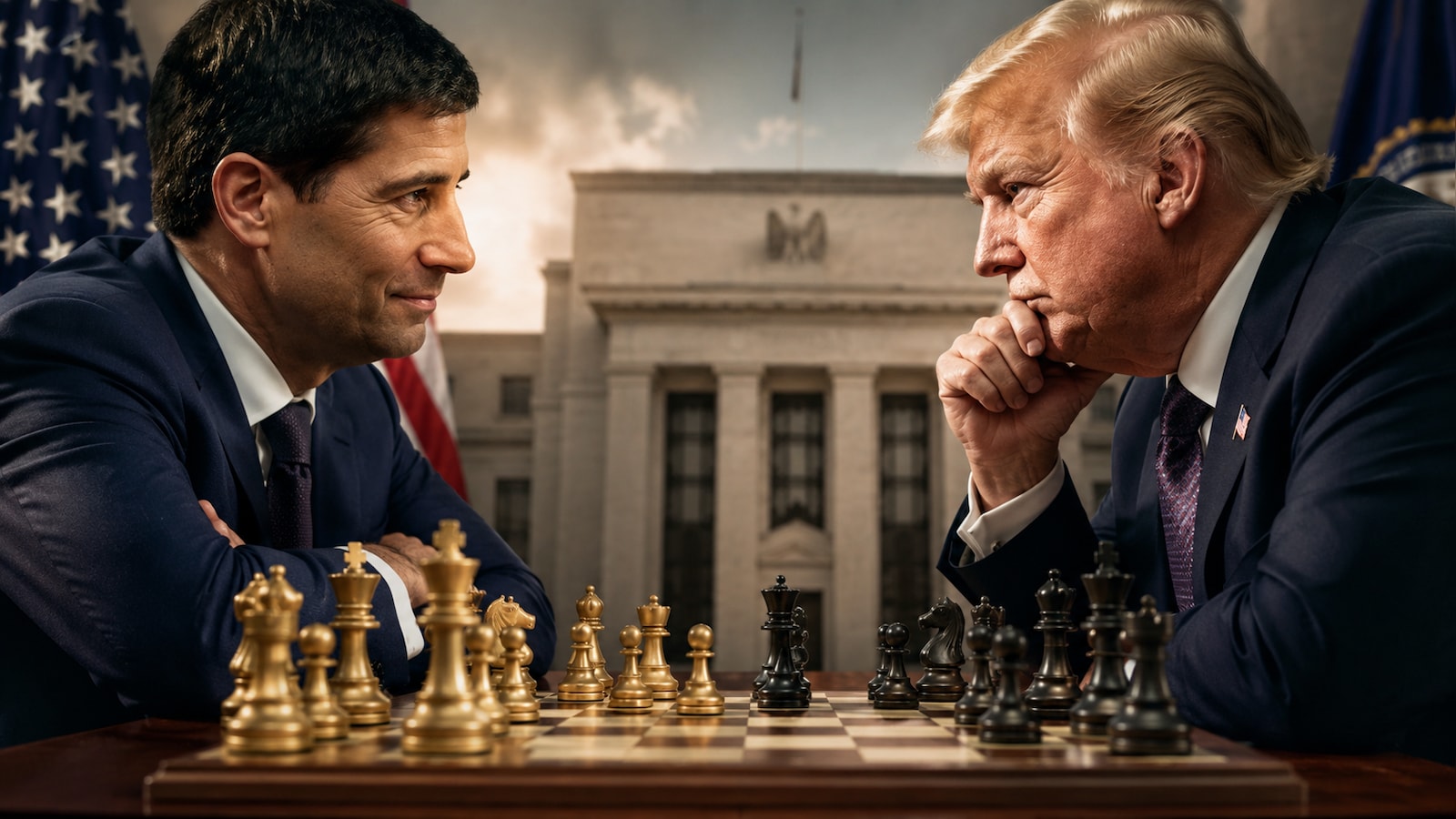
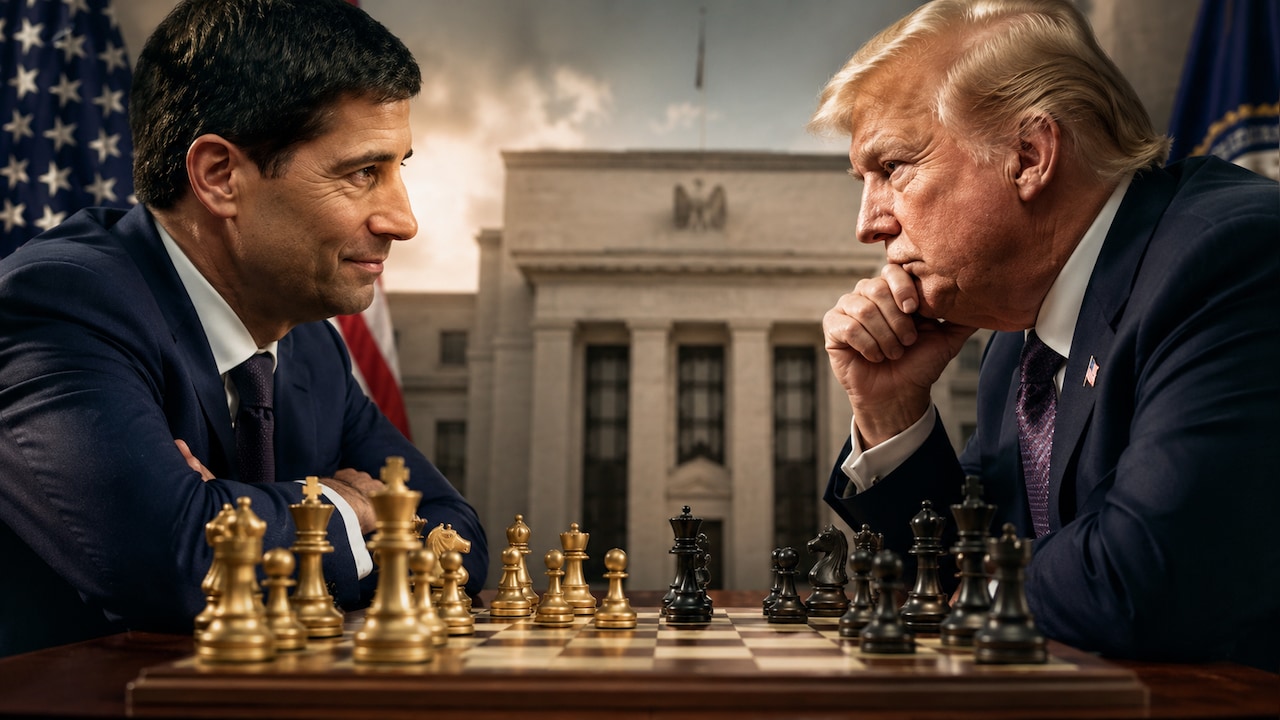
Kevin Warsh has not delivered the interest-rate cuts Donald Trump once demanded from the Federal Reserve. Yet Trump’s continued backing of the Fed chair points to a potentially bigger objective: changing how the central bank operates and how it interacts with the US government.
Donald Trump spent years attacking Jerome Powell for not cutting interest rates. With Kevin Warsh now leading the Federal Reserve, Trump has the Fed chair he wanted – but not the monetary policy he had demanded.
The economic backdrop has changed.
Markets had started pricing in at least one interest-rate cut this year after Trump nominated Warsh in January and inflation appeared contained. A month later, the US went to war with Iran. Oil prices rose and the inflation outlook deteriorated.
Markets are now pricing in the possibility of an interest-rate increase as early as September rather than a cut.
Yet Trump has continued to back Warsh, calling him “brilliant”. That contrasts with his repeated public criticism of Powell and raises a broader question about what Trump expects from his choice to lead the world’s most influential central bank.
Semafor’s Liz Hoffman framed the distinction between personnel and policy this way: “Trump cares less about any specific outcome than about declaring victory.”
“And in getting Warsh in and Powell out, Trump got his guy,” Hoffman said. “He lost on policy but won on personnel.”
That distinction could be central to understanding the Trump-Warsh relationship. Interest rates are one part of it. Warsh’s plans for the Fed, and the possibility of greater alignment between monetary policy and broader US economic objectives, could prove more consequential over time.
Markets Question Warsh
Bond markets initially appeared to trust Warsh’s approach to interest rates. His first post-meeting press conference tested that confidence.
The New Yorker described his responses at the press conference last week as “a series of evasive answers”. Long-term US Treasury bonds sold off following the meeting.
Dario Perkins, an economist at research firm TS Lombard, compared the episode with Trump’s “Liberation Day” tariff announcement last year and former UK Prime Minister Liz Truss’ 2022 budget.
Those were moments, Perkins said, “where you suddenly realise global policymakers are totally out of their depth and don’t know what they are doing.”
The market reaction matters because a central bank’s influence depends partly on confidence in its communication and policy framework. Warsh is simultaneously seeking to change some of the practices through which the Fed communicates with markets.
Trump-Warsh Equation
Trump’s response to Warsh is also notable.
Despite the absence of rate cuts, the president has continued to support him publicly. One explanation lies in the changed inflation environment. Higher oil prices following the prolonged war have made the case for lower rates harder to sustain.
Another lies in the longer-term relationship between the White House and the Fed.
Michael Every, global strategist at Rabobank, argues that markets are focusing too heavily on whether Warsh is a monetary-policy hawk or dove.
In Every’s interpretation, the larger questions involve loyalty, alignment with the US Treasury and Warsh’s potential place in a redesigned relationship between the state and private capital.
That changes the incentives for both Trump and Warsh.
Repeated public intervention of the kind Trump directed at Powell could weaken the relationship with a Fed chair whose broader agenda may align more closely with the administration. Trump’s support, meanwhile, gives Warsh political room to pursue changes at the central bank.
And Warsh has already outlined several of them.
ALSO READ: US Oil Output Is Near A Record Even As Rig Count Tumbles | The Reason Why
Warsh’s Fed Overhaul
One proposal concerns how frequently the Federal Open Market Committee meets.
The FOMC currently holds eight scheduled meetings a year. Warsh has proposed using six meetings for interest-rate decisions and two for broader discussions about the economy.
He also wants to move away from forward guidance – the Fed’s practice of signalling the likely direction of future monetary policy.
Warsh argues that once policymakers communicate an expected path for rates, they can become reluctant to change course when economic conditions change.
Under his preferred approach, markets would respond more to incoming economic data and less to attempts to anticipate the Fed’s next move.
Warsh has also created five task forces examining communication, balance-sheet policy, data, productivity and employment, and the Fed’s inflation framework.
Taken together, the proposals point to an attempt to change how the central bank makes decisions, communicates them and manages its balance sheet.
But the larger debate goes beyond the Fed’s internal machinery.
ALSO READ: Economists Are Arguing About China’s Surplus. Beijing Has Other Priorities | The Reason Why
Beyond Monetary Policy
Every argues that the Trump administration could envisage a broader role for the central bank – one that involves greater coordination with the government on geopolitical, economic, energy and technology objectives.
That would move the debate beyond conventional questions about inflation and interest rates and towards what Every describes as economic statecraft.
Stablecoins could provide one example of where Treasury and central-bank interests intersect.
The US government finances deficits by issuing Treasury securities, which are primarily purchased by private investors. The Fed can also purchase Treasuries, expanding its balance sheet in the process.
Warsh wants to move away from reliance on an expanding Fed balance sheet.
One idea being discussed in markets is for issuers of dollar-backed stablecoins to become another source of demand for US government debt.
Under such a framework, stablecoin issuers holding Treasuries as reserves could provide additional demand for government securities. That could allow a larger share of US borrowing to be absorbed outside the Federal Reserve’s balance sheet.
Stablecoins, under that interpretation, would serve not only as payment instruments but also as another source of demand for US government debt.
Whether that develops into a meaningful part of the financial system remains uncertain.
ALSO READ: What Holds Us Back? | The Week In Whys
Bigger Than Rates
Warsh’s appointment may therefore need to be viewed through a wider lens than Trump’s previous demands for lower interest rates.
Trump has not received the rate cuts he once wanted. The inflation environment has instead moved markets towards considering a rate increase.
What he does have is a Fed chair pursuing changes to the central bank’s decision-making, communication and balance-sheet framework – while retaining the president’s public support.
That brings a different question to the foreground: whether Warsh’s tenure changes only the way the Fed operates internally or ultimately alters its relationship with the Treasury and the US government’s broader economic strategy.
Such a shift would also intensify scrutiny of the Federal Reserve’s independence.
For now, many of the wider ideas remain proposals or interpretations rather than an established new framework. Their significance will depend on what Warsh implements and whether closer coordination between the Fed, Treasury and private capital actually emerges.
The immediate argument over interest rates could therefore turn out to be only one part of the Warsh story. The larger test is what kind of Federal Reserve emerges under him – and how far its role extends beyond monetary policy.
ALSO READ: Let’s Keep One-Handed Economists Away | The Reason Why
Disclaimer: The views expressed in this article are solely those of the author and do not necessarily reflect the opinion of NDTV Profit or its affiliates. Readers are advised to conduct their own research or consult a qualified professional before making any investment or business decisions. NDTV Profit does not guarantee the accuracy, completeness, or reliability of the information presented in this article.
Essential Business Intelligence,
Sharp Market Insights,
Practical Personal Finance Advice, Daily Fuel, Gold and Silver Prices and Latest Stories — On NDTV Profit.



