


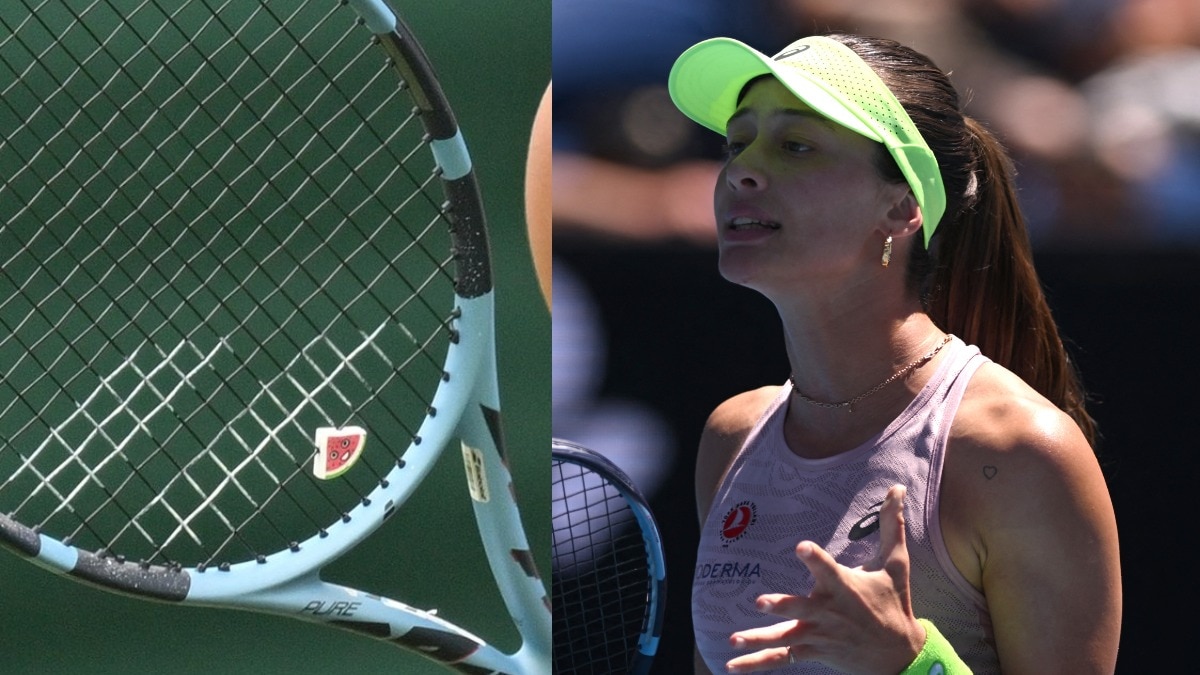
Turkish tennis player Zeynep Sonmez made a symbolic statement at Wimbledon 2026 after tournament organisers reportedly refused to allow her to wear a brooch in support of Palestine. Instead, the world No. 65 carried a watermelon-shaped vibration dampener on her racket, a subtle emblem that has come to represent Palestinian solidarity because it features the same colours as the Palestinian flag.
The 24-year-old disclosed the issue after her second-round defeat to American Claire Liu, explaining that she had spoken with Wimbledon officials but was told the brooch could not be worn during the Championships. While the pin was not permitted, Sonmez said there were no objections to the watermelon symbol on her racket, allowing her to express her support in a different way.
Sonmez said she had previously worn the brooch at WTA tournaments before being asked not to do so. She further claimed that symbols expressing support for Ukraine had been allowed while the Palestine emblem was prohibited, although Wimbledon has not publicly commented on that assertion.
“I used to wear a pin. Tournaments no longer allow me to wear it. We had a discussion with the organisers because the Ukrainian flag is allowed but the Palestinian is not,” Sonmez told Turkey news agency Anadolu after the match.
“They ultimately told us they definitely would not allow it. So, I can’t wear the pin. I can use the vibration dampener, and they can’t object to that. That’s why I put the watermelon symbol on my racket,” she said.
THE MEANING BEHIND SONMEZ’S GESTURE
The watermelon has become a globally recognised symbol of solidarity with Palestinians, particularly in contexts where displaying the Palestinian flag has been restricted. Featuring the same red, green, white and black colours as the Palestinian flag, the fruit has increasingly been used in protests, artwork and public campaigns as an alternative symbol of support.
Sonmez has been vocal about the issue in the past. Speaking to the WTA in 2024, she said she wanted to use her platform to raise awareness of the humanitarian crisis in Gaza, adding that although athletes could not resolve conflicts, they could still help bring attention to them.
“It’s a sensitive area for me. People in Palestine are suffering. I see the videos and photos and feel that there’s not so much we can do. But we can always do our best — it’s like I was saying, you can be the best version of yourself. I want everyone to know that I’m standing with them,” Sonmez had said.
SONMEZ CRASHES OUT
On the sporting front, Sonmez’s Wimbledon run ended with a 7-5, 6-3 loss to Claire Liu in the second round. She admitted afterwards that she failed to implement her game plan and made too many unforced errors at crucial moments, but stressed that her team would continue refining her game rather than making sweeping changes before the North American hard-court season.
Despite the defeat, 2026 has been a landmark year for the Turkish star. She reached the third round of the Australian Open as a qualifier, climbed to a career-high ranking of No. 65 and continued to establish herself as the highest-ranked Turkish woman on the WTA Tour.
– Ends



