


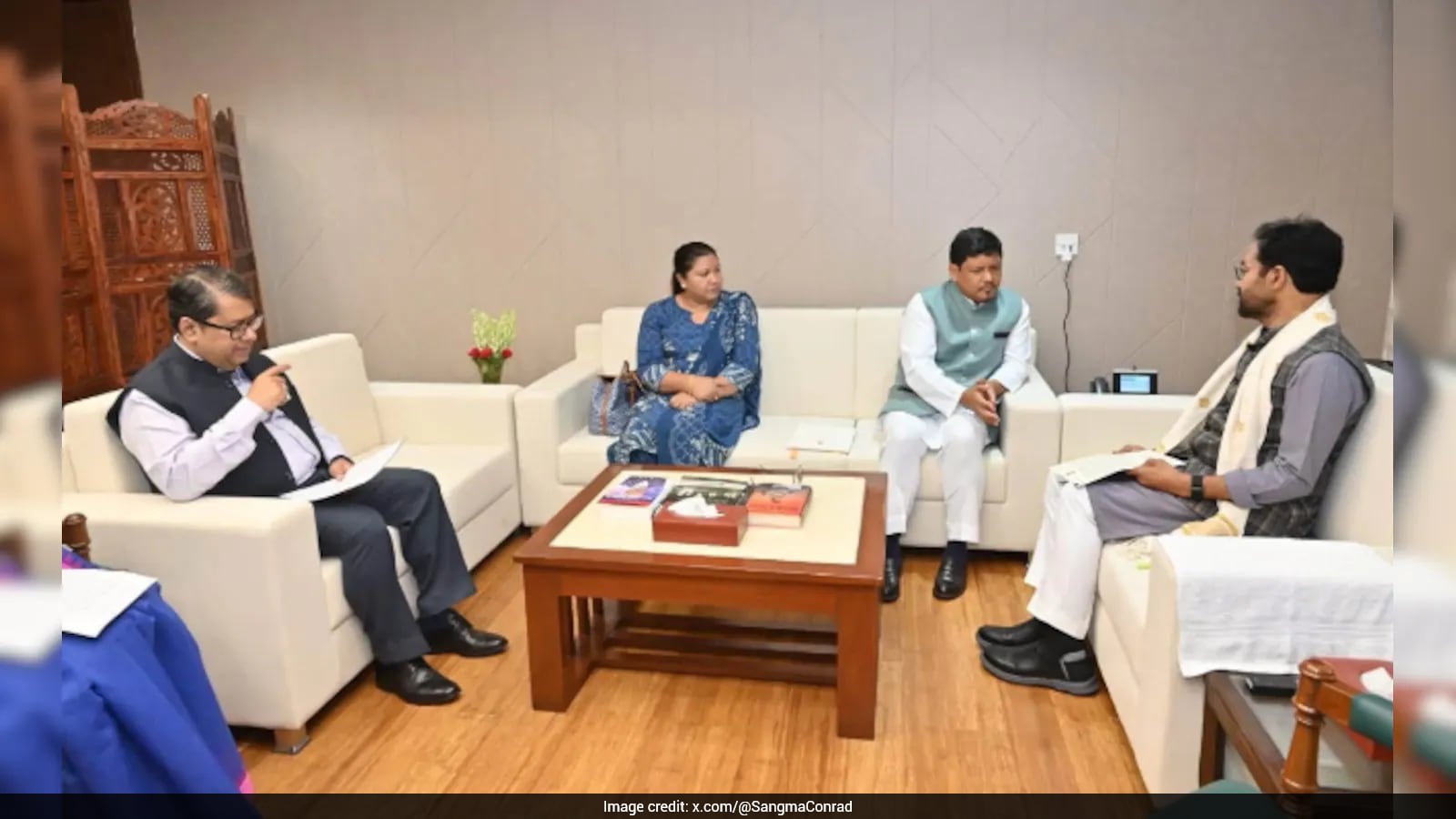
Meghalaya Chief Minister Conrad K Sangma urged the Centre to delegate certain statutory powers to the state government to facilitate legal coal mining by thousands of tribal landowners.
During a meeting with Union Coal and Mines Minister G Kishan Reddy in New Delhi on Tuesday, Sangma, accompanied by Santa Mary Shylla, MLA from Sutnga Saipung in East Jaintia Hills, sought delegation of powers under Section 26 of the Mines and Minerals (Development and Regulation) Act, 1957, to allow the state to grant previous approval and approve mining plans for coal.
According to a statement issued by the Chief Minister’s Office, the move would enable small tribal coal holders to obtain lawful mineral concessions and the required approvals within Meghalaya instead of having to seek clearances from central agencies.
Sangma said the state’s unique land tenure system under the Sixth Schedule makes the existing approval mechanism difficult to implement.
Today in New Delhi, I met the Hon’ble Union Minister of Coal and Mines, Shri @kishanreddybjp ji, on an issue that is close to my heart and to the lives of thousands of families across our coal-bearing regions.
Meghalaya is a Sixth Schedule State, where the land and the… pic.twitter.com/tHj5iDPzHT
— Conrad K Sangma (@SangmaConrad) July 7, 2026
“The step would allow thousands of small tribal coal-holders to obtain lawful mineral concessions and the necessary approvals within the state itself,” the chief minister said in a statement.
Explaining Meghalaya’s position, Sangma noted that land and minerals in the state are owned by individuals, clans and communities rather than by the government.
“The national model does not fit Meghalaya’s ground reality. Coal deposits here are thin and scattered and are held in small family and clan parcels rather than large mining blocks,” he said.
He pointed out that the minimum concession area of 100 hectares prescribed under the 2021 Standard Operating Procedure has effectively prevented many genuine tribal coal holders from securing mining leases.
“It is neither practical nor affordable for a small holder to travel repeatedly to Delhi and the Indian Bureau of Mines office in Kolkata to obtain approvals for a modest deposit,” he said.
Concerns Over Livelihood And Revenue Loss
Sangma said that since the National Green Tribunal (NGT) restrained rat-hole coal mining in April 2014 over environmental and safety concerns, thousands of families dependent on small-scale coal mining have lost their primary source of livelihood.
He also said the state has suffered significant losses in royalty, cess and tax revenues as a result of the restrictions.
The ban followed concerns over widespread unscientific mining practices, environmental degradation and fatal accidents in coal mines across Meghalaya. While allowing scientific mining subject to statutory clearances, the tribunal prohibited unscientific extraction and transportation of freshly mined coal.
Supreme Court Ruling
Referring to Meghalaya’s distinct constitutional status, Sangma said the state’s land ownership system is protected under the Sixth Schedule, under which land and minerals belong to individuals, clans or communities.
He noted that the Supreme Court, in its 2019 ruling, affirmed the rights of tribal landowners over coal and other minerals in Meghalaya while directing that mining activities must comply with the provisions of the Mines and Minerals (Development and Regulation) Act and environmental laws.
The chief minister said the court recognised that tribal communities own both the land and the minerals beneath it, even as it mandated compliance with statutory and environmental regulations for mining operations.
He reiterated that Meghalaya’s coal deposits are spread across small family- and clan-owned parcels, making the existing national framework unsuitable for the state’s circumstances.
(With inputs from PTI)



