


For weeks, this game had existed as much in the noise around it as it did on the football calendar. There was anticipation, criticism, ticket-price debates, questions over the turnout and endless discussion about whether Kolkata would actually show up for Brazil.
On Saturday night, the answer was complicated.
The official attendance was 51,402 at Salt Lake Stadium. It was a sizeable crowd, and the stadium certainly became louder as kick-off approached, but empty pockets remained visible around the ground. There was also no clear public breakdown of how many spectators had bought tickets and how many had entered through other arrangements, making the raw attendance figure an imperfect measure of the commercial pull of the night.
India vs Brazil live updates: Highlights
Still, once the teams walked out, all of that temporarily disappeared.
The rain that had threatened to interfere with the build-up had eased. Vinicius Junior had greeted the crowd during Brazil’s warm-up. Anwar Ali and Ryan Williams had received some of the loudest cheers from the home support. The stadium had slowly filled and, for a few minutes, Kolkata looked exactly like the football city everyone had spent weeks talking about.
Then came the football.
And for roughly 25 minutes, India made it surprisingly easy to believe this could become something more than a ceremonial Brazil appearance.
INDIA START WITH COURAGE
Brazil naturally tried to establish control, but India did not look overawed.
The defensive line stayed high and compact, and the offside trap repeatedly disrupted Brazil’s attempts to release Vinicius Junior behind the defence. Brazil were eventually caught offside 10 times, while India were flagged just once.
Vinicius, who had arrived in Kolkata as one of the biggest attractions of the evening, found himself repeatedly running into the same problem. He would start his movement, accelerate into space and then watch the flag go up.
It was not simply a case of the Brazilian forward failing to find his final touch. India’s defensive line was taking the risk deliberately, and for a while it was working.
Bijoy Varghese and Anwar Ali were particularly composed in organising the backline, while Gurpreet Singh Sandhu provided the experienced presence behind them.
There was personality at the other end, too.
Sahal Abdul Samad was one of India’s most entertaining players during the opening spell, using his close control and quick feet to escape pressure and give India a route out whenever they managed to find him between the lines.
India were not merely sitting inside their own box.
They were competing.
And that was perhaps the most encouraging part of those opening exchanges.
BRAZIL FIND ANOTHER ROUTE
The problem for India was that keeping that intensity against Brazil was always going to be physically demanding.
Manvir Singh and Tekcham Abhishek began to look increasingly stretched. Ryan Williams, who had initially offered India an attacking outlet, was dropping deeper and deeper until he was almost operating as an auxiliary midfielder.
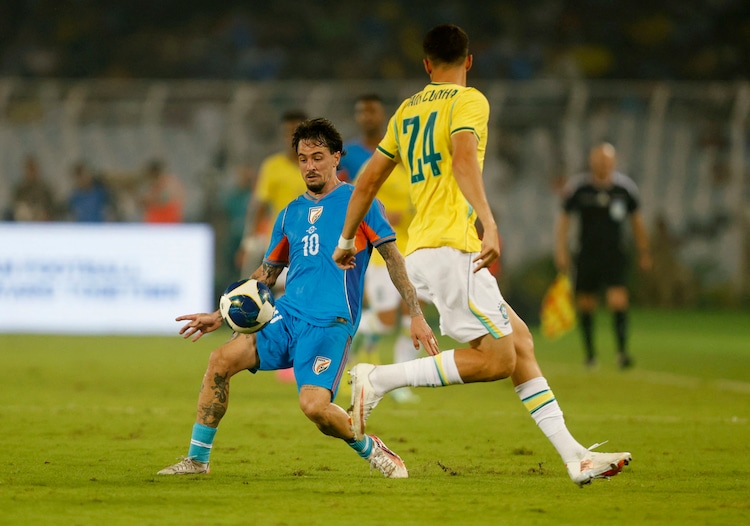
Brazil noticed that their attacks were becoming too concentrated around Vinicius on the left.
So they changed the point of attack.
Estvo suddenly became the outlet on the other side, and the shift brought immediate reward.
Ashique Kuruniyan could not close him down quickly enough. Estvo took aim and struck low and hard, sending the ball beyond Gurpreet in the 28th minute.
It was a moment that changed the temperature of the game.
India had defended bravely until then. Suddenly, they had to chase.
And against Brazil, chasing can be expensive.
INDIA’S FIRST-HALF PROMISE FADES
The goal altered India’s approach.
The forward runs became less frequent. The defensive line began retreating, and Brazil were able to spend longer periods in possession. The statistics eventually reflected that control, with Brazil finishing the game with 65 per cent possession and 21 shots to India’s seven.
Then came the second blow.
Pedro’s effort in the 42nd minute found its way through Gurpreet, who had looked assured during the opening phase but could not keep this one out.
For India, it was a particularly frustrating way to concede because the game had not initially looked as though it was getting away from them.
And there was still time for another scare before half-time.
Gurpreet misjudged another ball, which struck his knee and ricocheted dangerously into the area. Brazil were ready to pounce, but Bijoy Varghese reacted quickly and cleared the danger.
Without that intervention, India could have gone into the break three goals down.
Instead, it was 2-0.
Gurpreet did not return for the second half, with Prabhsukhan Gill taking his place in goal.
Vinicius, meanwhile, had endured a frustrating first half of his own. The Brazilian forward had struggled to find the clean runs he wanted, with India’s offside trap repeatedly breaking up his movements.
For all the noise surrounding his arrival in Kolkata, this was becoming a night in which India were making him work for everything.
BRAZIL PUNISH ANOTHER LAPSE
The second half began with India needing a response.
Instead, they conceded again.
Tekcham Singh made a mistake after India had initially defended well, and Brazil moved the ball quickly through the opening created. A sharp combination allowed Samuel Lino to finish in the 58th minute.
Brazil 3-0 India | Samuel Lino 58′
That was the moment the game began to feel beyond India’s reach.
Yet, strangely, it was also when India produced one of their best passages of attacking football.
Ryan Williams was still running.
And running.
RYAN WILLIAMS REFUSES TO GIVE UP
Williams produced one of India’s best individual moments of the evening when he drove forward against Jair Paula da Cunha.
He got beyond the Brazilian defender and simply refused to stop.
But what stood out was what happened next.
Williams did not rush the finish. He waited, created the angle and got his shot away. He even beat goalkeeper Pedro Morisco.
Then Mauro Jnior appeared on the goal-line.
The Brazilian defender produced an excellent clearance to deny what would have been one of India’s goals of the year.
The ball then fell kindly for Manvir Singh, who had another opportunity to finish.
India could not convert either chance.
Williams was furious.
And understandably so.
It was the kind of move that reminded everyone inside Salt Lake that India were capable of hurting Brazil when they committed enough bodies and courage to the attack.
It just happened too rarely.
MANVIR FINDS ANOTHER GEAR
There was an interesting shift as the match entered its final quarter.
Manvir, who had looked exhausted earlier, suddenly appeared to find another reserve of energy.
The runs returned.
The willingness to stretch Brazil’s defence returned.
But Williams, after carrying so much of India’s attacking responsibility, was beginning to look leggy.
The timing was unfortunate.
India’s two most direct attacking outlets were finding their best moments at different times. Had Manvir and Williams been able to combine that intensity earlier, when both had the energy to attack together, India’s attacking threat might have looked very different.
Instead, one was finding another gear just as the other was beginning to run out of fuel.
That was perhaps a neat summary of India’s night.
The intent was there.
The stamina and execution were harder to sustain.
THEN THE GAME LOSES ITS RHYTHM
From around the 70-minute mark, the match began to lose some of its shape.
The substitutions came rapidly. Brazil had the comfort of a three-goal cushion, while India had little left to chase. Carlo Ancelotti also used the evening to give minutes to several players, turning the final stretch into something closer to an experimental exercise than a full-blooded contest.
The intensity dropped.
The crowd, which had spent the evening waiting for its Brazil moment, became more subdued.
There were still flashes. Brazil continued to carry the greater technical threat, while India tried to find another opening on the break.
But Williams was eventually taken off, and with him went much of India’s most consistent attacking threat.
The game seemed to be waiting for the final whistle.
It wasn’t.
LINO HAS THE FINAL WORD
In the fourth minute of stoppage time, Samuel Lino found another opening and drove through to score his second of the night.
Brazil 4-0 India | Samuel Lino 90+5′
Almost immediately, the final whistle followed.
The night that had spent weeks being discussed, criticised, defended and debated had finally become just a football match.
FULL-TIME: BRAZIL 4-0 INDIA
And that is perhaps where the real story of the evening lies.
India had entered the night knowing exactly what the opposition represented. Brazil came to Kolkata with a squad full of players capable of changing a game in a moment, while Ancelotti was using the fixture as part of the process of shaping a new generation.
For India, the opening spell offered plenty to hold on to.
The defensive line was brave. The offside trap frustrated Vinicius repeatedly. Bijoy Varghese produced several important interventions. Sahal showed the kind of technical quality that can give India an outlet against stronger opposition. And Williams demonstrated that India can create genuine attacking moments even against a team of Brazil’s level.
But the other side of the evening was impossible to ignore.
India struggled to sustain the physical intensity of the opening stages. Defensive mistakes were punished. The attacking threat became increasingly dependent on individual bursts rather than sustained pressure.
And once Brazil had established a two-goal cushion, the gap in quality became increasingly difficult to disguise.
There was also a curious contrast in the stands.
This was supposed to be the night Kolkata showed the world what football means to the city. Instead, 51,402 officially found their way into a stadium that still had conspicuous empty sections. The crowd did grow as kick-off approached, and the cheers for Vinicius, Anwar, Williams and the Brazilian players made sure the night never felt flat.
But it was not the overwhelming wall of sound many had imagined when Brazil’s arrival was announced.
Perhaps that, too, was part of the story.
Kolkata had waited for Brazil. It had argued about Brazil. It had complained about tickets, questioned the organisation and wondered whether the city would actually turn up.
Eventually, the football provided its own answer.
Brazil got their night.
India got their test.
And Salt Lake got a reminder of what the difference between admiration and the highest level of the game can look like on the pitch.
Brazil 4-0 India.
This was not Panama.
– Ends


