


When Donald Trump argues for checking whether American voters are actually citizens, he points to India and Brazil. These countries “tie voter ID to a biometric database, while the United States largely relies on self-attestation for citizenship”, according to the White House. India does not do so compulsorily; linking Aadhaar’s biometric records to voter ID is voluntary. But Trump isn’t given to detail.
The US President recently moved a step closer to his own version of what India calls the Special Intensive Revision (SIR) of voter rolls.
Advertisement – Scroll to continue
On September 25, the US Supreme Court allowed his administration to offer every state a federal database, called SAVE, to check whether the people on their voter lists are citizens. It is a major win, even as the administration struggles to pass the SAVE America Act, which would make a citizenship proof mandatory for registering to vote at all in what’s considered the world’s oldest democracy.
In India, the world’s largest democracy, the Supreme Court upheld the SIR in May, confirming the Election Commission of India’s (ECI) power to scrutinise citizenship, too. About 13 crore names have so far been removed from draft rolls, about 14 per cent of pre-SIR voters. The figure includes dead, shifted and duplicate entries, but also “logical discrepancy” cases such as misspellings.
Advertisement – Scroll to continue
No numbers have emerged on how many non-citizens were left out, leading to graver fears.
Burden Of Proof
Deletion from the voter list is not, in Indian law, a finding on citizenship straightaway. The topmost court has said so. But among those removed, fears have been fed by how the exercise has been framed. Defending the SIR in the Lok Sabha in December 2025, Home Minister Amit Shah said, “We will detect the infiltrators, delete them from the voter lists and deport them to whichever country they have come from,” building on the BJP’s years-long focus on “infiltrators”, particularly from Bangladesh.
US officials have used strikingly similar language. “Our message to aliens who vote in American elections is clear. We will find you, arrest you, and you will face the consequences, including criminal charges and deportation,” a DHS official told Time magazine.
In India, Opposition parties have called it “NRC through the backdoor”, a reference to plans for a National Register of Citizens (NRC) that critics feared would target Muslims. The BJP denies this. The EC also told the Supreme Court that the electoral roll is fundamentally different from the NRC, and that an adverse finding “does not ipso facto result in deportation”. However, the Citizenship (Amendment) Act of 2019 offers a path to citizenship for undocumented migrants of six religions from three neighbouring countries. It does not include Muslims, who form the largest minority in Hindu-majority India.
The US has no equivalent of India’s Election Commission. Each of its 50 states runs its own elections and keeps its own voter list, usually through an elected state official and local county offices. Washington cannot simply order a nationwide revision of voter rolls the way the Election Commission of India did with the SIR.
Most states also do not ask for proof of citizenship when people sign up to vote. Applicants simply declare that they are citizens, and lying can mean jail. Trump says this lets foreigners vote. In July, he claimed 278,000 non-citizens were on voter lists in four states run by the rival Democratic Party. He did not provide evidence.
Trump’s answer is SAVE, a federal database that was built to check whether immigrants qualified for government benefits. Last year, his government added Social Security records to it. A Social Security number is the closest thing American residents, including citizens and many visa-holders, have to an Aadhaar number, so the database can now look up almost anyone. States can feed in their voter lists, and the SAVE database then flags rge names it cannot confirm as citizens.
States do not have to use this system, but 27 already do, particularly those ruled by Trump’s Republican Party.
SIR’s Citizenship Angle
In India, the Election Commission says the SIR is meant to clear the rolls of dead, shifted or duplicate entries, and of ineligible voters, including non-citizens. Voters who cannot link themselves or a parent to the previous intensive revision of about two decades ago — between 2002 and 2006 depending on the state — must prove their eligibility with documents.
This eligibility test follows the logic of the Citizenship Act. People born in India before July 1, 1987, are citizens by birth and need a document only for themselves. Those born between then and December 2, 2004, need one for at least one parent too, and those born later, for both parents.
READ | Election Commission Begins Special Drive To Enrol Voters Amid Protests
“We have funnelled our citizenship. First, it was birth plus one parent had to be Indian. Now, the birth(place) plus two parents have to be Indians,” Justice Joymalya Bagchi observed during the Supreme Court hearings in January, PTI reported.
The poll body calls the exercise a constitutional duty, since Article 326 limits voting to citizens. “Even if there are 10 or thousands of foreigners on the rolls, they have to be excluded. This is not a political judgment but a constitutional obligation,” senior advocate Rakesh Dwivedi told the Supreme Court on its behalf.
Similar Idea, Different Machinery
India’s SIR is mandatory and nationwide, run by a constitutional body whose officers went door to door. SAVE is optional for states, though driven by the President, and matches names against federal databases, often without the voter even knowing.
The exercises, thus, share a premise but not the method.
Proving citizenship is also harder in India, where, unlike in the US, most people cannot simply point to a passport or birth certificate. “No document issued by governmental authorities conclusively establishes an individual’s citizenship,” Vinod Kumar, a professor of law at National Law University Delhi, wrote in Bar and Bench recently. The Supreme Court, while upholding the ECI’s power to scrutinise citizenship, drew a line. “If a citizen does not appear on the electoral roll, that does not mean the citizen was unable to prove his citizenship, but shows the inability of the Election Commission to verify citizenship,” it said. But the last word on how to prove citizenship in India has not yet been spoken.
READ | Opinion: Gyanesh Kumar Row May Be Doing Something Unthinkable For India’s ‘Lost’ Opposition
The American database makes its own mistakes. For instance, a man named Anthony Nels moved from South Africa and became a US citizen more than a decade ago. SAVE flagged him as a foreigner, and his name was struck off until he got a new passport, news agency AP reported. “This just seems like another illegitimate way to affect upcoming and future elections,” he said.
Trump had mentioned CEC Gyanesh Kumar pointedly when praising India’s voting system in August. Congress spokesperson Pawan Khera clapped back: “Dear Donald Trump, please take Gyanesh Kumar Gupta to America. And keep him there.” The BJP has said the Congress is simply unable to digest successive defeats and is now behaving as any sore loser would.
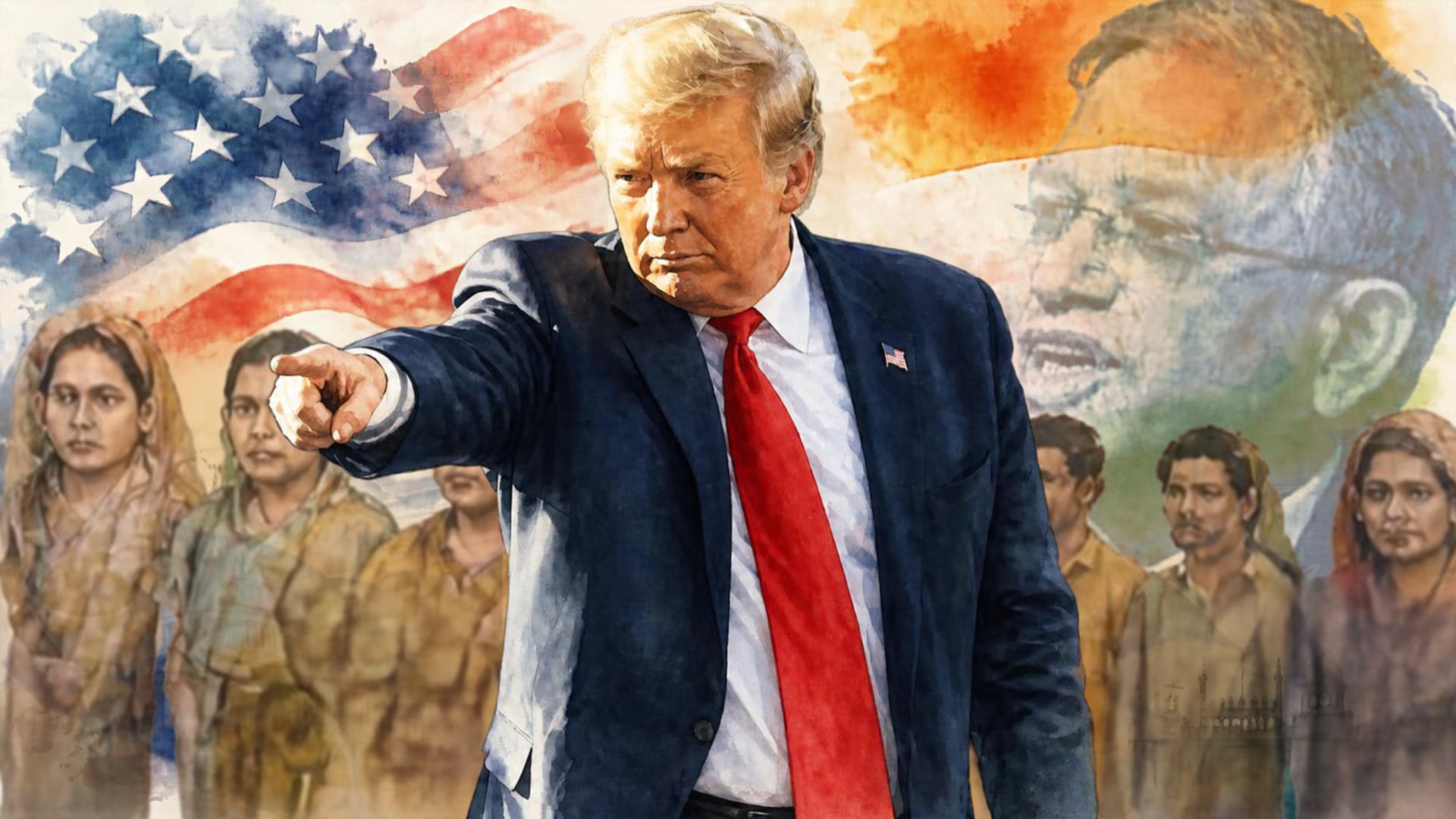
Donald Trump’s version of the SIR differs in method, but cites much the same intent as India’s.
Photos: Reuters, ANI; Image generated by Canva AI
How Many Non-Citizens, Really?
Trump’s administration has pursued 1,600 cases of alleged voter fraud since January 2025, leading to 160 arrests, among about 174 million (17.4 crore) registered voters. When Texas ran its 18 million voters through SAVE, it flagged 2,724; state officials later found hundreds were citizens. Only three non-citizens have been charged with illegal voting there. In Nevada, the Department of Homeland Security (DHS) sent state officials a list of 185 suspected non-citizen voters. All 185 were citizens.
India’s election body has not published how many foreigners the SIR found. “I don’t know how many illegal immigrants they have found, which was the main purpose of this exercise. It’s a pity they have not disclosed this figure,” former Chief Election Commissioner SY Quraishi told news agency ANI.
In India, the “non-citizen voter” claim has mostly been about Bangladeshi migrants said to have settled in West Bengal, Assam and other border states. Critics say the charge falls chiefly on Muslims. The BJP says it targets illegal immigrants, not any community.
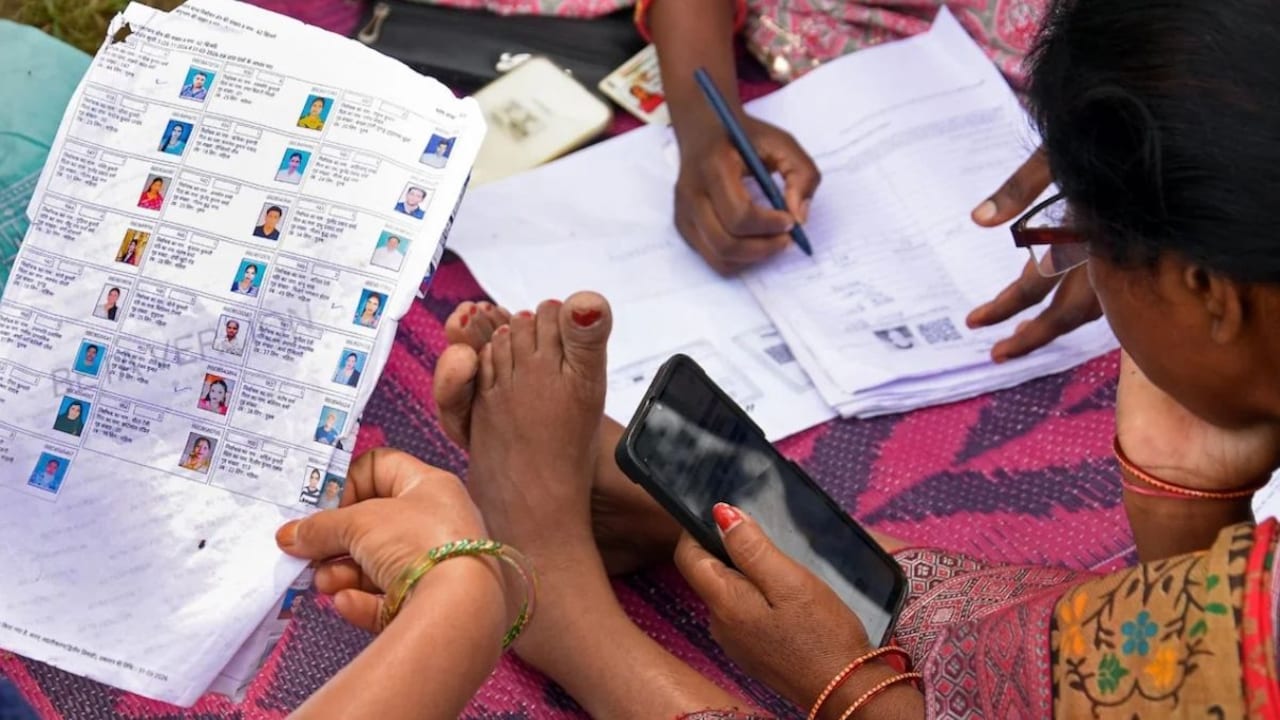
India’s SIR follows a door-to-door system to recount and recheck each voter. Photo: Reuters
In Bengal, after the dead and duplicates were removed, a second wave of removals came under the “logical discrepancy” header, which flagged mismatched name spellings and improbable age gaps between voters and their parents. About 27 lakh names were deleted on this count. According to Kolkata-based research group SABAR Institute, Muslims, about 27 per cent of the state’s population, made up over half of the names deleted once the “logical discrepancy” category was introduced. The ECI does not publish a religion-wise breakdown.
Most of the deletions challenged so far have been reversed. Of 1.26 lakh appeals decided by September 16, 1.14 lakh restored the voter, according to ECI figures filed in the Supreme Court. That is over 93 per cent.
Voices Against Disenfranchisement
In the US, the League of Women Voters, which led the legal challenge, said the ruling to allow mapping voters against the imperfect database on citizenships “puts millions of Americans at risk of being unlawfully targeted by the administration’s unreliable voter purge database.”
The Supreme Court 6-3 majority verdict said blocking the SAVE system “prevents the Federal Government from using the program it believes is best suited to the task”. But Justice Ketanji Brown Jackson, writing for the three dissenting judges, argued that “burdening or disenfranchising even a few lawful voters outweighs the nonexistent harm that the Government experiences”.
In India, Justice Ujjal Bhuyan of the Supreme Court made a similar argument on Sunday, without naming any exercise or authority. “The Indian Constitution does not provide for two classes of citizens: citizens with voting rights and citizens without voting rights,” he said in a speech in Hyderabad. He said a process that disenfranchised “millions and millions” of citizens would be “intrinsically arbitrary”.
Dissent Within, Protests Outside
The Election Commission of India has faced objections from inside too — a fact that spurred the movement against the SIR and the wider electoral system. Two of the EC’s three members, Sukhbir Singh Sandhu and Vivek Joshi, recorded objections at least 14 times in 10 months, The Indian Express reported on September 23. One was to a declaration added to Form 6, the form every new voter fills, asking applicants to trace themselves, their parents or grandparents to an earlier roll. In effect, that extended the SIR’s lineage test even to new voters. The EC says differences among its members are normal and its final decisions were unanimous.
Protests have since raged for nearly two weeks. On October 2, the Cockroach Janta Party led by Abhijeet Dipke, which helped force the education minister’s resignation in July, launched protests in Mumbai. Student organisations such as AISA led by Neha Bora, and the main Opposition parties’ INDIA bloc, began protests on October 6. All are demanding Chief Election Commissioner Gyanesh Kumar’s resignation. He has not commented.
The ECI has meanwhile ordered special drives to re-enrol voters left out. “Any person whose name has got left out during SIR or thereafter… may apply to the concerned ERO,” it said. It has also reverted to the original Form 6, without the requirement to map to the older SIR, in states where the revision is complete.
The Supreme Court is hearing multiple challenges to the SIR, the decisions made by the EC, and the very manner in which election commissioners are picked.


