


Parties to Phonorecords V have submitted their written testimony and rate proposals to the US Copyright Royalty Board (CRB).

This part of the proceeding will set the mechanical royalty rates that on-demand streaming services pay songwriters and publishers in the US between 2028 and 2032.
The filings were made on Monday (October 5), the deadline the CRB had set for participants that had not reached a settlement.
The Digital Media Association (DIMA), the trade body representing music streaming services in the US, said in a statement on Tuesday (October 6) that it looked forward to a “timely resolution” of the proceeding. Its members include Amazon, Apple Music, Feed.fm, Pandora, Qobuz, Spotify, Tidal, and YouTube.
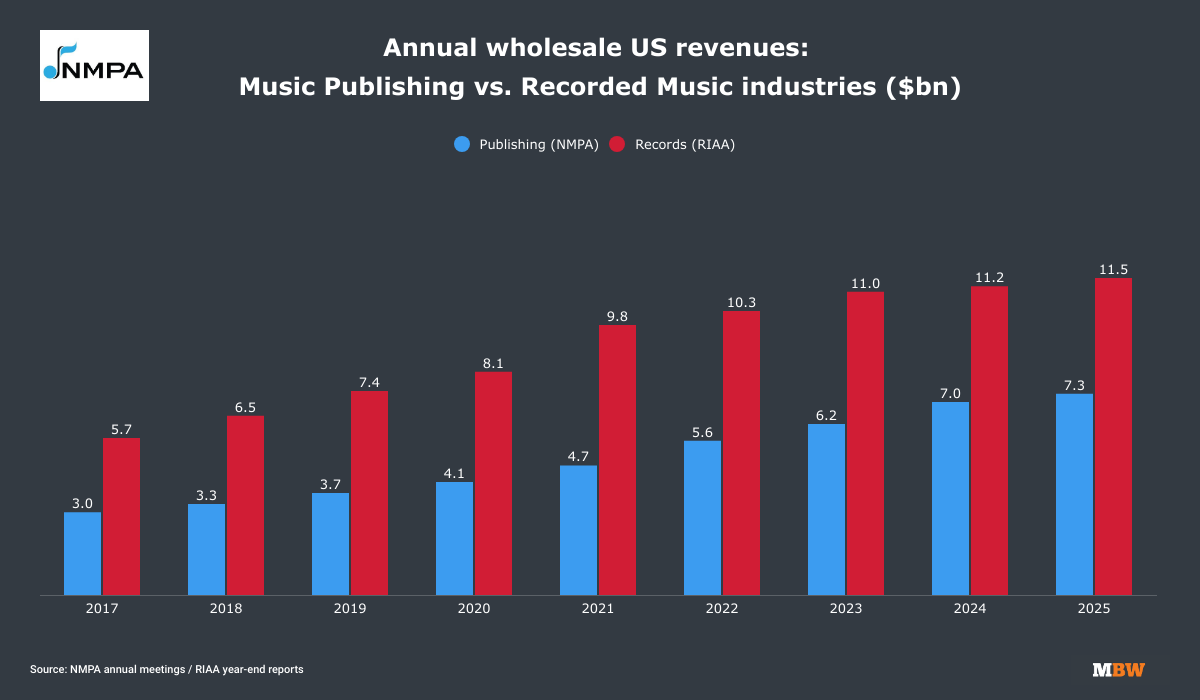
The trade body pointed to data from the National Music Publishers’ Association (NMPA) showing that US music publishing revenues have grown by more than 30%, from USD $5.6 billion in 2022 to $7.3 billion in 2025.
DIMA‘s statement did not refer to any specific rate proposal.
Spotify, Apple, Amazon, Google, and Pandora are all participants in the proceeding, according to the CRB’s online docket.
Opposite them are the NMPA and the Nashville Songwriters Association International (NSAI), which participate jointly as the “Copyright Owners.”
The three major record companies, filing jointly as the Joint Record Company Participants, and the American Association of Independent Music (A2IM) are also participants.
Other participants include the Songwriters Guild of America (SGA), Word Collections, Eminem publisher Eight Mile Style (listed as Eight Mile Music Companies), the Music Artists Coalition, and Nashville songwriter George Johnson.
The SGA, Word Collections, Eight Mile, and Johnson are among those backing a flat mechanical rate of $0.0030 per interactive stream or limited download in 2028, adjusted for inflation in each following year, according to Digital Music News. The Society of Composers & Lyricists (SCL) and Music Creators North America (MCNA) are also backing the proposal. Elton John’s longtime lyricist Bernie Taupin submitted written testimony in support of the flat rate.
“[On Monday], the parties to the Phonorecords V proceeding submitted their written testimony and rate proposals to the Copyright Royalty Board,” said DIMA President and CEO Graham Davies. “In this proceeding, which takes place every five years, the CRB will determine the mechanical royalty rates paid by music streaming services in the United States for the years 2028–2032.
“In the last proceeding, which concluded in 2022, publishers and DSPs reached a settlement, securing rates for 2023–2027 and laying the groundwork for future growth. According to the NMPA, U.S. music publishing revenues have grown more than 30% since 2022, from $5.6 billion to $7.3 billion, outpacing the growth of recorded music, and music streaming has continued to innovate and thrive.
“DIMA joins its member companies in looking forward to a timely resolution of this proceeding, and to continue building on the success of streaming for rights owners, music creators, and DSPs alike.”
“DIMA joins its member companies in looking forward to a timely resolution of this proceeding, and to continue building on the success of streaming for rights owners, music creators, and DSPs alike.”
Graham Davies, DIMA
The last proceeding, Phonorecords IV, covers 2023 to 2027. It followed Phonorecords III, which covered the years 2018 to 2022.
For the Phonorecords III period, the CRB raised the headline rate from 10.5% to 15.1%, phasing it in from 11.4% in 2018.
Spotify and other services won an appeal, but on remand in 2022 the CRB reaffirmed the 15.1% rate.
The Phonorecords IV settlement between the NMPA, NSAI, and the streaming services, which was announced jointly with DIMA in 2022, set a headline rate that rises to 15.35% of a service’s US revenue by 2027.
The settlement also raised the per-subscriber minimums and the Total Content Costs (TCC) prong, which is linked to what services pay record labels.
The Phonorecords IV terms also allow services to pay a lower rate on bundles than on standalone music subscriptions.
Spotify invoked that provision in March 2024, when it reclassified its Premium tiers as bundles that include 15 hours of audiobook listening a month.
The NMPA has projected that the move could cost publishers more than $3.1 billion through 2032 if it is not reversed.
Amazon has since introduced a similar music-and-audiobook bundle.
At the NMPA’s Annual Meeting in June, Chief Legal Officer and Chief Operating Officer Danielle Aguirre said Spotify’s bundling had cost songwriters and publishers almost $480 million since 2024, citing Spotify’s own estimates.
According to Aguirre, bundling at Spotify and Amazon has reduced what the two services pay in royalties by around 30%.
“All parties have expressed an interest to come to the table and discuss how to fix bundling issues and to move forward as partners,” Aguirre told the meeting. “That is a welcome first step. But what really counts are actions.”
The Mechanical Licensing Collective (MLC) sued Spotify over the reclassification in May 2024.
Judge Analisa Torres dismissed the case with prejudice in January 2025, holding that Premium qualifies as a bundle.
In September 2025, Torres granted the MLC‘s motion for reconsideration in part, vacating the judgment and reopening the case. The MLC filed an amended complaint the following month, arguing that Spotify improperly used the price of its standalone Audiobooks Access plan to value Premium’s audiobook component, reducing the royalties paid on the music component. It also argues that Spotify owes mechanical royalties on Audiobooks Access itself, because that plan includes music.
On September 1, 2026, Torres denied the MLC’s request to immediately appeal her bundle ruling, though she struck Spotify’s “unclean hands” defense.
The case has also reached the Phonorecords V proceeding, where the NMPA and NSAI have asked the CRB to issue a subpoena for documents from the litigation, a request Spotify has opposed, Digital Music News reported.
At the same June meeting, the NMPA reported US publishing revenues of $7.3 billion for 2025, up around 3.7% YoY.
It said publishing had outpaced the growth of recorded music for the fourth year running, a point DIMA’s statement echoes.
US recorded music wholesale revenues reached $11.5 billion in 2025, up 3.1% YoY, according to the RIAA.
Phonorecords V‘s streaming rates are being set separately from its rates for physical formats, permanent downloads, and ringtones.
In June, the three major record companies, A2IM, the NMPA, NSAI, and the Music Artists Coalition filed a proposed settlement that would keep the current rate structure for those formats through 2032, with annual inflation adjustments to the physical and download rate.
For 2026, that rate stands at 13.1 cents per song or 2.52 cents per minute of playing time, whichever is larger. The ringtone rate would stay at 24 cents.
The SGA, Word Collections, Eight Mile, and Johnson did not sign that settlement and have since objected to it.
The SGA and Word Collections argue that the deal leaves out inflation for 2021 and 2022 and would effectively reset the rate to 12 cents, the level set for 2023. Eight Mile has criticized the freeze on the ringtone rate.
The SCL has also objected, alleging a conflict of interest arising from overlapping ownership of labels and publishers among the settling parties.
Last month, the CRB ordered the settling parties to provide additional information, including responses to those objections and to questions about any common ownership among the record companies and publishers that signed the deal, and whether it was negotiated at arm’s length. It also separated the physical, download, and ringtone rates from the streaming case.
The settling parties have since filed their responses, saying the rate will keep rising with inflation under the existing formula. The record companies and A2IM project it at about 13.7 cents in 2028.
They also argued that the question of inflation for 2021 and 2022 had already been raised and resolved in Phonorecords IV. The record companies and A2IM declined to provide documents from the negotiations, saying the law allows the CRB to adopt a settlement without an evidentiary record.
The CRB has yet to decide whether to adopt the deal.
The October 5 filings also opened discovery. Unless the parties settle, the case will go to a hearing, scheduled to begin on March 22, 2027, with the CRB’s initial determination due by December 17, 2027.Music Business Worldwide


