


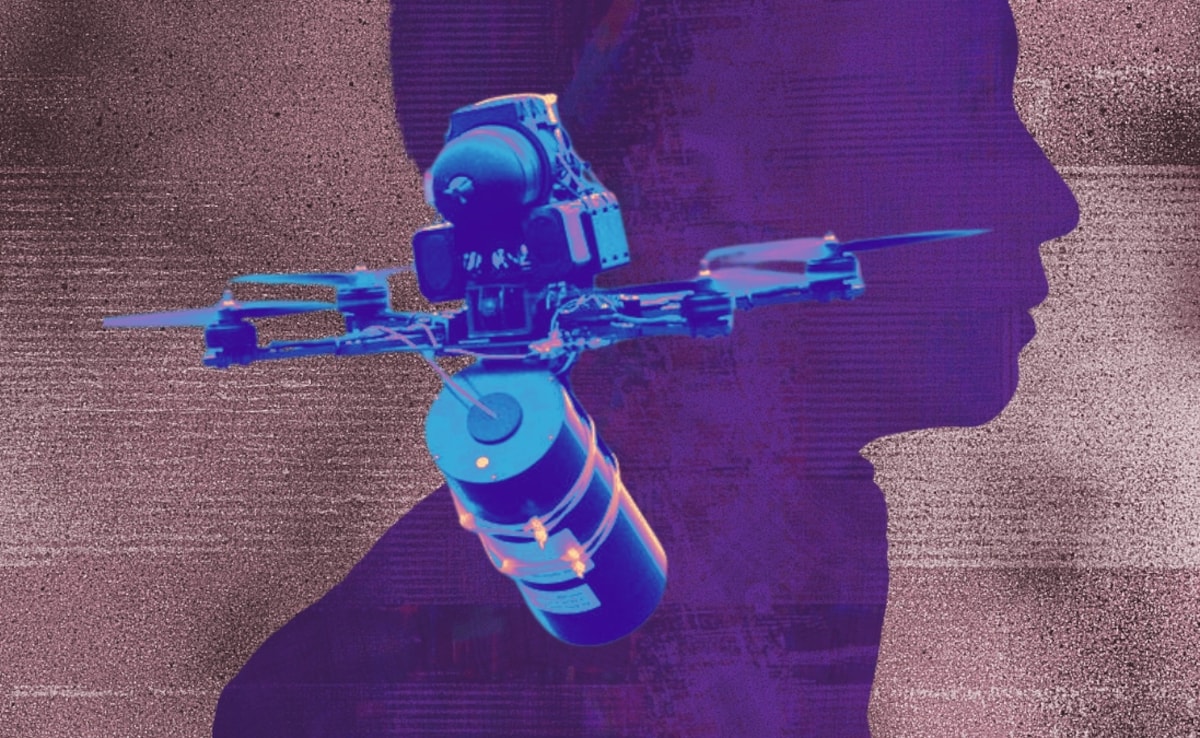
A typical 12-year-old knows plenty of things. How to dodge homework. What are the cool apps. Maybe, if they’re outdoorsy, how to score a goal on the field. But a Ukrainian boy knew how to disable a drone aiming for his family.
One evening, Anatolii Prokhorenko was perched in a pear tree, trimming a damaged branch for a neighbour, when he heard a familiar sound. The buzz of a drone.
The 12-year-old, who lives with his family in a small farming village in Ukraine’s northern Chernihiv region, just seven miles from the Russian border, knew that sound well. A drone had destroyed a car beside a local shop in March. Another had exploded on his street only the day before. This one was heading straight for his home.
He watched as a black quadcopter skimmed just above the ground, moving towards a cluster of buildings where three of his younger siblings were playing outside with other children.
“It saw the children and started gaining altitude. That’s when I realised something was about to happen,” Prokhorenko told The Washington Post. What he did next may well have saved their lives. His mind went back to a conversation he had with a soldier known by the call sign “Dynamo”.
Lesson From A Soldier Called Dynamo
Months earlier, the boy had been cutting firewood in a nearby forest with his father when he noticed a soldier handling thin, glinting threads. Curious, he asked what they were.
The soldier, an explosives specialist known by the call sign “Dynamo”, explained that the material was fibre-optic filament, nearly impossible to tear with bare hands. He showed the boy three techniques troops had developed to snap it, involving a specific combination of loops and pinches. He also told him to count to 15 after a drone passed before attempting it, ensuring the operator could no longer see him. The boy remembered all of it.
When the boy heard the drone from his tree, he immediately started looking for that fine, glinting line trailing behind it. Once, he locked in on his target.
He dropped from the tree, sprinted, and closed his fingers around the hair-thin thread running back, ultimately, all the way to Russia. He made a loop. He pulled it slightly. He remembered the instruction. Count to 15. “I didn’t have time. So I counted to 10, and I broke it,” he said.
The line snapped. The drone lurched upward, turned away from the children and the houses, and came down in a patch of wild ground nearby. It later emerged that it had crashed in a swamp.
“Not every soldier would have been able to react in a split second like that. How can a civilian person, especially a child, do something like that?” Dynamo told The Washington Post.
Rise Of The Fibre-Optic Drone
The use of small commercial drones to target civilians is not new to this war. The tactic began around two years ago in the Kherson region, where Russian forces across the Dnipro River began using cheap first-person view (FPV) quadcopters to stalk people going about their daily lives, including cyclists, pedestrians and dog walkers.
In one widely reported November 2024 incident, a drone dropped an explosive on a man riding a moped, then dropped another on the ambulance that arrived to help him.
By April 2025, such attacks were killing 42 civilians a month and injuring nearly 300, according to a report by an independent United Nations human rights commission. Investigators concluded the campaign had been ordered by Moscow to systematically terrorise the civilian population.
Ukraine initially responded with jamming technology, disrupting the radio frequencies the drones rely on. Russia’s answer was the fibre-optic tether, a hair-thin line that unspools behind the drone in flight for up to 12 miles. Because it bypasses radio signals entirely, it cannot be jammed.
Hero At Home, A Target Online
The boy was celebrated as a hero across Ukraine. On Russian Telegram channels, however, he became a target of online threats. His family of seven have since moved to a borrowed two-room flat in Chernihiv, the regional capital.
He is 12 years old. He knows how to break a fibre-optic drone tether under pressure. He learned it from a soldier in a forest, because in his part of Ukraine, that is just the kind of thing a child needs to know.



