



The AI conversation has become strangely repetitive.
Every conference has the same promises. Productivity will rise. Costs will fall. Chatbots will answer customer queries faster. Employees will save time writing emails.
Then you speak to Vala Afshar, Chief Digital Evangelist at Salesforce (a title created for him) and realise AI is much bigger than software.
Afshar compares AI to electricity. “AI is electricity for the 21st century,” he says. “It’s bigger than cloud, bigger than mobile, bigger than social.”
He has spent three decades in technology and says he has never seen a shift move this fast. He cites industry voices who believe artificial intelligence could have “10 times the impact of the Industrial Revolution at one-tenth the speed.”
That scale matters because the conversation around AI is already moving beyond chatbots and productivity tools. The real debate now is about how economies, companies and even human relationships get reorganised around intelligent systems.
And in Afshar’s view, this next phase is already underway.
The Next Company May Not Look Like a Company
For years, enterprise software was built around people sitting in front of screens. Open the CRM. Check the dashboard. Fill the workflow. Move information from one tab to another.
Afshar thinks that structure is starting to break.
“Agents aren’t going to log into your website. Agents don’t use dashboards,” he says.
The point he is making is larger than interface design. He believes companies are entering what Salesforce calls the “agentic enterprise” era, where software no longer just assists humans but executes tasks on its own.
“All work is now teamwork,” he says. “You and your favourite agent.”
That line captures how he sees the future workplace. Not humans versus AI. Humans working alongside AI systems that can retrieve information, complete workflows and make decisions within boundaries.
But those boundaries matter enormously.
One of Afshar’s biggest concerns with the current AI boom is that too many people are treating large language models as reliable systems when they are still probabilistic systems.
“You could put the same exact input prompt and get different answers,” he says. “That doesn’t work in finance or healthcare or any business.”
Which is why trust becomes the centrepiece of the conversation.
Afshar defines trust in two parts: competence and character. Competence means reliability and capability. Character means integrity and benevolence.
“There’s a fine line between manipulating and inspiring,” he says. “And that line is your intention.”
It is probably the most important point he makes all afternoon. The greatest risk from AI may not simply be automation. It may be persuasion at scale. Systems that can influence behaviour, shape opinion and personalise manipulation more effectively than anything before them.
“This powerful technology in the wrong hands could misinform, misguide society,” he says. “It’s not the technology, it’s the people using the technology, always.”
The Real Enterprise Battle: Waste, Not Workers
One of the more surprising parts of the conversation is that Afshar does not sound obsessed with replacing workers. In fact, he argues many companies are approaching AI transformation incorrectly.
“Companies should be in the waste management business, not the cost reduction business,” he says.
He believes businesses often cut costs too aggressively in pursuit of margins, only to damage long-term value creation. The smarter application of AI, according to him, is reducing wasted work: repetitive tasks, inefficient workflows, underutilised talent and broken processes.
“About half of work that’s done in business is wasteful work,” he says, citing his own research.
ALSO READ | India Missed Out On AI And Now Its Run As Market Darling May Be Over
That does not mean jobs remain untouched. When asked directly whether AI will eventually replace cognitive work and not just repetitive tasks, he does not dodge the question.
“Over time. And it will in the future. That’s not something we can avoid.”
The implication is clear. Companies will need to redesign jobs continuously. Afshar describes the process as redesigning, reskilling and redeploying workers rather than simply eliminating them.
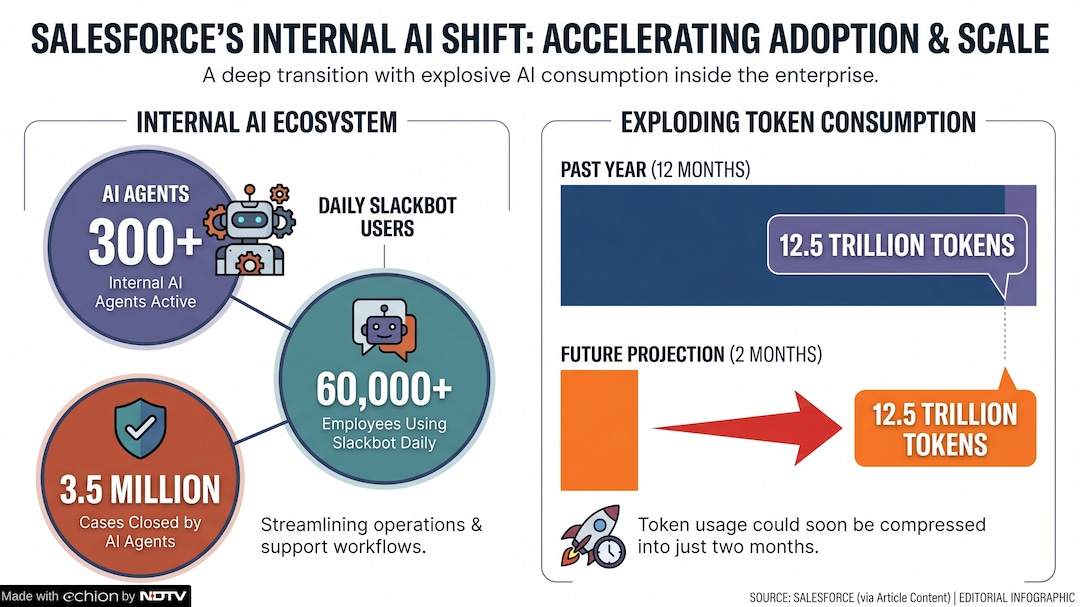
Salesforce itself is already deep into that transition. He says the company now has more than 300 internal AI agents, over 60,000 employees using Slackbot daily and agents that have already closed roughly 3.5 million support cases.
The scale of AI consumption inside enterprises is exploding too. Salesforce used 12.5 trillion tokens over the past year, he says. That number could soon be compressed into just two months of usage.
“Did anybody talk in enterprise about tokens two years ago?” he asks. “No.”
Why He Thinks India Has a Real AI Shot
One of the strongest moments comes when Afshar is asked about the growing investor narrative that India still lacks a genuine AI play and risks remaining stuck at the application layer while foundational AI breakthroughs happen elsewhere.
“I disagree with that narrative,” he says immediately.
He places India among the top three countries positioned to benefit from AI alongside the United States and China. His argument rests on scale: developers, internet users, startups, STEM graduates and a rapidly expanding digital ecosystem.
He points to Salesforce’s own India footprint growing more than eightfold since 2020 and says the company now works with roughly 3,000 colleges and universities in the country.
But the answer that lingers longest comes at the very end of the interview.
What human skill survives in 2040?
Afshar pauses.
“Love.”
Love for the work. Love for the mission. Love for relationships.
He brings up long-running research showing happiness and longevity are tied less to status or money and more to the quality of human relationships.
ALSO READ | WhatsApp Launches Incognito Chat With Meta AI To Keep Conversations Private
Then comes the line that may define the AI-era workforce better than any economic forecast.
“There’s no demand for average in the future.”
Machines, he believes, will increasingly automate average output. The people who stand out will still be the ones with judgment, curiosity, trust and genuine conviction in what they do.
Essential Business Intelligence,
Continuous LIVE TV,
Sharp Market Insights,
Practical Personal Finance Advice and
Latest Stories — On NDTV Profit.



