


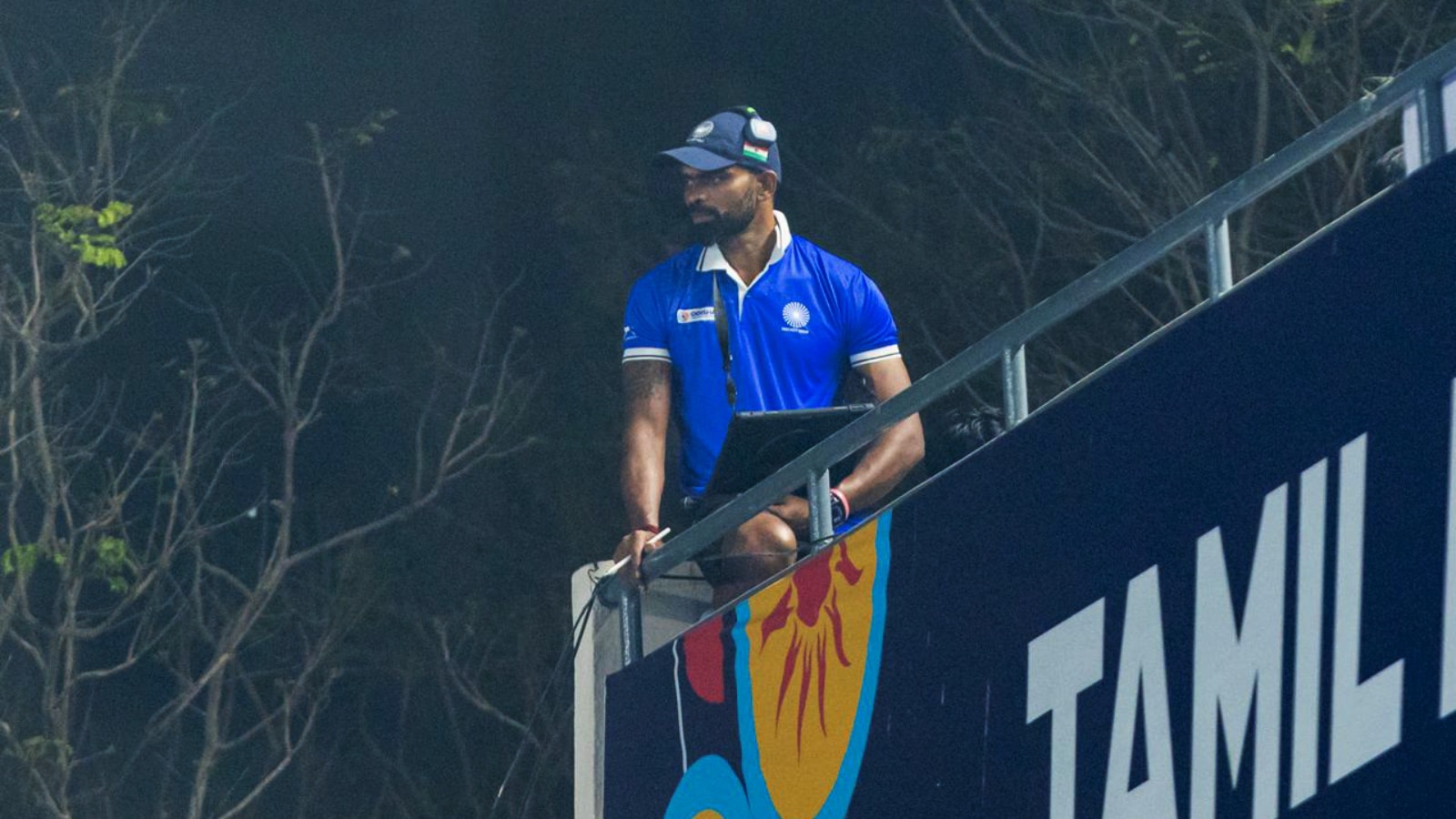
PR Sreejesh’s desire to become a coach came from the right place. A modern-day great, the former goalkeeper had learnt the sport a certain way, only to realise midway through his career that much of what he had been taught was completely out of sync with global trends.
For instance, he was told to keep his palms open, chest high and constantly move inside the goal. Modern goalkeeping, he discovered during tours of Europe, was almost the opposite: Stay still, ration movement, react late. “We never had former goalkeepers who learnt modern techniques and imparted them to us. They learnt 1+1 is 4 and taught us that. But no, 1+1 is 2,” he had once said.

After the 2012 London Olympics, Sreejesh did two things — first, he relearnt goalkeeping from scratch; then, he resolved that the next generation of Indian goalkeepers would not face the same hurdles he did.
In his head, there was never any doubt that coaching would be his Plan A after retirement.
Last week, that plan received a jolt.
Sreejesh alleged that on the insistence of current men’s team senior coach Craig Fulton, Hockey India decided to replace him as the junior team coach with a foreigner. Hockey India swiftly denied the claims, and in the following days, named Frenchman Frederic Soyez as his successor.
The instinctive reaction would be to point fingers at Hockey India for unfairly treating another legend. But there are many layers to this saga.
The first, where Hockey India can be rightly questioned, is Sreejesh’s appointment itself.
Story continues below this ad
In August 2024, at the Paris Olympics, India’s players hadn’t even received their medals when Hockey India informally announced that Sreejesh would take charge as the junior coach. The decision seemed to be based on emotions rather than rooted in long-term strategy. If other candidates were short-listed or interviewed, if Sreejesh himself was interviewed, or whether Fulton had any say given the junior team acts as a feeder to the senior squad, isn’t known.
The appointment, though, was puzzling because Sreejesh was parachuted into an important role as the under-21 team coach without any solid prior experience, or him attaining any formal coaching credentials like so many other Indians aspiring to manage the national side. This was also unlike the other Indian greats like Sardar Singh or Rani Rampal, who started with under-18 players, the lowest age-group. Sardar even went to the Netherlands, where he observed and picked finer nuances of coaching youth sides.
Sreejesh’s stature was his biggest qualification. In his lengthy tirade, he mentioned how he was sidelined despite leading the junior India team to five podium finishes, including a bronze medal at the 2025 Junior World Cup.
But he misses the point: the correct parameter for age-group tournaments isn’t the number of medals they win, but how the players develop technically, tactically and mentally. The job of the junior team coach, more than winning medals, is to provide a seamless pathway that allows young players to transition smoothly into the senior squad. In the current core group of 36, only three players from the 2025 Junior World Cup have made the cut.
Story continues below this ad
It is hard to fault Hockey India for turning to a foreign coach once again. And if Fulton indeed pushed for a foreigner with the U-21s — an unsubstantiated claim — the move can be justified as the idea is to align the junior setup with the senior team’s tactical philosophy.
India desperately needs to broadbase its player pool in the next two years, given that a bunch of players who have led the revival from Tokyo Olympics are expected to hang their boots.
That’s where Sreejesh’s successor, Soyez, comes in. Soyez has a reputation of integrating systems that link grassroots hockey, under-18 and under-23 teams, to senior sides. His astute penalty corner strategies and defensive systems made teams like Spain and France punch well above their weight.
There is no doubt that at some point, India will have to reduce its dependency on foreign coaches and create a robust pipeline for homegrown tacticians. Importing expertise every Olympic cycle isn’t sustainable. But nationalism cannot be a qualification in itself.
Story continues below this ad
Equally, Sreejesh must recognise that not renewing his contract, and offering him other options such as goalkeeping coach, is not necessarily a slight on his credentials, or a ‘demotion’ as he sees it. Coaching careers, especially at the elite level, are usually built in stages.
Sreejesh’s role in the revival of Indian hockey has been profound. Without him, it would have been next to impossible for India to win the 2014 Asian Games – their first since 1998 – that triggered a momentum shift leading to the two Olympic bronze medals. Both those medals are tough to imagine without Sreejesh’s match-defining interventions.
Few Indian players of his generation have absorbed modern goalkeeping methods from as many elite foreign coaches, across as many systems, over such a long period. Hockey India would be making a mistake if it allowed that knowledge to drift out of the system entirely.
Sreejesh is right to reject Hockey India’s offer to take over the development team; it has been an unserious project with very little thought or planning. But Sreejesh, evidently hurt, should not see a goalkeeping coach role as a ‘demotion’.
Story continues below this ad
Two years after his retirement, India still hasn’t found a goalkeeper of the same level as Sreejesh. Perhaps, the best way to honour his legacy is to let him shape the next generation of goalkeepers — the very support system he never had growing up.
After all, that’s why he wanted to become a coach in the first place.



