


New Delhi:
As West Bengal waits for the results of the Assembly elections, the battle hasn’t ended at the ballot box and is shifting to the strongrooms. This has also brought attention to the four-day gap between the last phase of polling on April 29 and counting day on Monday.
With both Trinamool Congress (TMC) and Bharatiya Janata Party (BJP) leaders making repeated visits to the strongrooms where electronic voting machines with polled votes are stored, allegations are flying thick and fast.
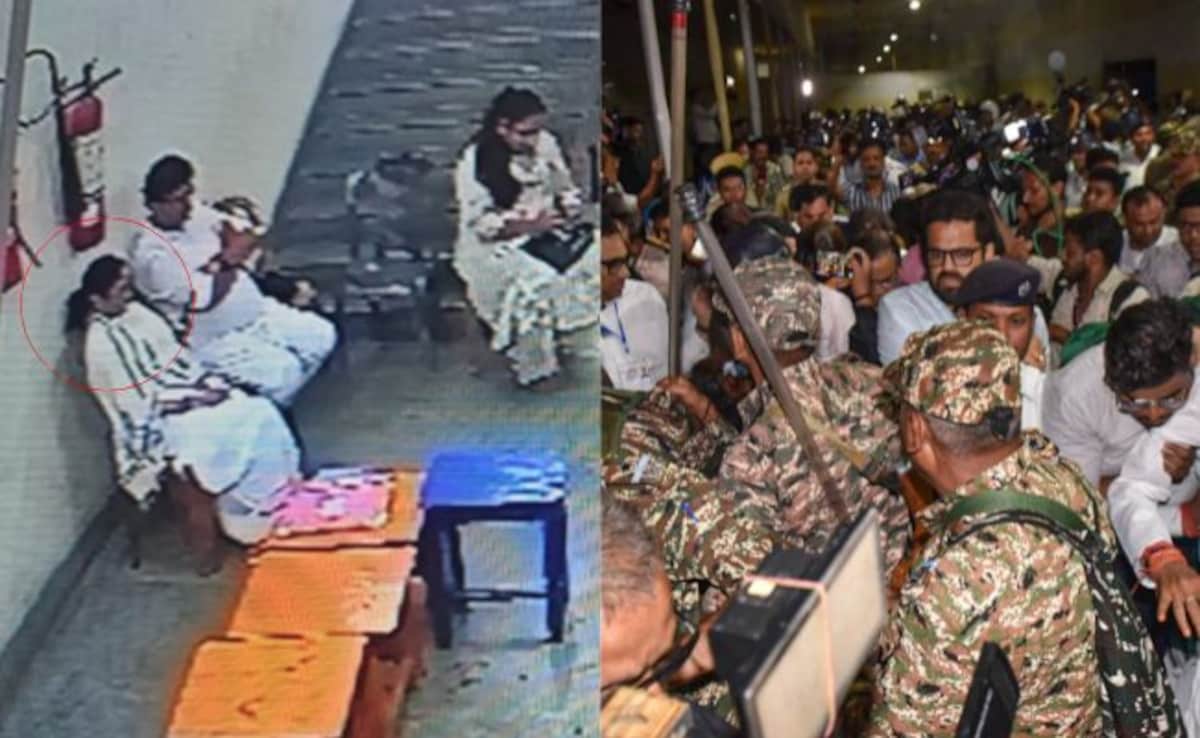
On Thursday, TMC leaders Shashi Panja and Kunal Ghosh staged a sit-in protest outside the strongroom at Netaji Indoor Stadium in central Kolkata. The leaders alleged that BJP members, in the presence of Election Commission officials, attempted to open ballot boxes in the absence of authorised party representatives. The protest continued late into the night, with Chief Minister Mamata Banerjee also visiting a strongroom in her constituency of Bhabanipur.
After TMC’s protest, BJP leader Suvendu Adhikari also visited a strongroom and hit back at the ruling party. He termed the episode “drama”, asking what purpose was served by prolonged visits.
The Election Commission has clarified that strongrooms storing EVMs remain fully secured and sealed under strict protocols. They stated that routine procedures like segregation of ballots were being carried out in designated corridors under the supervision of Returning Officers, dismissing allegations of any irregularities.
Some analysts said the four-day gap between the days of polling and counting may have contributed to such episodes. But an analysis of recent elections shows there’s no fixed timeline:
- Bihar 2025: Last phase of polling on November 11. Counting on November 14 (2-day gap)
- Delhi 2025: Voting on February 5, counting on February 8 (2-day gap)
- General Elections 2024: Last phase on June 1, counting on June 4 (2-day gap)
- Jammu & Kashmir 2024: Last phase on October 1, counting on October 8, (6-day gap)
- West Bengal 2021: Last phase on April 29, counting on May 2 (2-day gap)
- Tripura 2023: Polling on February 16, counting on March 2 (13-day gap)
- Meghalaya & Nagaland 2023: Poll on February 27, counting on March 2 (2-day gap)
- Uttar Pradesh 2023: Last phase on March 7, counting on March 10 (2-day gap)
- West Bengal 2016: Last phase on May 5, counting on May 19 (13-day gap)
Even in 2016, when multiple states like Assam, Kerala, Tamil Nadu, and Puducherry voted on different dates, counting was synchronised, leading to longer gaps for some.
So What Explains This Variation?
According to the Election Commission, the gap between polling and counting is entirely its prerogative. There is no fixed timeframe and several operational and logistical factors come into play – deployment and rotation of central security forces, transportation of EVMs from remote or sensitive areas, and the window required for re-polling if discrepancies are reported.
Legal experts echo this. Supreme Court lawyer Prateek Kumar points out that the Representation of the People Act, 1951, does not define any particular gap between polling and counting. While the law governs the broader framework, such as the notification and completion of elections, the exact schedule is at the Commission’s discretion, shaped by ground realities.



