


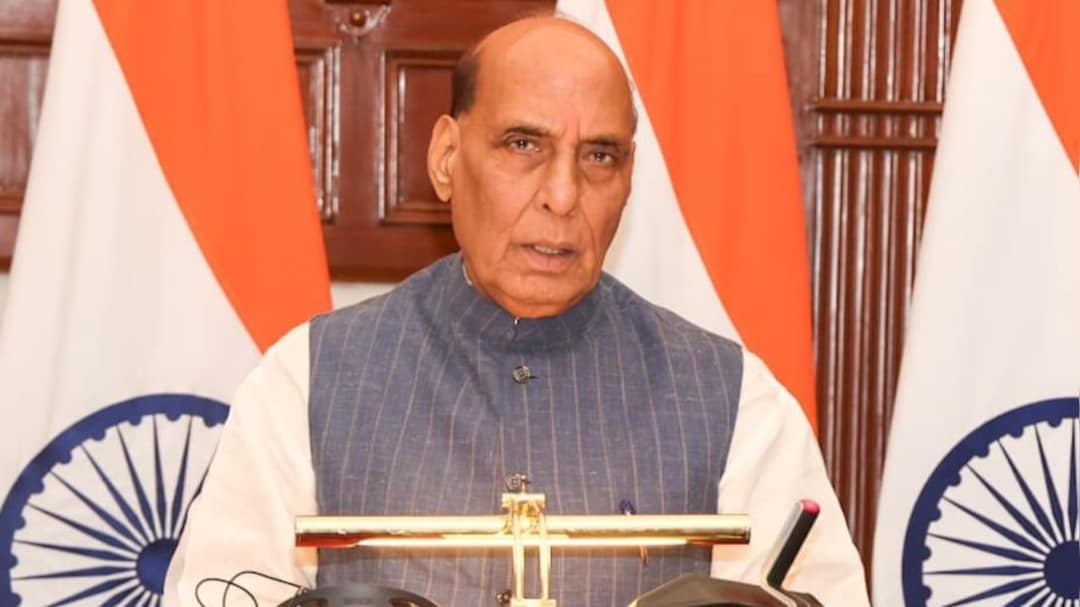
An AI-generated deepfake video impersonating Rajnath Singh is being widely circulated on social media, targeting retirees, salaried individuals and first-time investors with promises of extraordinary returns. The video, designed to resemble an official government address, uses the State Emblem of India, subtitles and logos of leading financial institutions to falsely project legitimacy. It claims that a modest investment of Rs 22,000 can generate daily profits of Rs 80,000 and monthly income running into lakhs, claims that are entirely fraudulent and economically implausible.
The manipulation goes beyond simple visual mimicry. The video dynamically inserts the current date to create urgency, while on-screen counters labelled “Today’s Profit” and “Monthly Income” increase in real time, reinforcing the illusion of active earnings. A scrolling banner showcases logos of major institutions such as State Bank of India, HDFC Bank, ICICI Bank, Axis Bank, Bank of Baroda, Punjab National Bank and Infosys as “Official Partners,” despite none of them having any association with the scheme. These elements are carefully engineered to override scepticism, particularly among less digitally savvy audiences.
ALSO READ: There Must Not Be Any Double Standards In Combating Terrorism: Rajnath Singh At SCO Meet
Investigations reveal that the scam operates through a structured two-tier funnel commonly seen in deepfake-driven financial frauds. It begins with targeted advertisements or viral posts, often on platforms owned by Meta Platforms, that push the deepfake video to specific demographics such as retirees and first-time investors using interest-based targeting. Once users click on the post, they are redirected to a fraudulent landing page hosted on a randomly generated domain. The site mimics legitimate financial platforms and prompts users to enter personal details including name, mobile number and PAN.
The next stage involves soliciting an initial deposit, typically Rs 22,000, via UPI or bank transfer to mule accounts. Once the payment is made, victims are shown fake dashboards reflecting high returns. However, when they attempt to withdraw funds, additional payments are demanded under various pretexts such as taxes, verification fees or compliance charges. Eventually, withdrawals are blocked, the platform becomes inaccessible, and the operators shift to a new domain and social media handle, repeating the cycle. Law enforcement data suggests victims have lost anywhere between Rs 50,000 and over Rs 2 crore in similar scams, with a surge in complaints reported in 2025.
Atenian Tech has outlined clear countermeasures. Citizens are advised not to click on suspicious links, share such videos or disclose personal information. Any such content should be reported immediately using in-app tools. Victims must contact the cybercrime helpline (1930) and file complaints without delay to improve chances of fund recovery.
Meanwhile, platforms are expected to remove such content swiftly, deploy detection tools to prevent re-uploads and cooperate with enforcement agencies. Banks and companies whose identities have been misused are urged to issue public clarifications, strengthen fraud monitoring and pursue legal action against perpetrators.
Essential Business Intelligence,
Continuous LIVE TV,
Sharp Market Insights,
Practical Personal Finance Advice and
Latest Stories — On NDTV Profit.



 and file complaints without delay to improve chances of fund recovery.)