In his very arrival, C. Joseph Vijay wrought change on Tamil Nadu’s polity—in a tense few days marked by both sparks of confrontation and gestures of rapprochement. That duality was guaranteed by the very nature of his victory. A euphoric one, but at 108 seats, his Tamizhaga Vettri Kazhagam (TVK) was 10 short of majority. He could no longer be the Outsider to the political system. He needed its support. The ensuing chain of events threatened to strain harmony across the board. Each party that came forward to back him had to endure discord to do so.
The Congress had to decide to ditch long-time ally Dravida Munnetra Kazhagam (DMK); the Left and the Viduthalai Chiruthaigal Katchi (VCK) took time to shed their reluctance and, finally, even a sizeable chunk of the All India Anna Dravida Munnetra Kazhagam (AIADMK) defied the party whip and cross-voted in the TVK’s floor test on May 13. Tamil politics is braced for aftershocks, while ‘Thalapathy’ Vijay got a comfortable buffer of 144 MLAs in a 234-member House.
The uncertainty behind him, one of the first major statements the new chief minister made was to accuse the previous DMK regime of leaving Tamil Nadu with an “empty treasury” and a mountain of debt. The DMK hit back almost immediately, with former chief minister and party president M.K. Stalin responding that the “money was therewhat was required was efficiency and the political will to deliver”. Ordinarily, such an exchange would have set rolling a phase of acrimony. Instead, Vijay surprised everyone by going to meet Stalin soon after. He also met other senior leaders, including Marumalarchi Dravida Munnetra Kazhagam (MDMK) chief Vaiko, Anbumani Ramadoss of the Pattali Makkal Katchi (PMK), and Naam Tamilar Katchi (NTK) boss Seeman. He had made his point, bought time by pointing to the allegedly damaged system he had inherited, and then chosen to present an image of respectful civility.
Civility may soon be in short supply within the AIADMK, though, and that has to do with how things led up to the scenes in the assembly on May 13. The Congress and other supporting parties added 13 MLAs: that put the TVK’s nose only just above water. Real oxygen had to wait till 25 of the AIADMK’s 47 MLAs, led by C. Ve. Shanmugam, came on board, heedless to warnings from party chief Edappadi K. Palaniswami (EPS). Vijay had met Shanmugam the previous evening to confirm this little mutiny, indications that he’s a fast enough learner in politics.
If anything, the opening session was an indicator that governance in Tamil Nadu is a jigsaw puzzle where many things have to fall in place. For the TVK, now that political accommodation is done, foremost among these would be administrative continuity. The party may have come to power as an outsider force, but it now has to work with institutions, bureaucracies and political networks shaped over decades by the Dravidian parties. Vijay’s outreach to rivals and veterans, therefore, appears significant, aimed at reassuring both the establishment and the electorate. Leaders across party lines praised Vijay for the gesture. “It was something new in the recent political history of Tamil Nadu,” says VCK legislator Vanni Arasu.
FISCAL STABILITY
Yet beneath all the symbolism lies a more serious question: what exactly does Vijay intend to do with the economy he has inherited? Accusing the previous regime of leaving “empty coffers” is alright in the short term because it lowers public expectations and gives room to explain difficult decisions. But the statement also creates pressure on the government to present a clear economic roadmap fairly quickly. Tamil Nadu is the only state in India to record double-digit real economic growth for two consecutive years (FY25 and 26). It also has the second highest per capita income in the country and is one of India’s most industrialised regions, with deep investments in manufacturing, automobiles, electronics and healthcare.
Observers cite all this to say that any perception of fiscal instability can have consequences beyond politics, affecting investor confidence and administrative continuity. Vijay’s government will, therefore, be judged not only by whether it exposes financial stress but also by whether it can reassure industry, the welfare beneficiary class and the bureaucracy that the state’s long-term stability remains intact. “The new CM spoke too soon,” says a senior political commentator. “He should have waited till he actually got to grips with his office.”
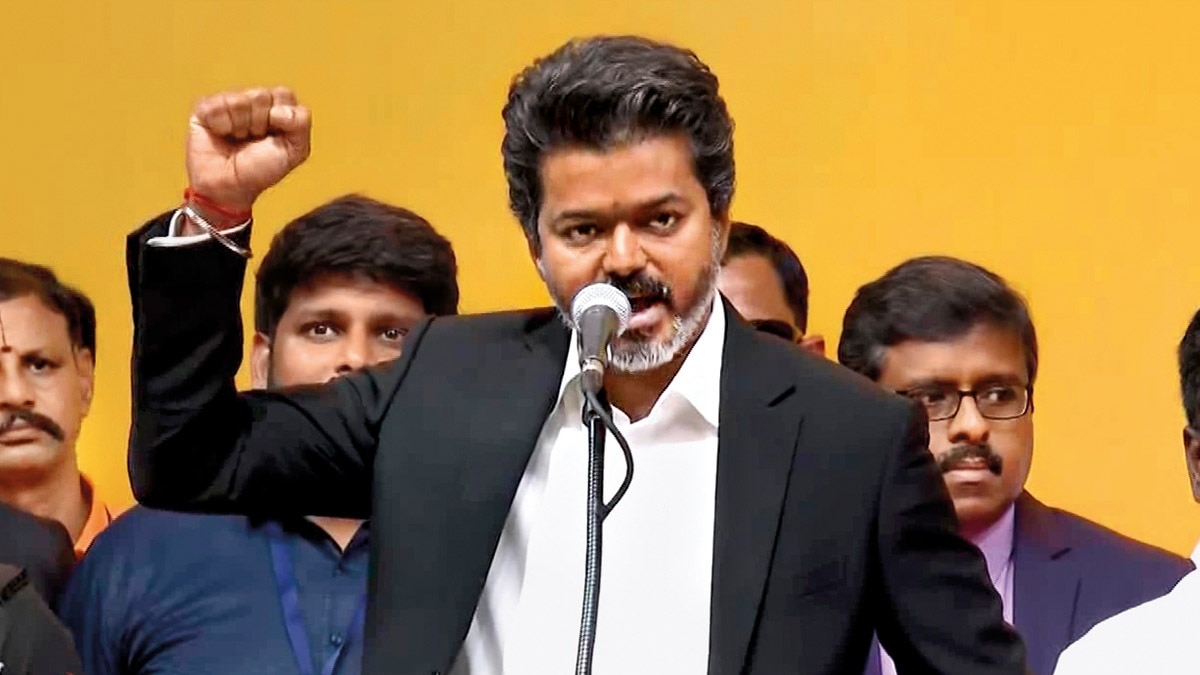
Meanwhile, the making of the ‘Vijay legend’ has started in right earnest. In the opening House session, new speaker J.C.D. Prabhakar invoked the late CMs MGR and Jayalalithaa in the same breath as Vijay, all the while calling the latter a “living MGR”. Since the election results came in, supporters and sections of the TVK leadership have framed Vijay’s rise within the same long tradition of cinema-driven mass politics in Tamil Nadu. Even his public appearances now, including the distinct black coat and carefully choreographed entries, are a confirmation of this.
But the comparisons also underline the scale of the challenge before him. MGR and Jayalalithaa succeeded not just because they were charismatic film stars, but also because they transformed the charm into durable political structures. Both eventually built a highly centralised but disciplined party machinery capable of surviving electoral cycles and governance pressures. Right now, the TVK is just a party created from his fan base and turncoats from other parties. If the party is to survive future challenges, the current volunteer force will have to transform into a regimented political party structure, especially at the booth level. The TVK’s sweeping win in its first ever election— a ‘black swan’ event, according to the BJP’s K. Annamalai at least—may not be so easy next time around. Future elections will not give the TVK the ‘unknown outsider’ advantage against entrenched parties.
OPENING ROUNDS
Among the most headline-grabbing announcements of the new TVK government has been the closure of around 700 state-owned TASMAC liquor outlets, particularly those located near schools, colleges, places of worship and crowded public spaces. Alongside this, the government has announced special initiatives focused on women’s protection and public safety.
Politically, these are highly effective opening moves. Liquor regulation has long been an emotionally resonant issue in Tamil Nadu, especially among women voters. Every major party has, at different moments, promised some form of restriction on alcohol sales while simultaneously relying heavily on TASMAC revenue to fund welfare commitments while in power.
Talking of the latter, Vijay and the TVK could rack up a humongous bill with their pre-poll promises. Analysts say the welfare spend could add up to an outgo of nearly Rs 1 lakh crore every year, accounting for one-third of the state’s total revenues. Gold guineas for new brides and rings for newborns, six free gas cylinders for every family, cash doles to mothers, women, jobless graduates, farmers, the list goes on. Balancing the books might be a more onerous task now, and even Stalin couldn’t resist taking a backhanded jibe at Vijay, asking, “Didn’t you know this before making promises to the people?”
Meanwhile, another move by the new administration— the appointment of his high-flying astrologer, Radhan Pandit Vetrivel, to the crucial post of CM’s officer on special duty (OSD)—was not just controversial but also exposed Vijay’s inexperience. TN is still the land of the great rationalist thinker Periyar, who the Dravidian parties—and even Vijay—set much store by, so the appointment got flak from every corner. The new CM had to back down on it within days.
Going forward, the TVK government will have to prioritise its challenges. Chief among them will be the fragile coalition government with the Congress (the others are offering outside support). Managing constructive ties with the BJP-led government at the Centre will also require Vijay’s constant ministrations, especially with Congress in the mix—with stakes. Lastly, the TVK cannot even appear to be cowed down on crucial issues such as Hindi, NEET and GST, for the big Dravidian parties will be waiting and watching, ready to pounce.
Tamil Nadu politics has historically rewarded leaders who successfully merge spectacle, welfare and emotional connection. But those comparisons also create enormous expectations. Charisma may win elections, but governance ultimately determines political longevity. The first week of the TVK government has showcased more symbolism than structural policy shifts. Vijay has shown a sharp instinct for public mood, media optics and political messaging. These are valuable tools, but the larger challenge before him is to hone those instincts so as to create a coherent governing philosophy—one capable of sustaining both his popularity and institutional credibility in one of India’s most politically complex states.
– Ends