


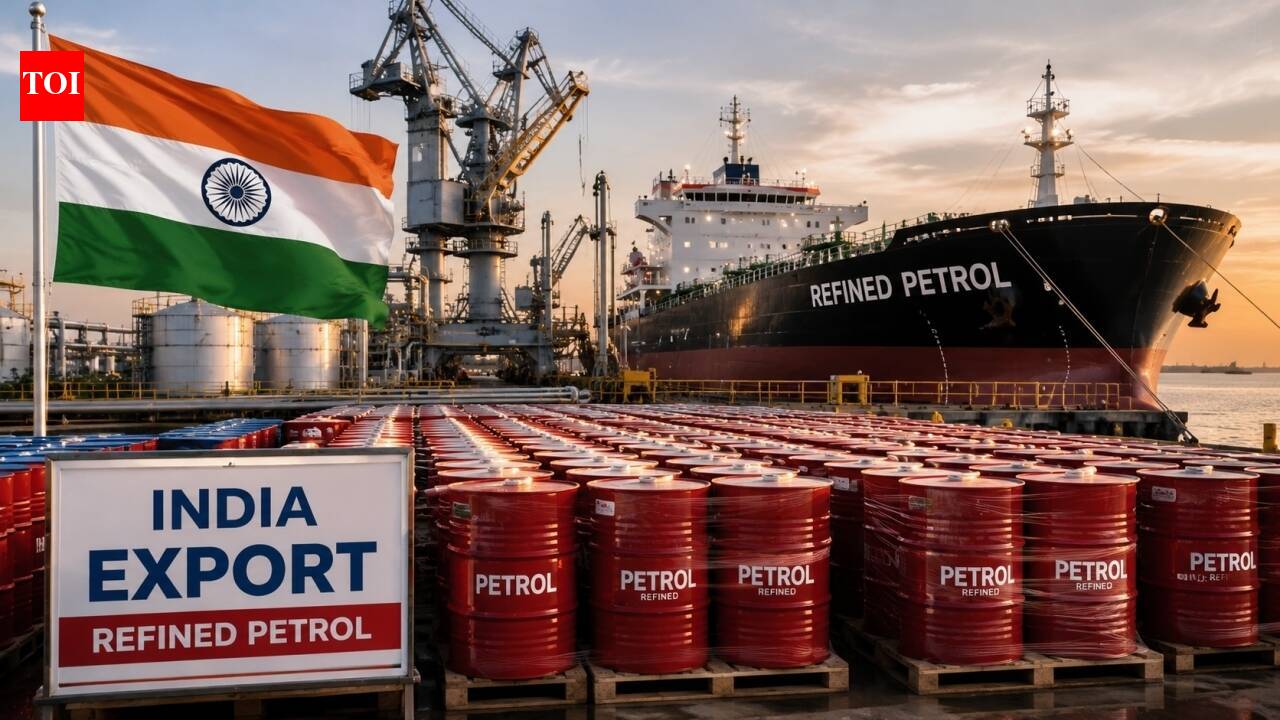
India’s petroleum product exports could increase by around 25% from the FY25 level of $44.4 billion. India is one of the world’s leading exporters of refined petroleum products. The increase is expected to come over the next few years as new refining capacity becomes operational by December 2026 through Indian Oil Corporation’s (IOCL) largest expansion programme to date.Although India imports around 90% of its crude oil requirement, it has become one of the world’s largest exporters of refined petroleum products by using its large and sophisticated refineries to process imported crude for both the domestic market and international buyers. The latest capacity expansion also comes at a time when additions to global refining capacity remain limited, while supply disruptions in Russia and the Middle East continue to support refining margins.Also Read | Trump’s ceasefire ‘over’ remarks & fresh Strait of Hormuz disruptions: What it means for India
IOC’s refining capacity boost
The capacity enhancement undertaken by the state-owned refiner IOCL is set to raise its total refining capability from the current 80.75 million metric tonnes per annum (MMTPA) to a record 98.05 MMTPA.“Whatever surplus capacity we have after meeting domestic needs, we will look to export. This has the potential to raise our export share to about 15% of total revenues, from 5% currently. That said, we don’t work with a fixed export target, and our priority remains domestic first,” senior official at IOCL told ET.The company has already spent more than Rs 53,500 crore under the Rs 75,000 crore expansion programme. The project spans IOCL’s refineries at Panipat, Vadodara and Barauni. Refining capacity at Panipat is being expanded from 15 MMTPA to 25 MMTPA, while Vadodara’s capacity is set to increase from 13.7 MMTPA to 18 MMTPA. At Barauni, capacity will rise from 6 MMTPA to 9 MMTPA. All three expansion projects are slated to be commissioned during November-December 2026.At present, India’s refining industry has an installed capacity of around 258.1 million metric tonnes per annum (MMTPA), compared with domestic petroleum product consumption of approximately 239 MMTPA.Also Read | India’s economy passed the Iran war test. Could El Nino spoil the party?In practice, however, refineries generally operate at 105-115% of their installed capacity, resulting in actual annual production of close to 300 million tonnes. Of this, roughly 61.5 million tonnes represents surplus output that is shipped to overseas markets.Reliance Industries accounts for nearly 70% of the country’s refined fuel exports through its 70 MMTPA Jamnagar refinery, the world’s largest refining complex at a single location. By the end of 2026, IOCL is expected to add another 17.3 MMTPA of refining capacity. After meeting domestic requirements, a substantial portion of the additional production is likely to be available for export. Should the incremental output be sold overseas, it could provide a significant boost to India’s petroleum product exports, further reinforcing the country’s standing as a global refining hub while increasing foreign exchange earnings.The senior official, however, added, “if the demand rises significantly in India, then we may not have a major exportable surplus on a sustained basis from our refining systems.”Also Read | Strait of Hormuz toll proposal: What are the key waterways in the world & is there a fee to transit them?



