


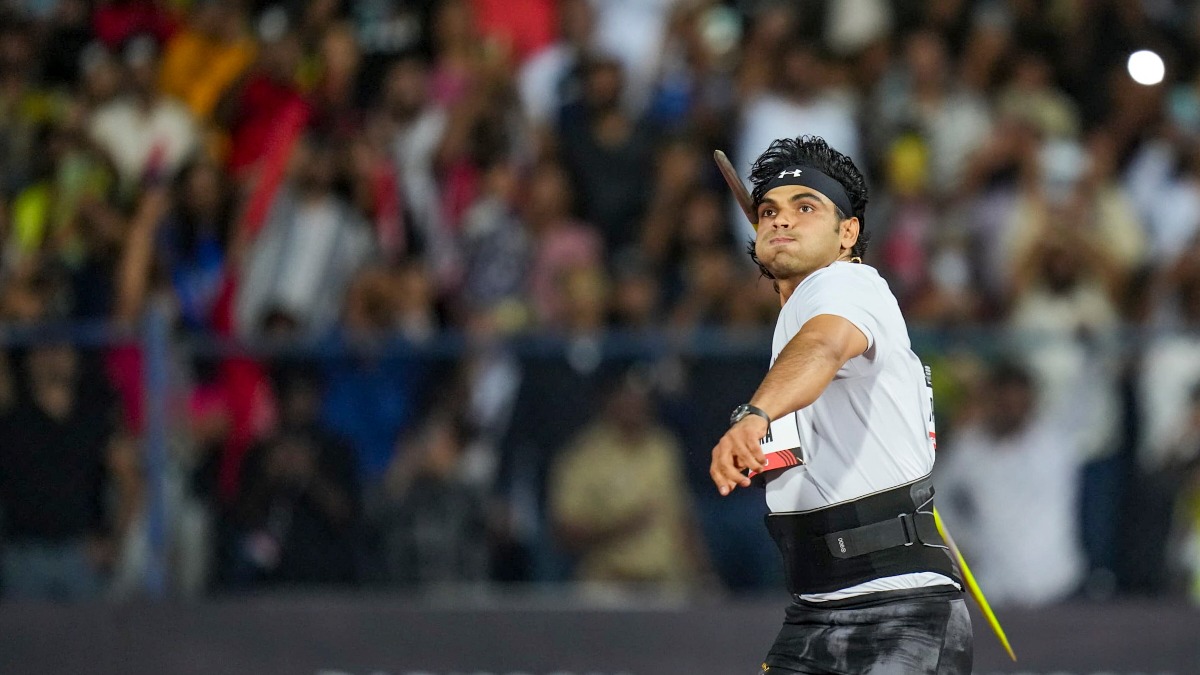
Neeraj Chopra opens his season fit. That, more than any number on a scoreboard, is the headline Indian and world javelin fans have been waiting for since he limped out of last year’s Tokyo World Championships.
“I feel really good and really fit,” he said on the eve of the Doha Diamond League, his first competition in nearly a year. The reassurance matters because of how the year before it ended.
The men’s javelin event at Doha Diamond League will begin at 11:14 pm IST on Friday, June 19. There is no TV broadcast of the event. Wanda Diamond League YouTube and Facebook channels will stream the event live in India.
Neeraj had gone into Tokyo carrying a back injury, and admitted now that he should not have competed at all.
“I don’t think competing there was a good decision because I already knew I had some problems,” he said.
“But because that was the last competition of the year, I wanted to compete there.”
He finished eighth with 84.03m, the worst result of his career, and the injuries multiplied rather than healed.
“As athletes, when we try to manage one injury, we end up getting another one,” he said.
“After the back injury during the World Championships, I had another one in my ankle and then in my shoulder.”
What followed was a long, deliberate rebuild rather than a quick return. Chopra sat down with his team and his physiotherapist and decided to take his time, throwing again for the first time only a month and a half ago. He based himself at Magglingen, a Swiss Olympic training centre in the mountains above Biel.
“It’s very quiet, and you can focus on your training and your technique,” he said.
“I really like it there.”
He only confirmed his place in Doha a week out from the meet, his favourite venue to open a season, and the place where he broke 90 metres for the first time in his career last year, a personal best of 90.23m that still stands.
THE NEW COACH
The most significant change sits in his corner. After Tokyo, Chopra parted ways with legendary Jan Zelezny and returned to Jaiveer Singh Chaudhary, the coach who first put a javelin in his hands some 15 years ago.
“After the World Championships, I thought I needed to work more with my own ideas,” he said.
“Now I work with an Indian coach. He is my senior. When I started javelin, I started with him, so he knows my story from the last 15 or 16 years.” The work, he insists, is not a technical overhaul but a return to instinct. “We are not working on anything specific or anything too deep. I am working on my natural technique,” he said.
Ahead lie the Commonwealth Games in Glasgow and the Asian Games in Aichi-Nagoya, both confirmed targets for a season he expects to be unusually demanding.
“As an Indian athlete, we have the Commonwealth Games and the Asian Games. So this is also a busy season,” he said, rating the Commonwealth field as deceptively brutal.
“It will be no less competitive than the Olympics or the World Championships.”
THE NEW RIVAL
That assessment is not theoretical. The man most likely to test him first is also the rival Chopra helped create. Last July, at the Neeraj Chopra Classic in Bengaluru, Chopra won gold with 86.18m, Julius Yego took silver, and a 22-year-old Rumesh Pathirage settled for bronze at 84.34m, behind two men he had grown up idolising.
Afterwards, noticing the young Sri Lankan freezing up in front of the cameras over his English, Chopra told him not to let it hold him back: speak without fear, because there would be many more podiums to come.
He has been at considerably more of them than even Chopra could have predicted.
Pathirage opened this season with 89.37m in March and 89.28m in Nairobi in April, then finished second to Anderson Peters in Rabat with 85.97m, his only loss of the year.
Days later in Rome, he produced a 92.62m national record, just 35 centimetres short of Arshad Nadeem’s Asian record, making him the eighth-best thrower in history and the second-best Asian ever. He has won six of his seven competitions this season and arrives in Doha as the world leader.
This will be his first Diamond League meeting with Chopra; their head-to-head currently stands level, Bengaluru to Chopra, Tokyo to Pathirage, who finished seventh there to Chopra’s eighth.
Of him, Chopra has nothing but warmth.
“He is a really good guy and a good friend of mine,” he said.
“I am happy for him. It’s really big what he has achieved for Sri Lanka.”
Pathirage will not be the only thrower with something to prove. Doha brings together the entire Tokyo World Championships podium: world champion Keshorn Walcott, two-time former champion Anderson Peters, and bronze medallist Curtis Thompson.
THE STACKED DOHA FIELD
- Keshorn Walcott (Trinidad and Tobago) – SB: 83.45m | PB: 90.16m
- Neeraj Chopra (India) – SB: Yet to compete | PB: 90.23m
- Anderson Peters (Grenada) – SB: 86.08m | PB: 93.07m
- Rumesh Tharanga Pathirage (Sri Lanka) – SB: 92.62m | PB: 92.62m
- Curtis Thompson (USA) – SB: 85.33m | PB: 87.76m
- Julius Yego (Kenya) – SB: 80.59m | PB: 92.72m
- Jakub Vadlejch (Czech Republic) – SB: 85.24m | PB: 90.88m
- Ahmed Sameh Mohamed Hussein (Egypt) – SB: 83.10m | PB: 83.10m
- Artur Felfner (Ukraine) – SB: 83.11m | PB: 84.32m
Doha has a habit of producing numbers that look unreal even by the sport’s own standards. Thomas Rhler threw 93.90m here in 2017, on his season’s opener, a mark that moved him to second on the all-time list. Peters’ own best, 93.07m, also came in Doha, in 2022, and still ranks second on the Diamond League’s all-time list.
Neeraj Chopra’s task on Friday is smaller than chasing those numbers. It is simply to find out, in front of a crowd for the first time in months, whether the throw he has spent a year rebuilding is enough to hold off the rival he once told to speak without fear.
– Ends


