


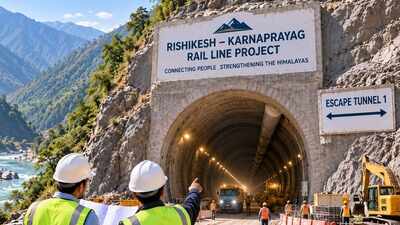
The 125 kilometres long Rishikesh-Karnaprayag new railway line, which is currently under construction, has achieved a major milestone with a new tunnel breakthrough. Rail Vikas Nigam Limited (RVNL), which is the implementing body for the project, has completed another major milestone in the Rishikesh-Karnprayag New Broad Gauge Rail Line Project with the final breakthrough of Escape Tunnel 1. This takes the total number of tunnel breakthroughs in the project to 41.The Rishikesh Project Implementation Unit of RVNL achieved the breakthrough on Friday after completing the full 10.847-km length of Escape Tunnel 1. The tunnel is the second-longest on the project.
Why tunnel breakthrough is important
The completion is particularly significant given the difficult geological conditions along the Himalayan alignment. The route passes through rock formations that are highly tectonized, multi-folded and extensively faulted, with widespread shearing and areas of intense rock crushing.Officials said these challenging geological conditions led to the development of thick mylonite zones, which are largely associated with the tunnel’s proximity to the Main Boundary Thrust (MBT).The project has now recorded 41 tunnel breakthroughs, with work progressing towards completion. The remaining five breakthroughs are expected to be completed over the next year, taking the project closer to its final target.The latest breakthrough is being seen as another significant engineering achievement for the Rishikesh-Karnprayag rail project and brings the Himalayan railway connectivity initiative a step closer to completion.
Rishikesh-Karnaprayag new rail line
The 125-km Rishikesh-Karnaprayag new rail line has been sanctioned to provide rail connectivity for the Chardham pilgrimage circuit.The project runs through Dehradun, Tehri Garhwal, Pauri Garhwal, Rudraprayag and Chamoli districts of Uttarakhand.It is intended to connect the religious and tourist destinations of Devprayag and Karnaprayag with Rishikesh and the National Capital of India through the railway network.A large number of pilgrims from across the country visit the Char Dhams, while Uttarakhand also draws a significant number of domestic and international tourists for trekking and sightseeing.However, the existing road network passes through fragile mountain slopes and faces major limitations in terms of traffic load, capacity, safety and speed. Providing rail connectivity to the Char Dhams will make travel safer, more economical and comfortable, while also making it more environment-friendly and reliable throughout the year.A large part of the alignment runs through tunnels. The project comprises 16 main-line tunnels covering 104 km and 12 escape tunnels extending about 98 km.As per a July 2026 update, 101 km of main-line tunnelling and more than 95 km of the nine escape tunnels have been completed.To accelerate construction, eight adits were identified at different tunnel locations. These adits provided additional faces for tunnel excavation, helping speed up work on the longer tunnels. All eight adits, covering a combined length of 5 km, have now been completed.The rail line also requires the construction of 19 important/major bridges. Eight of these 19 bridges have been completed, while work on the remaining bridges has also commenced.Railway Minister Ashwini Vaishnaw has said that surveys have been completed for extending rail connectivity to Gangotri, Yamunotri, Kedarnath and Badrinath. However, the proposed alignment is located close to the main Central thrust of the Himalayas, an area that is highly seismically active.The timeline and cost of railway projects are influenced by several factors. These include land acquisition, forest clearance, relocation of infringing utilities, statutory approvals from different authorities, geological and topographical conditions, the law and order situation around the project site, and the number of months during which work can be carried out at a particular site each year.All these factors have a bearing on both the completion schedule and the cost of railway projects.


