


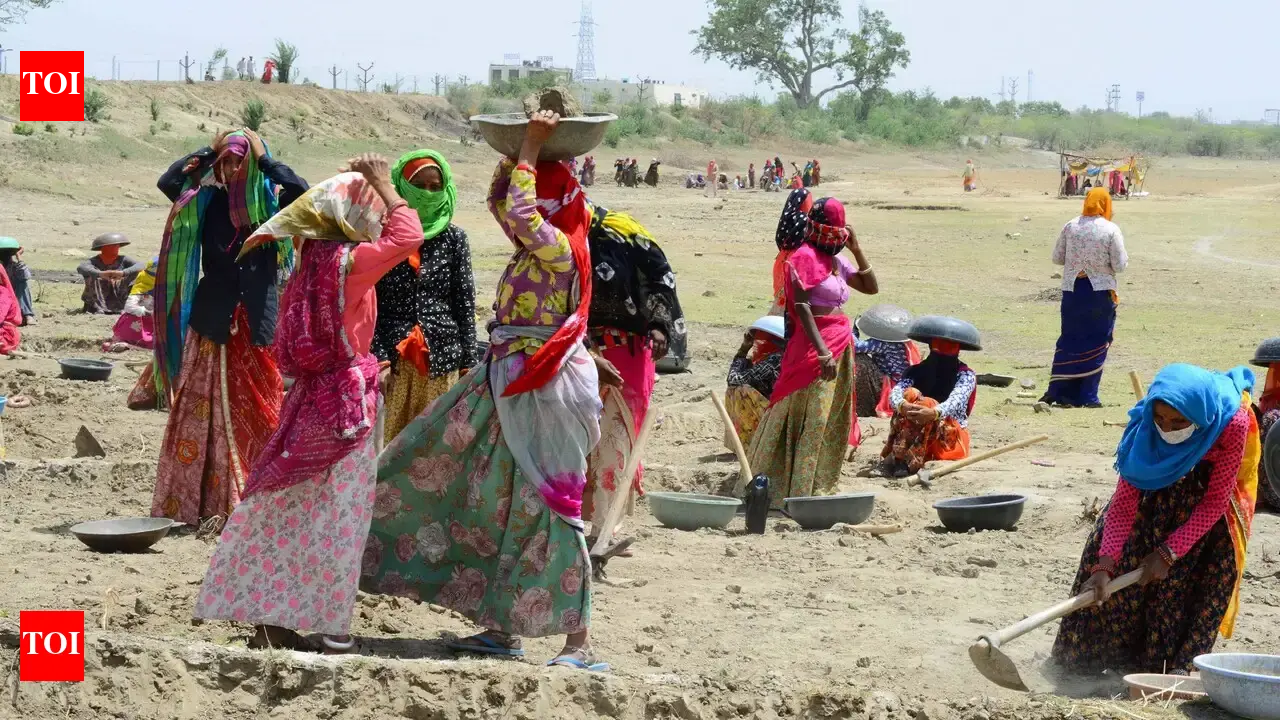

The Centre on Monday announced that the Viksit Bharat Guarantee for Rozgar and Ajeevika Mission (Gramin) Act, or VB-G RAM G Act, 2025, will come into force across India from July 1, replacing the Mahatma Gandhi National Rural Employment Guarantee Act (MGNREGA) after nearly two decades.The government has pitched the new legislation as a “next-generation rural development framework” aligned with the Viksit Bharat 2047 vision, promising to expand guaranteed wage employment from 100 days to 125 days annually while integrating rural jobs more closely with infrastructure creation, climate resilience and village-level planning.In a separate notification, the rural development ministry confirmed that the MGNREGA Act, 2005, will stand repealed from July 1, 2026.The Centre, however, assured that the transition would be “seamless and uninterrupted”.“Ongoing works under MGNREGA as on June 30 shall be saved and carried over to the new framework seamlessly,” the notification said.The ministry added that existing e-KYC-verified MGNREGA job cards would remain valid until new “Gramin Rozgar Guarantee Cards” are issued.Workers will not be denied employment because of pending e-KYC verification, while fresh registrations for those without job cards will continue at the gram panchayat level, the government said.Draft rules related to wage payments, grievance redressal, allocation norms and transitional provisions are currently being prepared in consultation with states and Union Territories and will soon be opened for public consultation.The Centre described gram panchayats as the “central pillar” of rural transformation under the new framework.
What changes under the new law?
The biggest change is the increase in guaranteed rural employment from 100 days under MGNREGA to 125 days annually for rural households seeking unskilled manual work.

The new Act reorganises permissible works into four broad categories:
- Water security projects
- Core rural infrastructure
- Livelihood-related infrastructure
- Extreme weather mitigation works
Under MGNREGA, works were categorised around activities such as water conservation, drought proofing, irrigation, flood control, land development and renovation of traditional water bodies.The new framework also introduces “Viksit Gram Panchayat Plans” (VGPPs), which will serve as convergence-based local development plans prepared by gram panchayats and approved by gram sabhas.According to the government, all projects under the Act must emerge from these village development plans to ensure “need-based and saturation-focused” rural development.Officials say the law seeks to move beyond a purely “demand-driven wage programme” towards a convergence-led rural development model with stronger local planning and infrastructure creation.The inclusion of extreme weather mitigation projects has also been projected as a response to growing climate vulnerabilities in rural India.
How will the transition happen?
The Centre said the transition from MGNREGA to the VB-G RAM G Act would be smooth, with all ongoing projects migrating into the new framework.Incomplete public assets and ongoing projects will be prioritised for completion.Existing MGNREGA job cards linked with e-KYC will remain temporarily valid until new cards are issued under the revised system.The government has also clarified that fresh works may be opened during the transition period if existing projects are insufficient to meet labour demand.
What remains unchanged?
Several key worker protections remain intact under the new framework.Employment must still be provided within 15 days of demand, failing which workers become eligible for unemployment allowance payable by state governments.Wages will continue to be transferred directly into bank or post office accounts through DBT and must be paid weekly or within a fortnight after muster roll closure.The law also retains compensation provisions for delayed wage payments.
What are the new administrative features?
Attendance at worksites will now be captured through a face authentication-based system.However, the government said exceptions would be permitted in cases involving poor connectivity, technical failures or other genuine difficulties.Another major feature is the restriction on undertaking works during peak agricultural seasons. States will notify sowing and harvesting periods to avoid labour shortages in agriculture.
How will funding work?
The funding pattern under the new framework marks a departure from MGNREGA.Under the VB-G RAM G Act:
- Northeastern and
Himalayan states will receive 90:10 Centre-state funding - Other states and Union Territories with legislatures will follow a 60:40 ratio
- Union Territories without legislatures will receive 100 per cent central funding
The material expenditure component has been capped at 40 per cent at the district level.Under MGNREGA, the Centre fully bore wage costs, while material costs were shared in a 75:25 ratio between the Centre and states.A major change flagged by critics is that MGNREGA was demand-driven, requiring the Centre to allocate additional funds whenever work demand increased.Under the new law, allocations to states will follow normative limits, with expenditure beyond sanctioned allocations to be borne by state governments.
Why does the government say the new law is needed?
The government argues that the new framework modernises rural employment by integrating livelihood generation, infrastructure development and climate resilience into a single framework.Officials say the enhanced 125-day employment guarantee, convergence-led planning and uninterrupted work availability during transition are among the key improvements over MGNREGA.The Centre has also highlighted provisions such as:
- Mandatory appointment letters
- Free health check-ups for workers aged 40 years and above
- Equal work, equal pay and equal opportunity provisions for women working in different shifts
- Creation of a National Reskilling Fund for workers who lose jobs
- Weekly working hour cap of 48 hours
- Mandatory overtime payments
- At least one weekly rest day for workers
What concerns are being raised?
Opposition parties and labour rights groups have strongly questioned the repeal of MGNREGA instead of strengthening the existing framework.Congress leader Jairam Ramesh described the move as “yet another lazy headline-grabbing exercise” and alleged that the only guarantee under the new law was one of “extreme centralisation” and weakening of rural labour rights.“The only guarantee that VB-G RAM G offers is that of extreme centralisation and weakening of the bargaining power of rural labour,” Ramesh said on X.He also questioned why operational details were still unavailable despite the law being scheduled for implementation from July 1.Activists have also expressed concern that mandatory face-authentication attendance could exclude workers in remote regions with weak internet access or elderly workers facing authentication failures.Others fear that shifting the programme’s focus towards convergence and long-term planning may dilute its original strength as a legal guarantee for immediate wage employment.There are also concerns that restricting work during peak agricultural seasons may reduce earning opportunities for landless labourers.Critics have additionally demanded clarity on whether the expanded 125-day guarantee will be backed by sufficient budgetary support, pointing to recurring delays in wage payments and fund releases under MGNREGA in recent years.



 Act, or VB-G RAM G Act, 2025, will come into .)