


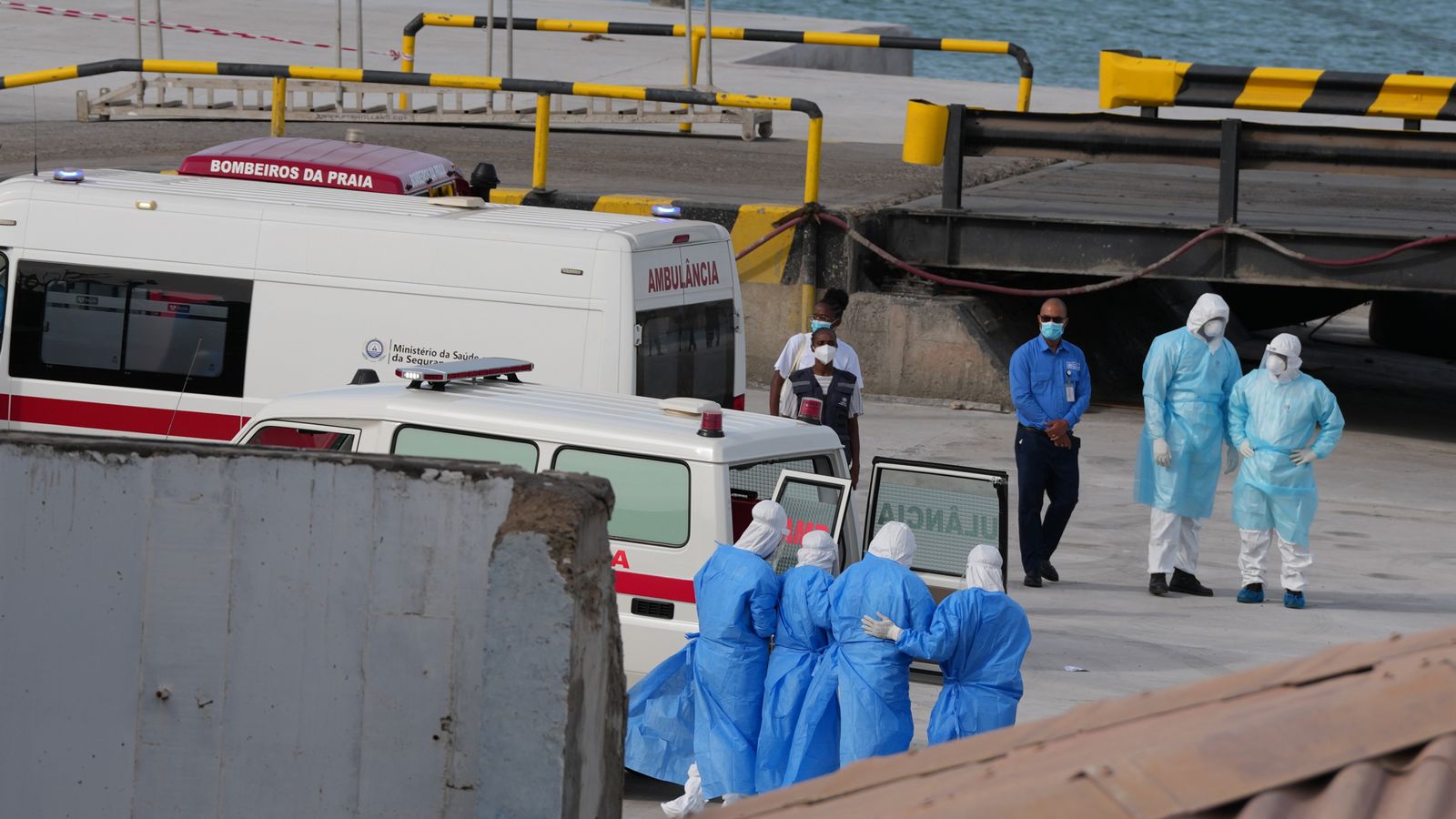
Three passengers have died after being on board a hantavirus-hit cruise ship that had been heading for the Canary Islands.
Several others have fallen ill with suspected cases and been evacuated from the Dutch-flagged MV Hondius, which still has more than 140 passengers and crew members on board.
Meanwhile health authorities in the UK, Switzerland, Netherlands, France, Singapore, South Africa and elsewhere are isolating people who previously left the cruise ship and tracing those who might have come into contact with them.
So what is hantavirus – and how concerned should we be about a wider outbreak?
What is the deadly virus?
Hantavirus is primarily spread by rodents but can be transmitted between people in rare cases, according to the World Health Organisation (WHO).
People most typically become infected when the virus in rodent droppings, saliva and urine becomes airborne, such as when areas where rats and mice have nested are swept out.
It is a family of viruses which can cause two illnesses: one that primarily affects the lungs and the other that attacks the kidneys.
See live updates on hantavirus
The first – hantavirus pulmonary syndrome, most commonly found in the Americas – has a fatality rate of about 40%.
According to the Canadian government, only about 200 cases of hantavirus pulmonary illness occur each year worldwide.
But it made headlines when concert pianist Betsy Arakawa, wife of actor Gene Hackman, died from the disease in New Mexico in 2025, according to post-mortem results.
What are the symptoms?
Hantavirus usually begins with flu-like symptoms, such as fatigue and fever, one to eight weeks after exposure, according to the US Centers for Disease Control and Prevention.
Four to 10 days later, coughing, shortness of breath and fluid in the lungs appear.
There is no specific therapy for hantavirus infection, so treatment focuses on supportive care, including rest and fluids.
Patients may need breathing support such as a ventilator.
Experts say exposure to hantavirus can be minimised by deterring and eliminating rodents from areas where people are.
They also recommend avoiding vacuuming or sweeping dried droppings, which can aerosolise the virus.
Why the Andes strain is significant
The Andes strain of hantavirus has been identified as the one that spread on the ship.
It circulates in parts of South America, including Argentina and Chile, and has been responsible for person-to-person transmission in the past.
Experts told Sky News that the identification of the strain was a step in the right direction, as it meant officials knew precisely what they were up against.
Professor Paul Hunter, professor in medicine at the University of East Anglia, said: “The finding of the Andes variant strengthens the hypothesis that the initial cases were acquired in Argentina.
“This is endemic in Argentina and its host is the long-tailed pygmy rice rat, which as far as I know does not occupy ships, though I am not an expert on rats in ships.
“The question remains how this infection then spread to the later cases.”
Dr Michael Head, senior research fellow in global health at the University of Southampton, gave an example of a previous Andes strain outbreak.
He said: “In one outbreak in Argentina, there was a single environmental exposure to rodents and three symptomatic patients then infected others at crowded social events, resulting in 34 cases and 11 deaths.”
Infectious disease expert Kentaro Iwata told Sky News there were three key things about hantavirus that we still don’t know: the origin of the infection, its transmissibility and its incubation period – the length of time between when the disease is contracted and when symptoms occur.
Is it as big a threat as COVID?
There has been concern among the public that hantavirus will lead to another pandemic, but experts have said this is unlikely and the WHO considers the risk to the wider public as low.
Maria Van Kerkhove, an epidemiologist at the WHO, said: “This is not the next COVID, but it is a serious infectious disease. Most people will never be exposed to this.”
Global health law expert Professor Larry Gostin told Sky News’ health correspondent Ashish Joshi that hantavirus is more lethal than COVID but far less transmissible.
“Some people in the media have overhyped it: this is not going to be a pandemic and it’s not going to be a sustained, long outbreak unless things change rapidly,” he said.
“It is really very difficult to transmit this disease; you need to be in very close quarters for a prolonged period of time with someone that’s exposed.
“You’re not just going to walk into your hotel lobby or someone on the street and get this. People can be reassured that the risk is very, very low.
He added the caveat that a new variant is always possible and that this could make it more transmissible than prior strands.
“We need to take this seriously because in many ways this is more lethal than COVID, that is, it’s more pathogenic, but it doesn’t have the capacity to transmit anywhere near Sars-COVID2,” he said.
How many cases have there been?
So far, five confirmed cases of hantavirus linked to the outbreak have been identified, along with three further suspected cases, according to the WHO.
This does not include the three people – a Dutch couple and a German national – who have died on board amid the outbreak.
Three British passengers have suspected cases of hantavirus, according to the UK Health Security Agency (UKHSA), which says none of them are currently in the UK.
One of the British passengers is on the island of Tristan da Cunha, in the South Atlantic, where passengers on the cruise ship disembarked last month.
Another, understood to be a 69-year-old man, was taken to South Africa on 27 April, while the third Briton is Martin Anstee, 56, who was taken off the ship on 6 May and flown to the Netherlands, where he’s receiving specialist medical care.
Another seven British nationals disembarked the MV Hondius cruise ship at the island of St Helena on 24 April, the UKSHA said.
Four remain in St Helena, while another has been traced somewhere else outside of the UK.
Two of the British passengers, neither of whom is reporting symptoms, have returned to the UK independently and are isolating at home.
UK government teams are working “at pace” to get medical support to all affected Overseas Territories, the UKHSA has said.
Some 149 people were on the cruise ship when it set off from southern Argentina on 1 April, including 23 British people – 19 passengers and four crew members.
How will we be kept safe when other passengers return?
UK government staff will be on the ground in the Canary Islands to support the British nationals disembarking the ship when it docks, which is expected on Sunday, the UKHSA said.
Britons – passengers and crew – not displaying any symptoms of hantavirus will be escorted to an airport and given free passage back to the UK on a dedicated repatriation flight.
The flight will operate “under strict infection control measures”, with public health and infectious disease specialists from on board to monitor the passengers, the health body said.
All British passengers and crew who were on board the MV Hondius will be asked to isolate for 45 days upon returning to the UK, it added.



