













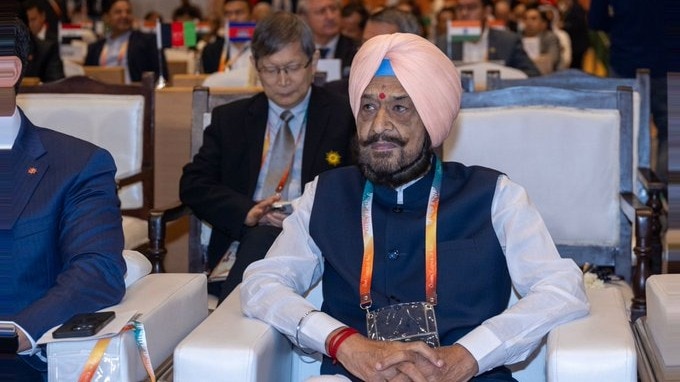
Veteran sports administrator Randhir Singh, India’s first Asian Games shooting gold medallist and one of the most influential figures in the country’s Olympic movement, died on Wednesday at the age of 79 after battling age-related ailments.
Singh had been hospitalised for several days before passing away at his residence. He is survived by his wife Vinita and daughters Mahima, Sunaina and Rajeshwari.
His death marks the end of an era in Indian sport, where he left an enduring legacy both as a decorated athlete and a powerful administrator.
Singh had only recently stepped down as President of the Olympic Council of Asia (OCA) due to health concerns. Elected to the post in 2024 for a four-year term, he had already served the organisation for more than two decades, including as Secretary General from 1991 to 2015.
“With deep sorrow, we share the sad news of the passing of Raja Randhir Singh, who left for his heavenly abode today, on 27th May 2026,” National Rifle Association of India (NRAI) Secretary Rajiv Bhatia said in a statement.
“A distinguished Olympian, Arjuna Awardee, and one of the most respected sports administrators in India, Asia, and the International Olympic Committee, Raja Randhir Singh made invaluable contributions to the development of shooting sports and the Olympic movement.”
Born into the erstwhile Patiala royal family as a descendant of former Maharaja Bhupinder Singh, Randhir Singh carved his own path in Indian sport through excellence in shooting. His crowning sporting achievement came at the 1978 Asian Games in Bangkok, where he won trap gold to become India’s first shooting gold medallist at the continental event. The feat earned him the Arjuna Award in 1979.
His Olympic journey stretched across decades. He was part of India’s contingent as a reserve shooter at Tokyo 1964 before competing in Mexico 1968, Munich 1972, Montreal 1976, Moscow 1980 and Los Angeles 1984.
If his competitive career was distinguished, his administrative impact was arguably even greater.
Singh served as Secretary General of the Indian Olympic Association (IOA) from 1987 to 2010 and held multiple roles within the International Olympic Committee (IOC) between 2001 and 2014. In 2003, he also represented the IOC at the World Anti-Doping Agency (WADA), further cementing his stature in global sport governance.
Widely respected for his ability to build consensus in India’s often fractured sports administration, Singh played a central role in promoting the Olympic movement in the country and shaping policy at the highest levels.
His sporting legacy continues through his family. Daughter Rajeshwari Singh followed him into shooting, winning silver at the 2022 Asian Games and gold at the 2016 Asian Championships, while Sunaina Singh established herself in sports administration and currently serves as an IOA vice-president.
Randhir Singh’s passing closes a defining chapter in Indian sport — one marked by medals, leadership, and decades of influence behind the scenes.
– Ends