


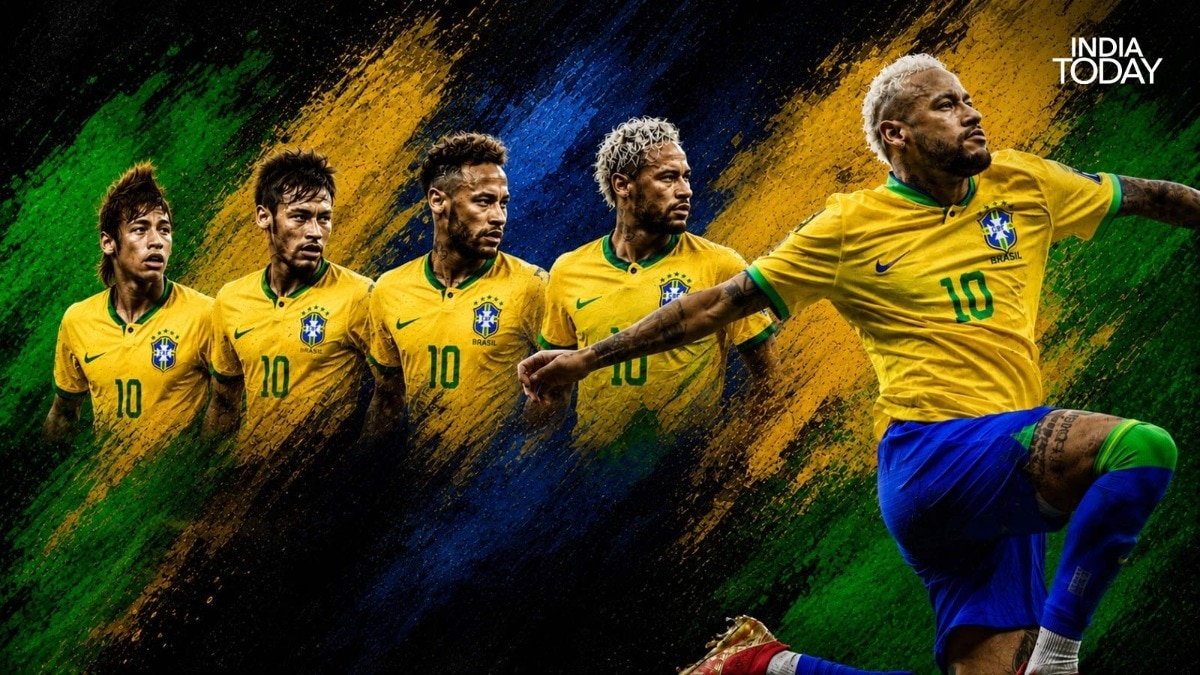
Back in 2011, Brazil was searching for its next football king.
The country that had once produced Pel, Romrio, Ronaldo and Ronaldinho was desperately looking for another player capable of carrying the famous yellow shirt into a new era. Then came a teenager from Santos with a blond mohawk, fearless swagger and the kind of confidence that only geniuses and teenagers possess.
As national-team coaches gathered in Brazil ahead of the World Cup qualifying draw, the spotlight belonged to Ronaldinho. It usually did. The two-time World Player of the Year had spent a decade hypnotising defenders with elastic dribbles, dancing feet and a smile that seemed permanently attached to his face.
But on one unforgettable evening, the old master was upstaged by the boy who was supposed to inherit the throne.
Receiving the ball near the edge of the penalty area, Neymar exploded into life. One defender lunged and missed. Then another. Then another. The teenager slalomed through bodies as if gravity and logic simply did not apply to him before coolly sliding the ball into the net.
The move unfolded so quickly that television producers had to slow it down frame by frame for viewers to fully understand what they had witnessed.
Across Brazil, jaws dropped. A nation obsessed with football had found its newest obsession.
The Prince had arrived.
THE WEIGHT OF A NATION’S EXPECTATION
Brazil has spent much of the last two decades chasing its own history.
It has been 24 years since the Selecao last lifted the World Cup. Nearly two decades have passed since a Brazilian was officially crowned the world’s best player. Vinicius Junior may dispute that drought, but the broader reality remains: Brazilian football has spent years searching for a successor to its golden era.
That search repeatedly pointed toward Neymar.
He was meant to be Brazil’s answer to Lionel Messi — a transcendent talent capable of carrying an entire footballing nation on his shoulders. Every dazzling dribble, every goal and every trophy seemed to reinforce the belief that he would eventually lead Brazil back to glory and remind the world why the yellow jersey was once the sport’s most feared symbol.
For a while, it felt inevitable.
THE KNEE THAT BEANT THE DREAM
The summer of 2014 was meant to be Neymar’s crowning moment. The World Cup had come home to Brazil. The streets were painted green and yellow. Flags hung from apartment windows. Every conversation, every headline and every heartbeat seemed tied to the fate of one player.
Neymar wasn’t simply Brazil’s star. He was Brazil’s hope. Then, in a split second against Colombia, everything changed. Juan Camilo Zuniga’s knee crashed into Neymar’s back during the quarter-final.
The image remains frozen in football history — Neymar lying on the grass, tears in his eyes, his World Cup over. A fractured vertebra had ended his tournament. It also shattered a nation’s dream.
Days later came the darkest night in Brazilian football history, the infamous 7-1 humiliation against Germany in Belo Horizonte. As goals flew into Brazil’s net, one question echoed through the country.
What if Neymar had been there?
CAUGHT IN FATE’S GRIP
Neymar has had a career that somehow managed to be both extraordinary and unfinished.
There were trophies. Plenty of them. There were moments of genius that belonged in football museums. The magical Messi-Suarez-Neymar (MSN) partnership at Barcelona. The Champions League triumph. The world-record transfer to Paris Saint-Germain. Goals, assists and highlight reels that stretched for hours. There were also injuries. Always injuries.
Every time Neymar seemed ready to launch another assault on football immortality, his body betrayed him. Ankles twisted. Ligaments snapped. Muscles failed. The footballing gods appeared determined to test him at every turn.
Yet even as critics questioned his selection, Neymar’s pull remained irresistible.
ONE LAST SHOT AT HISTORY
Which brings us to today. To what may be Neymar’s final World Cup. His selection immediately sparked debate across Brazil.
Was this football logic or football romance?
The numbers paint a worrying picture. Just 27 league starts across the last three years. Only 682 league minutes this season. Another injury concern arriving shortly after his call-up.
On paper, younger and sharper options exist. Vinicius Junior is entering his prime. Raphinha is producing some of the best football of his career. Brazil’s attack has evolved while Neymar has spent much of the past three years fighting his own body.
Yet football is rarely played on paper. And Carlo Ancelotti understands that better than most.
“Neymar has to play in the position he’s meant to play,” the Italian explained. “That is in the centre of the field; he can’t play on the wing.”
The Neymar of 2026 is no longer the electric winger who left defenders dizzy and chasing shadows. This version is something different. A conductor rather than a sprinter. A creator rather than a destroyer. A veteran trying to influence games with vision and intelligence instead of raw acceleration.
Now, with what could be one final World Cup on the horizon, Brazil faces a familiar question.
Is Neymar still the answer? Or is this simply the final chapter in one of the most captivating careers the game has ever seen?
Either way, the story is impossible to ignore.
– Ends



