


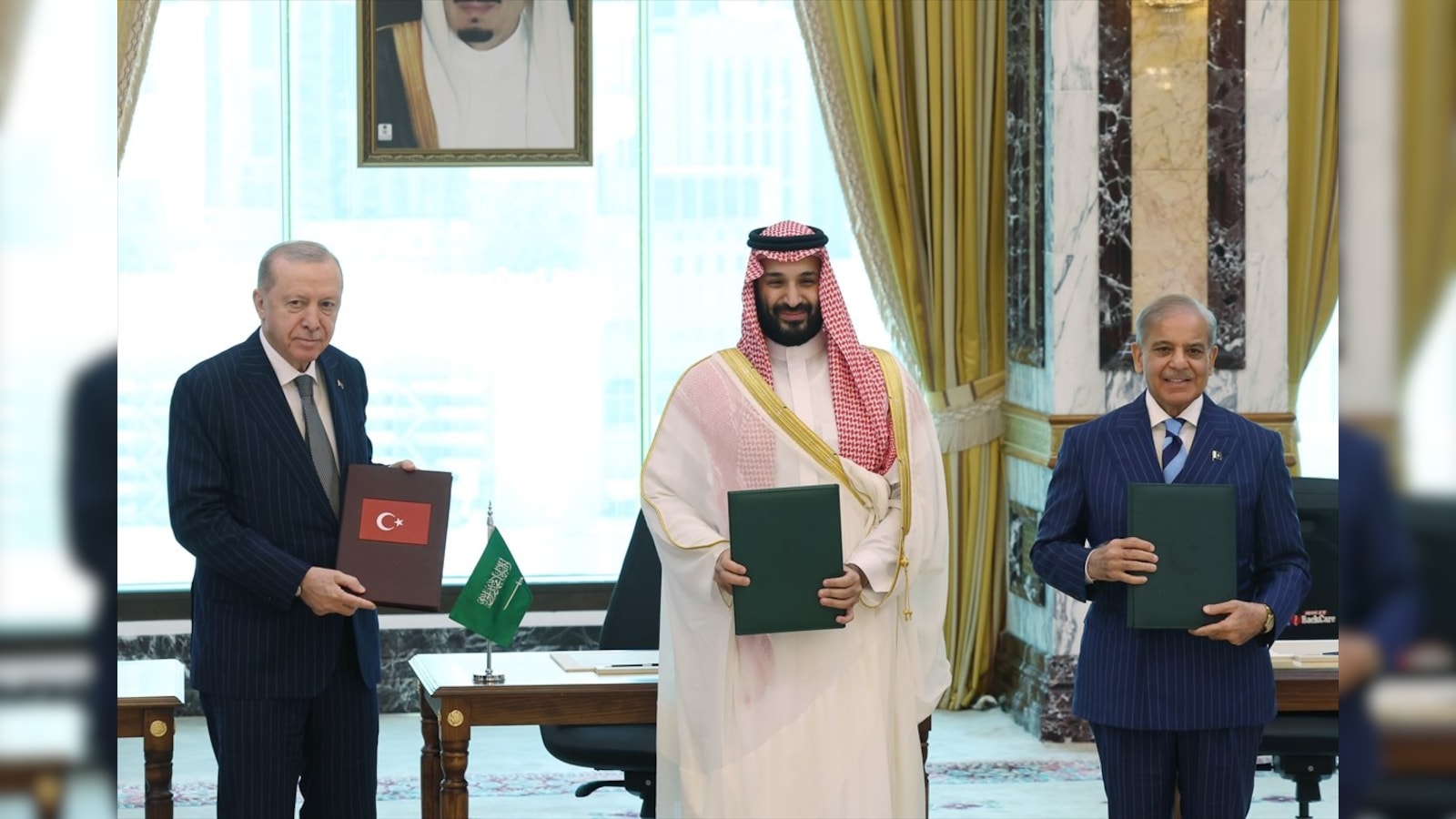
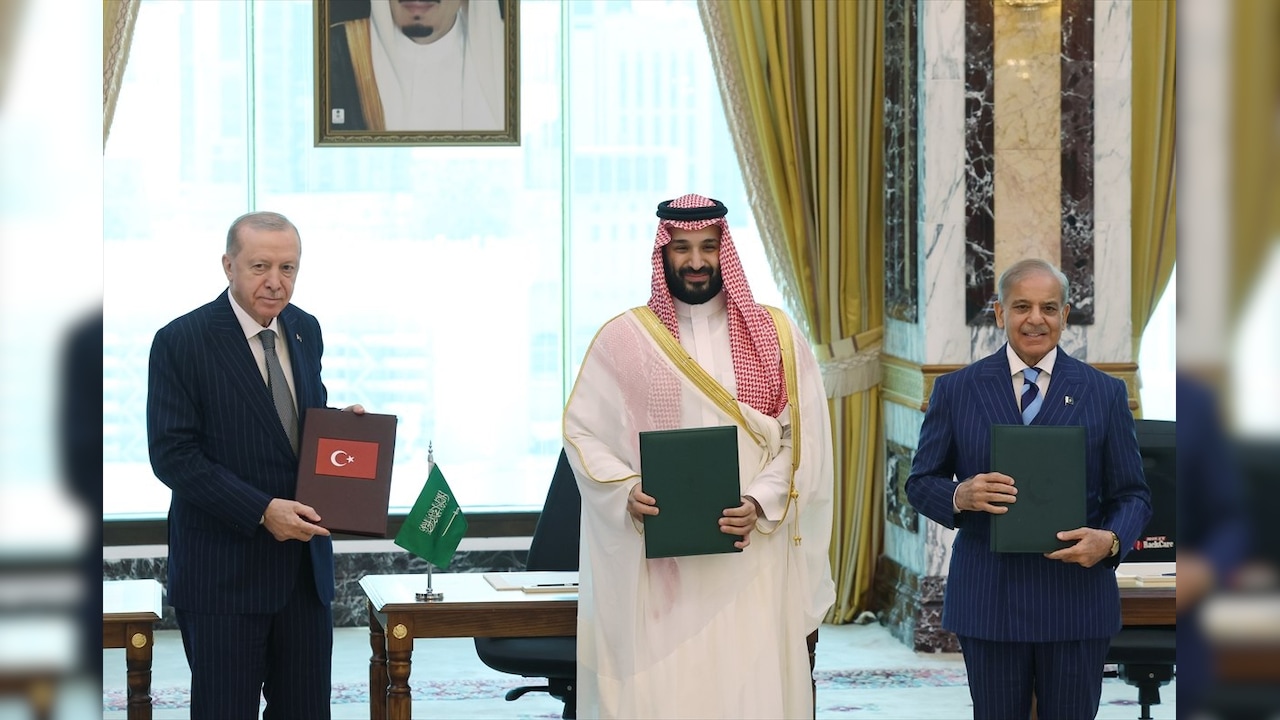
By establishing a new “NATO-style” security alliance, the historic Mecca Joint Defence Agreement, which was signed on August 7, 2026, significantly changed the geopolitical landscape of the Middle East. Three of the most powerful Muslim countries in the world are legally bound by this historic agreement, which was signed by Saudi Crown Prince Mohammed bin Salman, Turkish President Recep Tayyip Erdogan, and Pakistani Prime Minister Shehbaz Sharif. The agreement states that an attack on one is an attack on all.
According to commentators, a defence agreement between Saudi Arabia, Turkey, and Pakistan marked the beginning of a new security alliance that aims to counter an untrustworthy US, dissuade a belligerent Iran, and send a message to Israel.
With a NATO-style provision that views an attack on one nation as an attack on all, this alliance unites three strong Sunni nations that are strategic partners of the United States as the Middle East conflict rages on, reports The Economic Times.
ALSO READ: US Expects Strait Of Hormuz Deal Soon As Saudi Arabia, Turkey, Pakistan Sign Defence Pact
With Pakistan and Turkey serving as middlemen, analysts doubt that this clause would be upheld as the three parties look for ways to end the conflict.
Rich Saudi Arabia has taken the lead in this new alliance, which was inked in Mecca, the holiest place in Islam, but what does this actually mean?
As Tehran continues to blockade commerce in and around the Strait of Hormuz and its Houthi allies obstruct ships in the Red Sea, the United States has failed to deliver a decisive blow to Iran nearly six months into the Middle East conflict.
The security architecture of the area has been disrupted by this reality, necessitating a reconsideration of decades of conventional wisdom based on US military might.
American forces have had difficulty intercepting all of the drones and ballistic missiles fired by Iran and its proxies, despite the region’s archipelago of US outposts.
“American deterrence has been significantly weakened, and the Iranian threat will increasingly need to be managed by regional powers,” according to Ali Shihabi, a political expert close to the Saudi administration, who wrote about the new alliance.
Saudi Arabia has been closer to Egypt, Pakistan, and Turkey, with whom it had previously had tense relations, since the start of the conflict. The four countries have backed the conflict’s mediation.
Pakistan and Saudi Arabia have a long history of security cooperation, and last year they signed a similar deal.
While Saudi Arabia has been reeling from repeated strikes by Iran and its supporters, it has become closer to Pakistan and Turkey as the Gulf is plagued by profound differences.
Even before the conflict, there was a public gap between Saudi Arabia and the UAE. Despite their recent seeming reconciliation, many predict that the UAE would be suspicious of the new agreement.
ALSO READ: ‘Stop Begging For Security’: Iranian Official Slams Saudi’s ‘Paper Pact’ With Turkey, Pakistan
In an effort to create a regional coalition that includes its close partner, the United States has long pushed to expand on the Abraham Accords, which saw the UAE, Bahrain, and others normalise relations with Israel.
However, commentators noted that the new defence agreement unites significant US partners into a different security framework that opposes Israel’s control.
Saudi Arabia has stated that it will not normalise until Israel agrees to a path to Palestinian independence, while Pakistan and Turkey have been outspoken in their criticism of Israel.
Essential Business Intelligence,
Sharp Market Insights,
Practical Personal Finance Advice, Daily Fuel, Gold and Silver Prices and Latest Stories — On NDTV Profit.



