


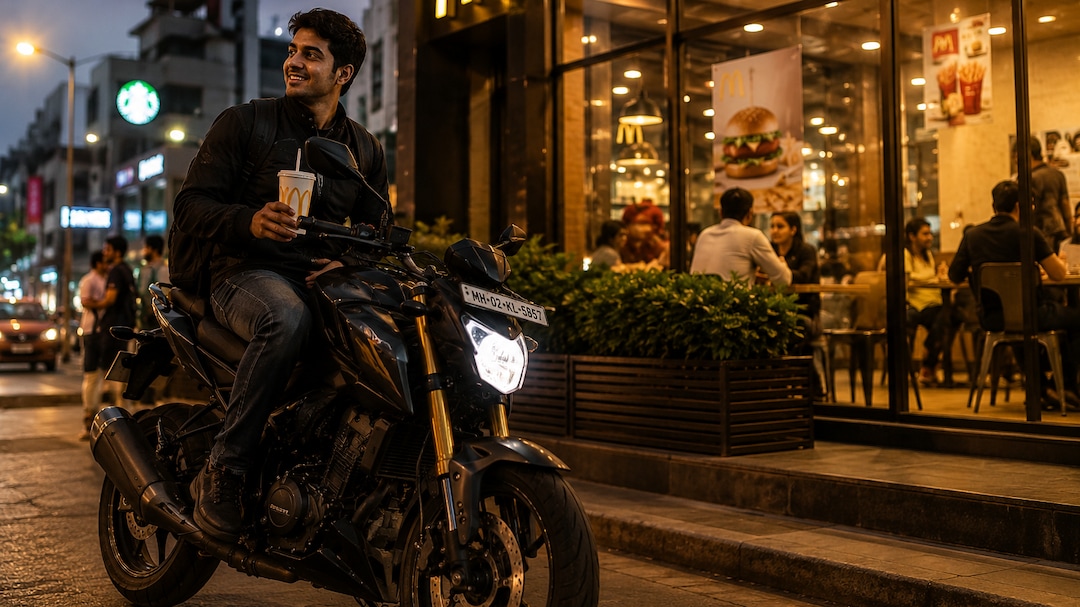
Even as inflation pressures household budgets and companies warn about rising commodity costs, Indian consumers are still spending more on premium motorcycles, scooters and electric vehicles instead of basic commuter bikes.
Comments from executives at Hero MotoCorp, Bajaj Auto and TVS Motor Company during their quarterly earnings calls point to the same trend — buyers are moving toward scooters, 150cc-plus motorcycles, EVs and premium products, while entry-level commuter motorcycles remain under pressure.
Affordable Indulgence
The pattern resembles what consumer researchers increasingly describe as “affordable indulgence” spending, where households under financial pressure continue spending on smaller aspirational purchases even while cutting back on larger expenses.
A 2025 consumer trends report by McKinsey & Company said consumers globally are now “trading down in one place while simultaneously splurging on something else” as traditional links between inflation, consumer sentiment and spending weaken. The report said buyers increasingly prioritise convenience, instant gratification and emotionally rewarding purchases even during uncertain economic conditions.
A separate report by Deloitte-FICCI in 2025 said urban Indian consumers now spend nearly half their food budgets on packaged foods, dining out and food deliveries, reflecting rising demand for convenience-led and aspirational consumption.
ALSO READ | India Auto Retail Posts Best-Ever April, Clocks 26.11 Lakh Units
That pattern is already visible in India’s food and quick-service restaurant market.
In the two-wheeler market, the equivalent upgrade is increasingly becoming:
- a sporty motorcycle
- a connected scooter
- or an EV with premium styling and technology features
Instead of choosing the cheapest commuter bike, buyers are stretching budgets toward products that feel more aspirational without reaching car-level prices.
ALSO READ | Royal Enfield Parent Eicher Motors Clocks 13% Rise In Two-Wheeler Sales
Scooters Over Commuters
The strongest shift is emerging in scooters and EVs.
Harshavardhan Chitale, chief executive officer of Hero MotoCorp, said scooters are expected to grow faster than motorcycles this year, while the company plans to outgrow the industry in both categories.
Chitale said Hero MotoCorp’s EV scooter volumes expanded 2.5 times over the previous year, while its Harley-Davidson motorcycle range grew 26% year-on-year.
“We continue to strengthen our portfolio in FY26 with nine impactful launches and multiple key refreshes, both in our ICE as well as EV portfolio,” Chitale said during the company’s earnings call.
At Bajaj Auto, Joint Executive Director Rakesh Sharma said the 150cc-plus motorcycle segment continues to grow faster than entry-level motorcycles and described premium motorcycles and EVs as the company’s main growth drivers.
“Growth continues to be driven by the upper half of the industry with the 125cc plus segment going faster than the 100cc segment, and in particular, the 150cc plus segment being the fastest growing,” Sharma said.
TVS Motor Director and Chief Executive Officer KN Radhakrishnan also pointed to a widening divide between premium and economy segments.
“The challenge will continue in the economy category,” Radhakrishnan said, while adding that scooters, EVs and super-premium motorcycles are expected to perform strongly this year.
The New Status Purchase
The scooter market itself is also changing.
Scooters were once positioned mainly around mileage and practicality. Companies are now increasingly marketing them around technology, lifestyle and identity, similar to how smartphone brands pitch premium features and design to younger buyers.
Radhakrishnan said scooters could account for more than 40% of the market over time, supported by demand for models such as Jupiter and iQube. Chitale said Hero MotoCorp is doubling capacity for some scooter and EV models as demand improves.
At Bajaj Auto, Sharma said electric scooter demand continues to outpace ICE scooter growth, helped by rising acceptance among younger consumers. “In quarter four, Chetak crossed the 1 lakh retail mark for the very first time in a single quarter,” Sharma said.
Even as companies flagged inflation, rising metal prices and supply-chain disruptions linked to tensions in West Asia, none of them suggested premium demand was weakening.
Instead, companies are increasing investments in branding, technology and premium products.
Hero MotoCorp said it plans additional launches across scooters, EVs and premium motorcycles while expanding investments in connected vehicles and GenAI-led customer platforms. “We are now increasingly leveraging GenAI for improving our customer conversion,” Chitale said.
Bajaj Auto’s Sharma described the 150cc-plus motorcycle segment and electric vehicles as “the absolute epicentre” of the company’s strategy.
Radhakrishnan said TVS Motor would continue investing in technology, R&D and premium products despite commodity inflation pressures.
ALSO READ | Royal Enfield Overtakes Ferrari, Audi To Become World’s Third Strongest Auto Brand
A Different Consumer
For years, India’s two-wheeler market was largely defined by fuel efficiency and affordability.
The latest earnings season suggests manufacturers increasingly see the next phase of growth coming from aspiration, premiumisation and lifestyle spending instead.
That mirrors a wider shift across India’s consumer economy, where buyers may postpone larger discretionary purchases but continue spending on smaller upgrades that offer a sense of comfort, convenience or status.
Essential Business Intelligence,
Continuous LIVE TV,
Sharp Market Insights,
Practical Personal Finance Advice and
Latest Stories — On NDTV Profit.



