


A Washington Post analysis of 50 hours of televised football, basketball and hockey games found that betting references have become a ubiquitous part of the viewing experience.
A gambling reference, promotion or commercial occurred every four minutes on average during the segments of professional and college games examined by The Post. Every one of the sporting events had a reference to betting.
The Post developed an artificial intelligence tool to analyze the broadcasts, which were recorded in Washington, D.C., in December and January on six TV channels and one streaming service. The tool searched for promotional logos and text associated with gambling, however subtle or brief, in nearly 90,000 frames of video. It also identified references to betting in the transcribed audio of the games.
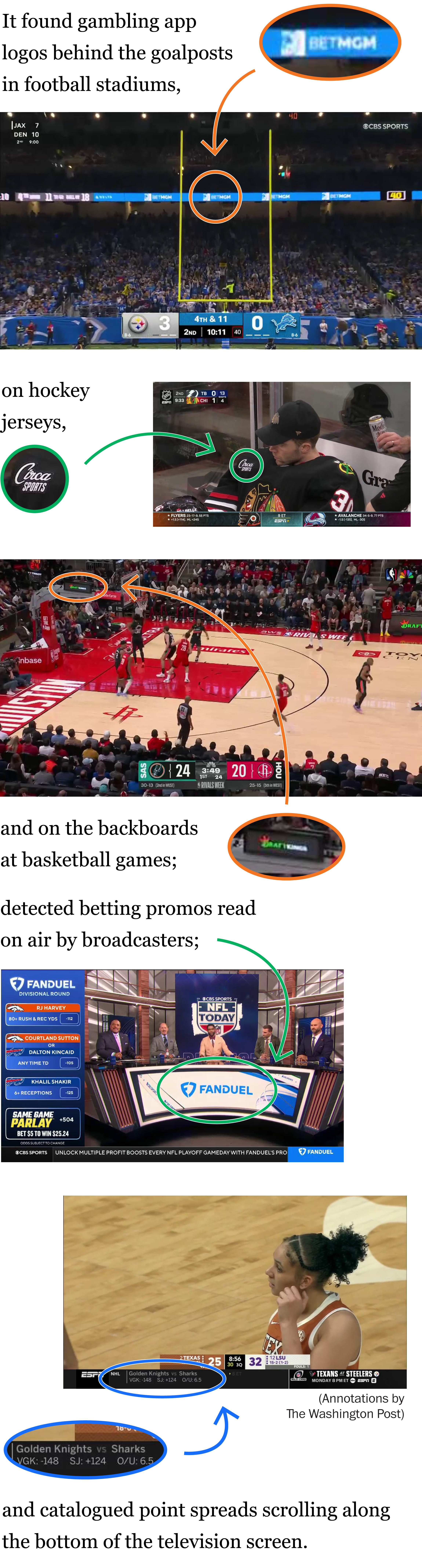
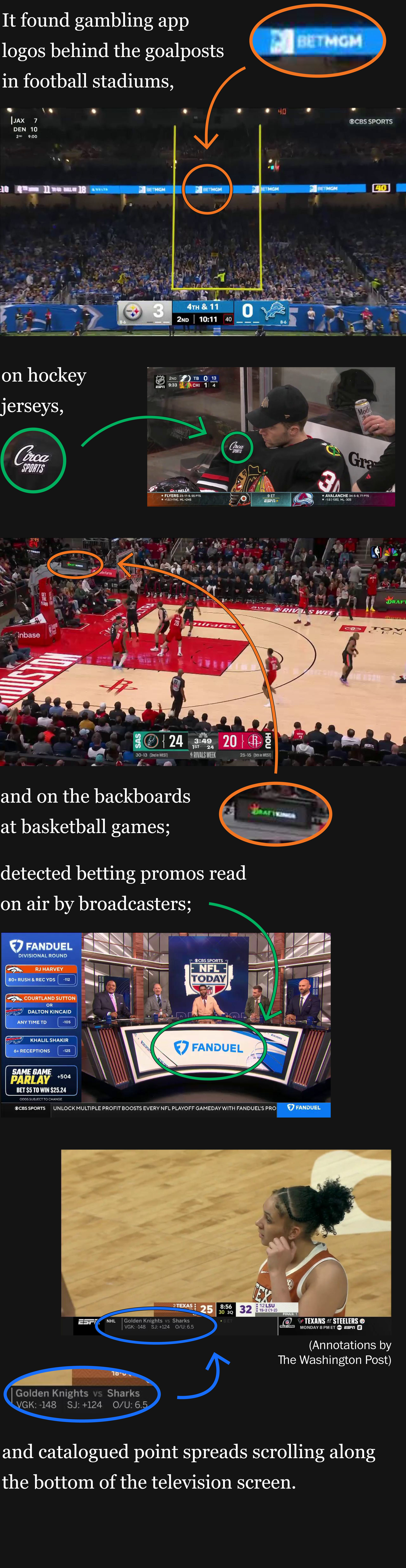
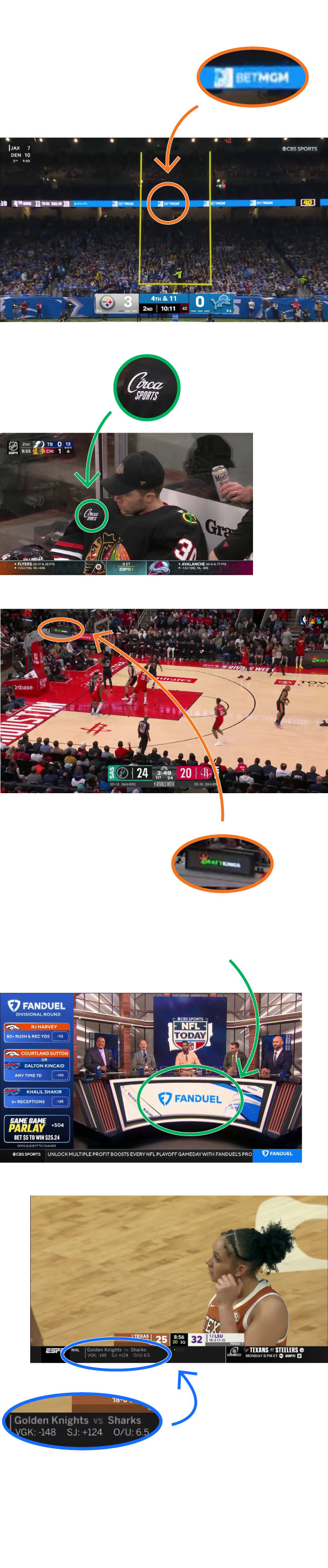
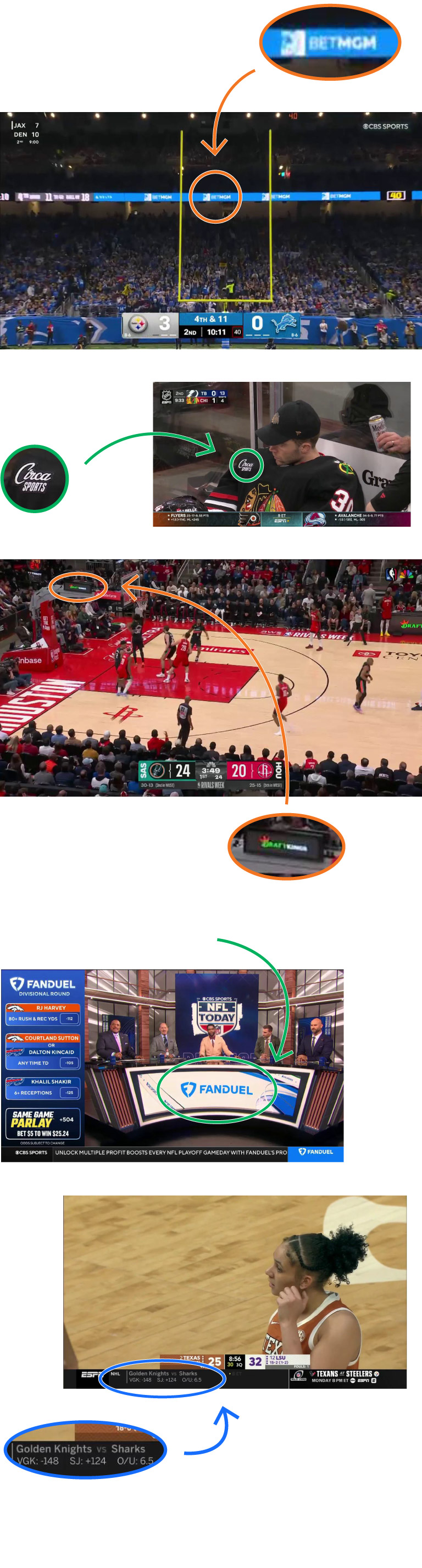
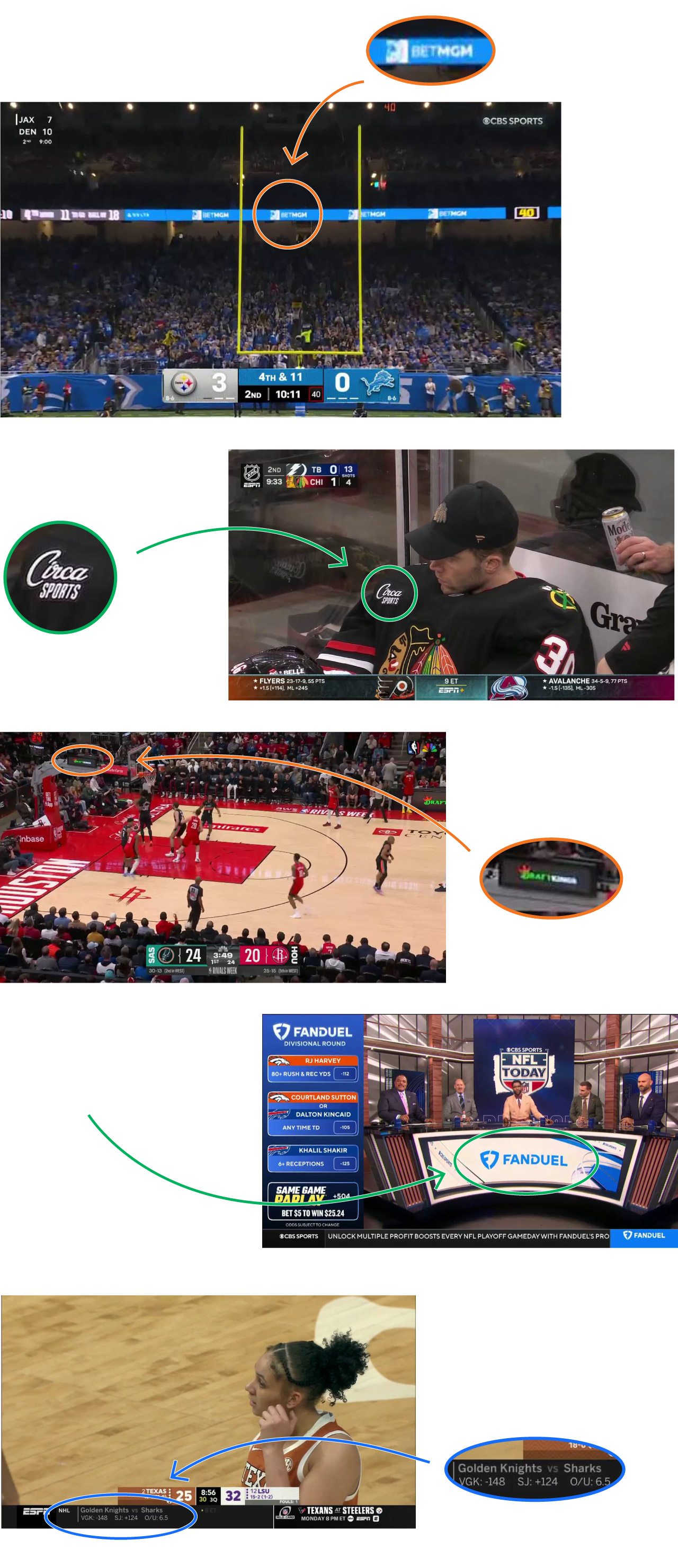
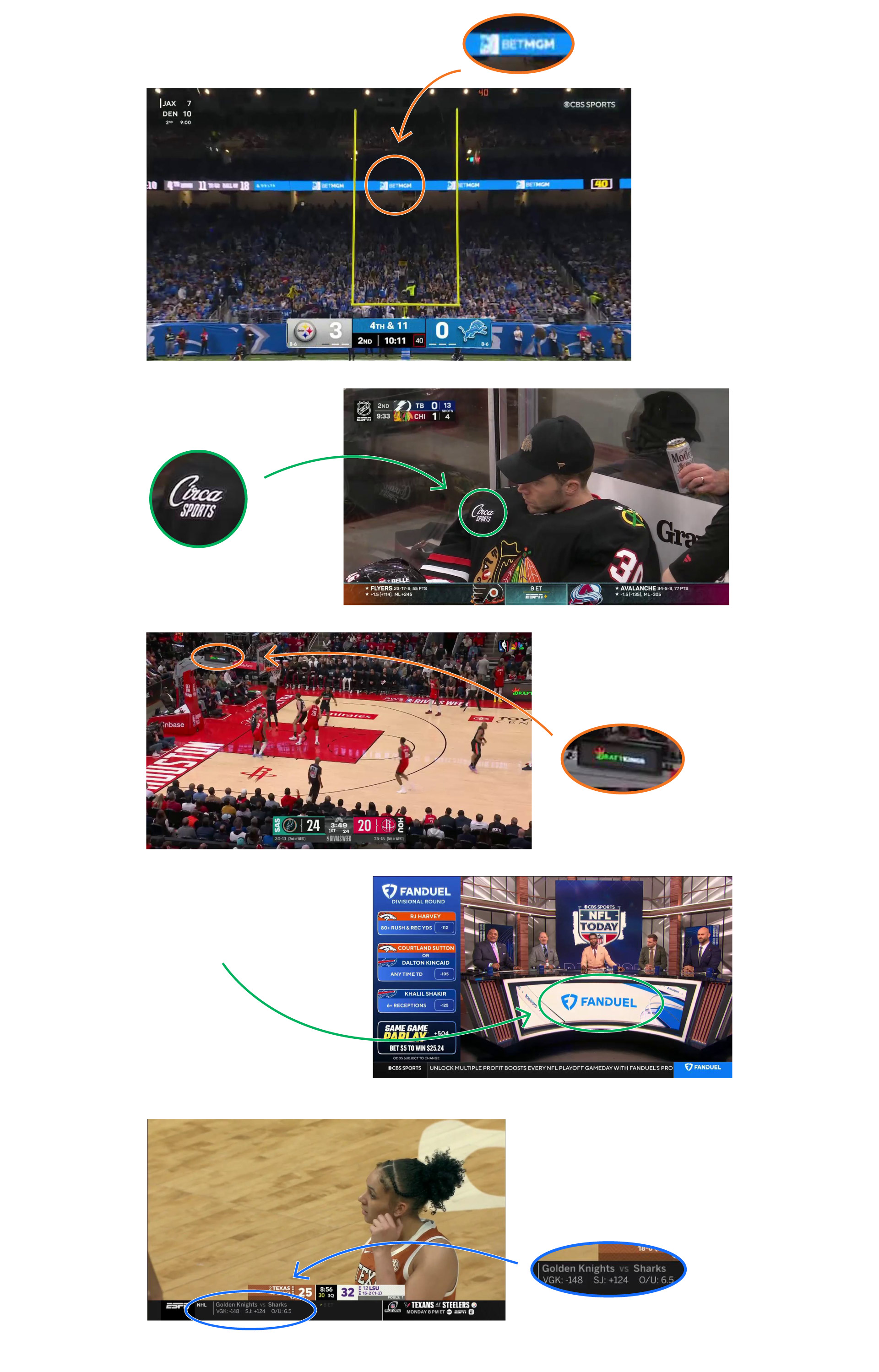
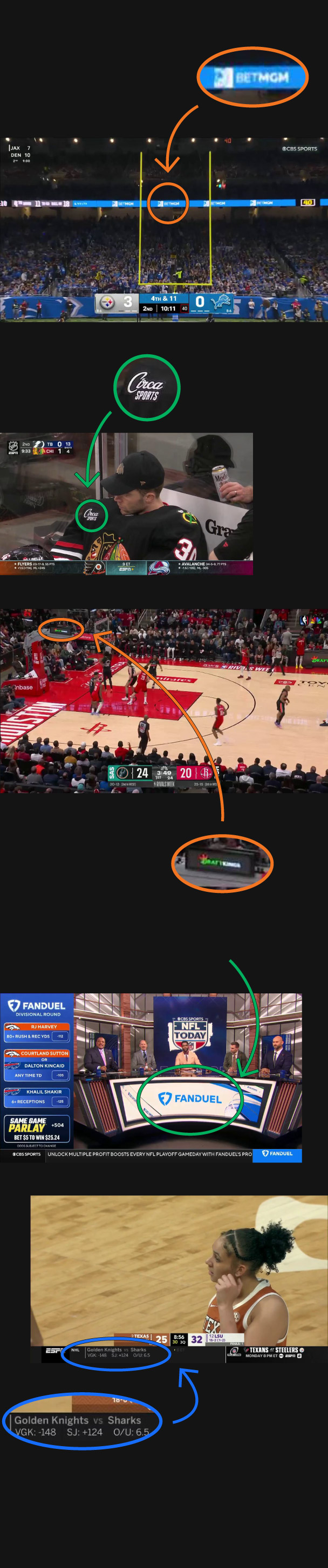
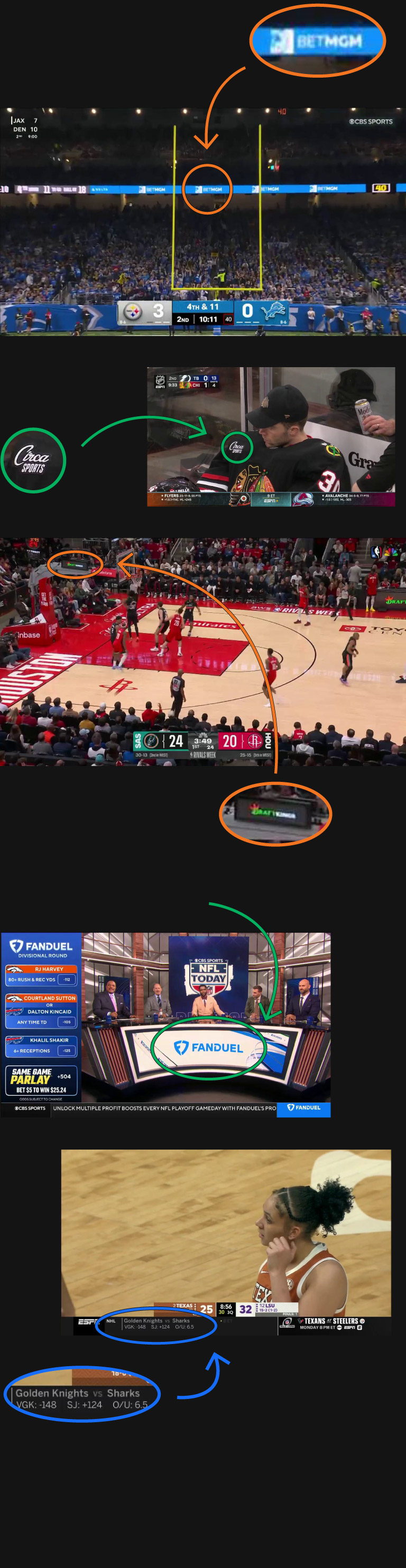
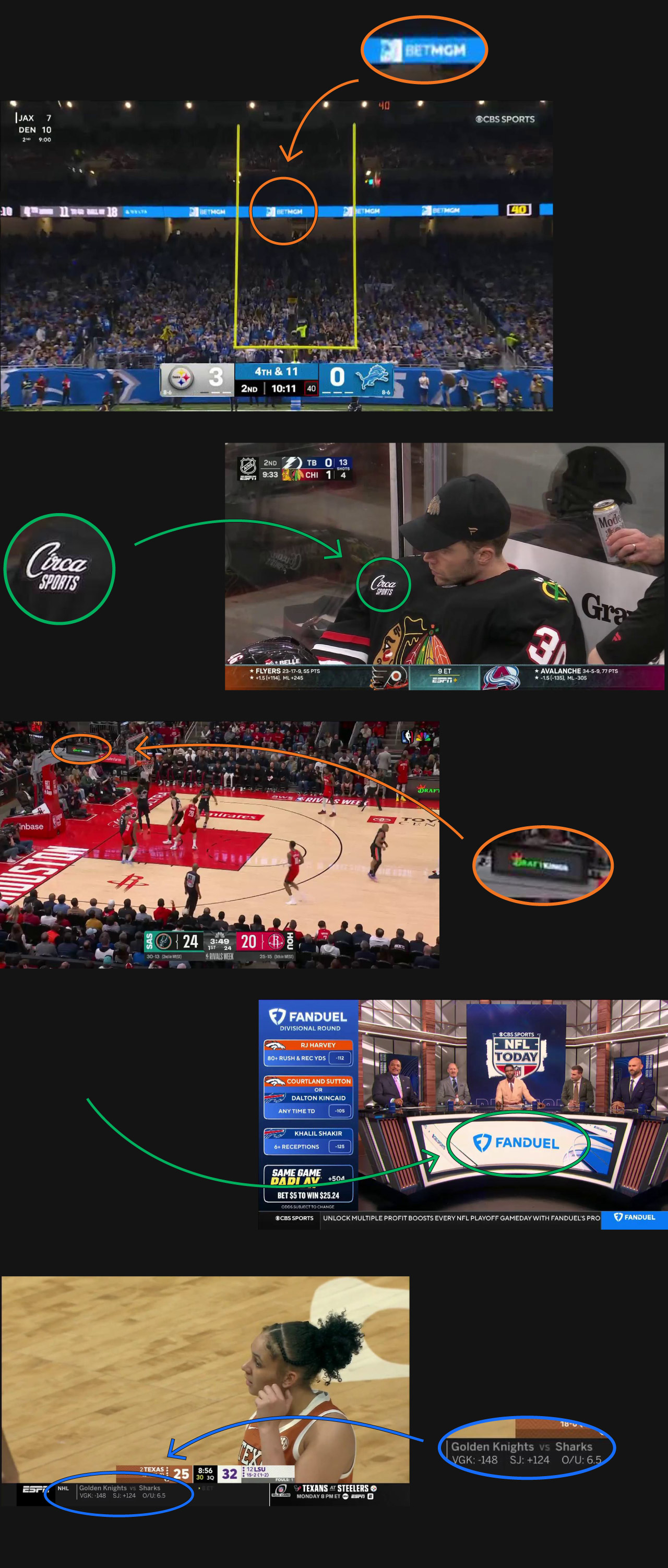
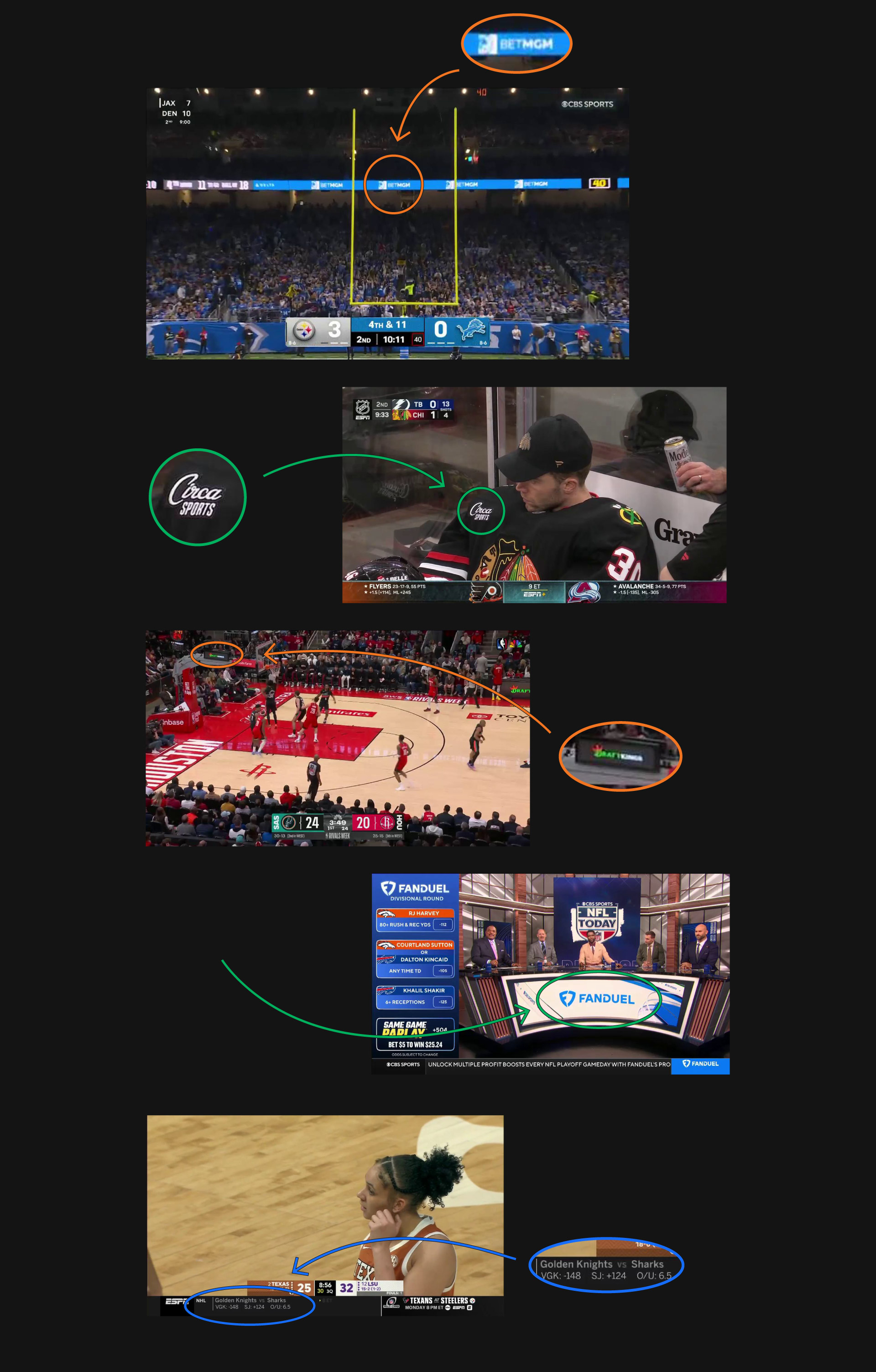
The first-of-its-kind analysis demonstrates how billions of dollars in advertising annually by sports betting companies has profoundly changed televised sports in America. While the gambling industry was viewed by professional league owners and the NCAA as a grave threat a little over a decade ago, it is now so integrated with televised sports that it’s virtually unavoidable.
“The overarching aim is that as soon as you think about sports, you think about betting,” said Raffaello Rossi, a marketing professor at the University of Bristol in the United Kingdom who has studied the prevalence of gambling messages in sports broadcasts.
For its analysis, The Post chose 50 games across a variety of sports leagues, venues and networks, and randomly selected a one-hour segment during each of those games. The selected segments were then divided into one-minute intervals, and the analysis counted how many contained at least one reference to betting. By that measure, 27 percent — or 1 in 4 minutes — included at least one gambling reference.
Betting references were most frequent in hockey, appearing in 60 percent of the one-minute segments across eight hours of broadcasts. NCAA football had the least, with references in 6 percent of the segments across five hours of footage.
Gambling’s prevalence during sports broadcasts reflects its status as an enormous and growing business in America. Sportsbooks, the companies that take bets, shattered records last year, accepting almost $200 billion in wagers, 15 times more than in 2019, according to H2 Gambling Capital, a sports betting data company.
Following a 2018 Supreme Court decision allowing states to legalize and regulate gambling, sportsbooks began spending “an astronomical amount of money” trying to attract new bettors, said Matthew Bakowicz, who ran a DraftKings sportsbook at a Connecticut casino before becoming an American University sports business professor.
Virtually all professional teams in the top U.S. leagues have now agreed to sponsorship agreements with sportsbooks, in deals that allow the gaming companies’ logos and messages to appear on stadium signage, jerseys or other surfaces during game broadcasts, said Bob Lynch, founder and chief executive of SponsorUnited, a firm that tracks sports sponsorship data.
The Post analysis also found arena advertisements for the growing prediction market industry. The online exchanges allow peer-to-peer betting on the outcome of future events, including, in some cases, sports.
Leagues, teams and media companies all rake in the advertising dollars. Athletes benefit too, because NFL, NBA and NHL players receive a cut of total league revenue through union-negotiated deals.
What this means for sports, media and society is now the focus of fierce debate. Age-old concerns about gambling are growing, as addiction hotlines see a dramatic increase in calls for help. Athletes have been suspended or banned for gambling violations. A majority of fans say betting threatens the integrity of sports, according to recent polling.
Joe Maloney, president and chief executive of the Sports Betting Alliance, which represents sportsbooks, including DraftKings, FanDuel and BetMGM, responded to The Post’s findings by pointing to a report by the American Gaming Association. That report shows the amount of money spent on sportsbook television advertising is down from a peak in 2021 and the industry airs far fewer commercials than the pharmaceutical sector.
“Advertising is just a way to communicate to some fans how to increase their level of engagement,” he said. “There is not a digital entertainment product that is more regulated than we are.”
He also said legal sportsbooks offer customers an alternative to illegal betting sites, which often provide few customer protections and do not verify players’ ages. He shared with The Post a five-page code of conduct that he said top sportsbooks have agreed to comply with that includes commitments to not enter into promotional agreements with amateur athletes or advertise in college-owned newspapers or radio stations.
“The deck is always stacked in favor of the house.”
— Bob Costas, television host for 12 Olympics, World Series games and Super Bowls
The top professional sports leagues formed a coalition with some broadcasters, including NBC and Fox, three years ago and agreed that betting should be marketed only to fans of legal age and that excessive gambling should not be promoted.
But all the betting ads make legendary broadcaster Bob Costas, the television host for 12 Olympics, World Series games and Super Bowls, uncomfortable, he said in an interview about The Post’s findings.
“I have declined to read any gambling promos on anything that I’ve been involved in,” said Costas, who described his late father as an inveterate sports gambler. Costas did not take a position on whether such promos should be banned or limited but warned that sports wagers are fueling the growth of casinos and international sportsbooks.
“The deck is always stacked in favor of the house.”
Less than 15 years ago, every top professional sports league opposed widespread legalization of sports betting. MLB Commissioner Bud Selig in 2012 called gambling “evil,” adding: “It creates doubt and destroys your sport.”
In 2014, the leagues began a remarkable about-face. NBA Commissioner Adam Silver penned a column suggesting that sports gambling “be brought out of the underground and into the sunlight where it can be appropriately monitored and regulated.”
When the Supreme Court ruled in 2018 that states had the power to legalize gambling, it took just a few months for the four major professional leagues to announce multiyear promotional deals with online sportsbooks.
State legislatures also embraced the promise of gambling-related tax revenue to fund schools and fill budget gaps. Thirty-nine states, plus D.C. and Puerto Rico, now allow online or in-person sports betting. Last year, 1 in 6 Americans said they had placed a live bet on sports, double the previous year.
Sportsbooks have focused on turning as many fans into gamblers as possible, Bakowicz said, an effort the firms sometimes refer to as “player acquisition.”
“Sports betting companies are saying, ‘Listen, you and your buddies can stay at home doing some betting and have a great time,’” he said.
That makes advertising and marketing by far their biggest expense. In the U.S., FanDuel and DraftKings, the leaders in the industry, spent $1.3 billion and $1.4 billion, respectively, on marketing in 2025, or about one-fifth of all their revenue. Of the 50 games analyzed by The Post, promotions for sportsbooks FanDuel and DraftKings appeared in 24 and 20 games, respectively. Both companies referred requests for comment to the Sports Betting Alliance.

Lynch, the SponsorUnited CEO, said marketing deals now allow sportsbooks to blanket arenas with advertising that shows up in broadcasts.
He provided The Post with a copy of an NHL team’s sponsorship package under the condition that neither the team nor sportsbook were identified. It showed that a sportsbook purchased 41 different marketing “assets” from the NHL team for the 2024-25 season, allowing the company to place its name on digital and physical signage in the arena; ticket gates; scoreboards; jersey patches; entertainment during a commercial break; club seats; stadium restaurants; and team social media posts.
Lynch said such deals can cost up to $5 million annually and include as many as 60 components.
The promotions in the NHL arena that viewers see on TV may not actually exist in person. Starting in 2022, broadcasters could “erase and replace” the physical ads on the boards surrounding the ice with alternatives sold for TV, using technology installed in all the rinks. That year, the league’s commissioner told Sports Business Journal that the revenue from the digitally-inserted ads is split between the league and both teams.
“Sports betting is one way that some fans engage with all sports and it is one of many categories of partnership that support leagues,” the NHL said in a statement, adding that it is committed to “responsible gaming and fan protections.”
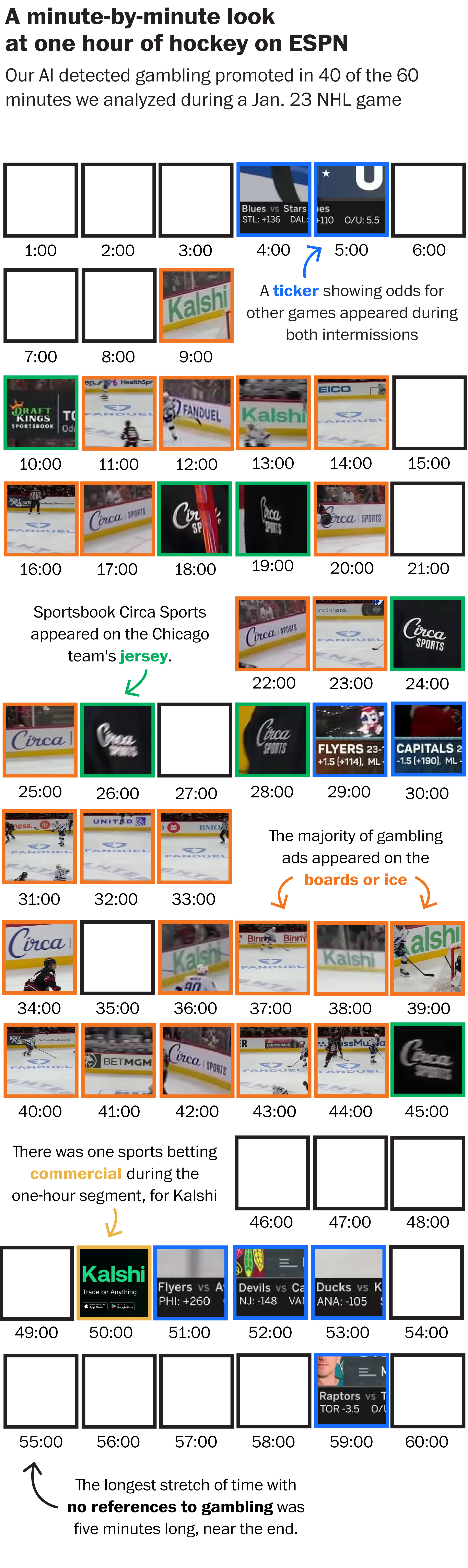
The Post analyzed eight hockey games in different venues. Arena ads made up the vast majority of all gambling references in all of the games, appearing once every 11 seconds on average.
Three of the eight games had arena ads for prediction market firms — two for Polymarket and one for Kalshi. The companies, which offer peer-to-peer sports betting, did not provide a comment for this report.
Arena ads are “a really smart media investment because it is exactly where people are keeping their eyes,” said Angeline Scheinbaum, a professor of sports marketing at Clemson University, who has studied how fans’ eyes track ads close to the “center of action” in tennis. “We found out that people do notice it.”
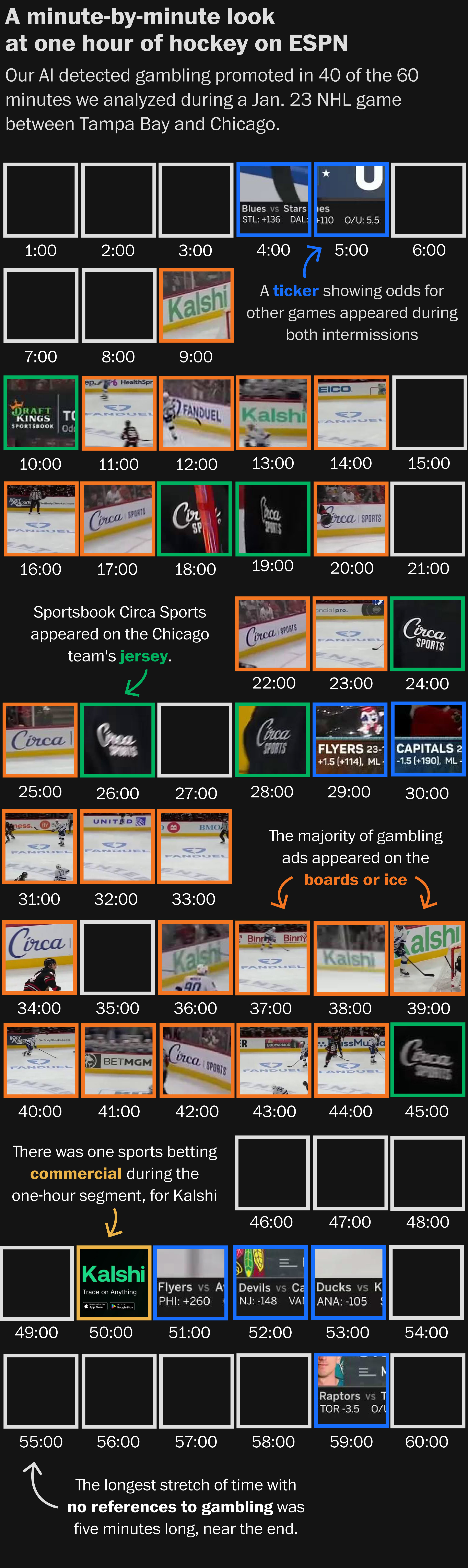



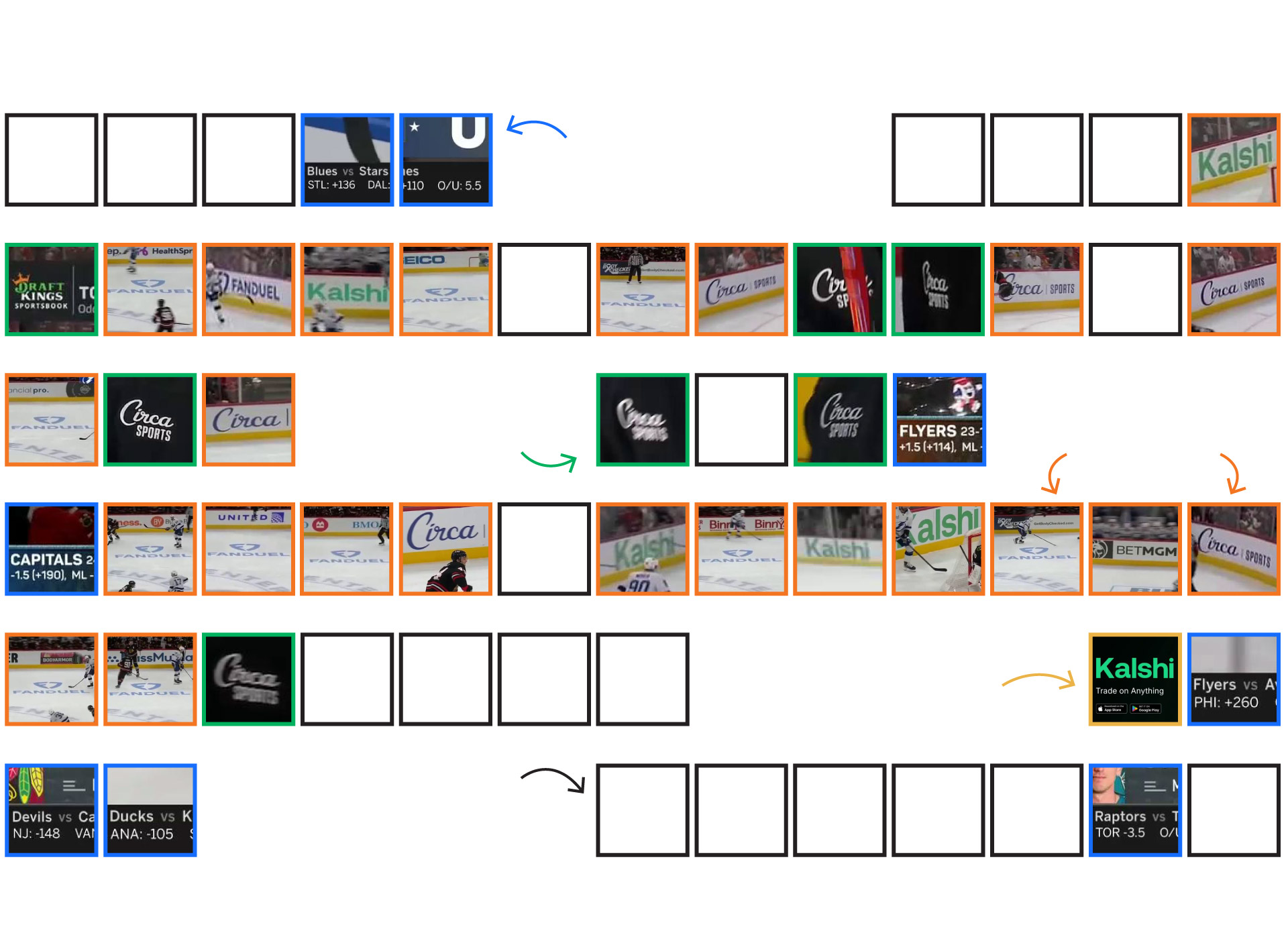




The in-game signage “signals legitimacy and institutional acceptance,” said Ken Wilbur, a marketing professor at the University of California at San Diego who has studied gambling advertising. It often reappears after the game in social media clips and, he said, it allows sportsbooks’ TV commercials to “focus more on promotional offers and calls to action, rather than establishing legitimacy.”
Derek Stevens, owner and chief executive of Circa Resort & Casino, said the company sponsors teams — including the NHL’s Chicago Blackhawks — to attract customers in the six states where it is licensed. “We’re looking for brand awareness in a market that’s relevant to us,” he said.
The hockey games analyzed by The Post appeared on ESPN, ABC and TNT.
ESPN and ABC declined to comment, but their parent company, Disney, has self-imposed restrictions on gambling advertising, including limits on the number of commercials that can appear during game telecasts. Those standards bar ESPN from airing ads that refer to college sports, for example. TNT did not respond to requests for comment.
Some networks, such as ESPN, have integrated betting odds into news tickers that report live scores.


The Post analyzed one hour of regular season men’s college basketball and three hours of women’s college basketball on ESPN. The men’s game showed the ticker with odds for upcoming games at least once every minute. The women’s games showed the ticker on average three of every four minutes. The odds usually appeared alone, without referencing any specific sportsbook, but, periodically, text appeared in the ticker saying they were provided by DraftKings.
ESPN announced a multiyear deal with DraftKings in November, saying that the sportsbook’s “entertainment products will be exclusively integrated across ESPN’s ecosystem.”
NCAA spokeswoman Saquandra Heath said in a statement that the NCAA “has been very aggressive in addressing gambling harms to protect student-athlete well-being and competition integrity” including a ban on commercials and restrictions on sponsorships during championship events such as March Madness. “We are doing our best to monitor our broadcast partners and will continue to remind/address this policy with them,” Heath said. The NCAA leaves conferences and teams to negotiate sponsorship deals for regular season games.
References to gambling during NBA games analyzed by The Post appeared on average in 1 of every 3 minutes and were often prominent. During a January game on ESPN, for example, a commentator described betting that a specific player would score at least 30 points before a second commentator announced a DraftKings promo code.
An NBA spokesman said the league has strict limits on gambling ads but declined to enumerate them.
Both professional and college football had fewer gambling references than hockey and professional basketball among the games analyzed by The Post. One out of every 16 minutes across six hours of NCAA football bowl games referenced gambling — far less than any other sport. And a January NFL playoff game on ESPN had the longest interval with no gambling reference at all — more than one hour.
The NFL said it has set limits on advertising for gambling. It bars more than one gambling commercial per quarter, prohibits gambling ads on player jerseys and playing surfaces, and does not allow active players to appear in such ads.
“The NFL’s approach to legalized sports betting is built on an unwavering commitment to protect the integrity of the game and our fans,” the league said in a statement. The NFL “has navigated this rapidly evolving landscape intentionally and with our fans in mind.”
Despite the NFL’s limits, pregame football shows were replete with gambling mentions. In addition to its in-game analysis, The Post examined six hours of pregame shows before 12 professional and college football games. Those shows contained a gambling reference every two minutes on average.
Fans, legislators and even some sports leagues have begun calling for restrictions on gambling ads.
Around half of fans, 51 percent, say they support banning betting ads during games, according to a November 2025 Ipsos poll.
Rep. Paul Tonko (D-New York) and Sen. Richard Blumenthal (D-Connecticut) have proposed legislation that would ban gambling marketing during daytime hours and during live sports events, a “whistle-to-whistle” blackout that is already in place in the U.K. The bill would also ban ads offering bonus bets or odds boosts, which Tonko said he finds particularly problematic.
“We should see this as a public health crisis,” he said. So far, no Republicans have signed on to Tonko’s bill.
Silver, the NBA commissioner who was early to embrace gambling more than a decade ago, now favors reining it in.
“I think, probably, there should be more regulation, frankly,” Silver told ESPN in October. “I wish there was federal legislation rather than state by state. I think you’ve got to monitor the amount of promotion, the amount of advertising around it.”
Methodology
The Post used AI to analyze 50 televised sports games for references to betting, extracting still frames from video every two seconds and asking models to detect and classify gambling-related imagery. We combined that with transcribed audio from the same games. For more details on how we did our work, see here.
About this story
Photos and videos obtained by The Washington Post.
Reporting by Jeremy Merrill, Jonathan O’Connell and Luke Connors. Emily Giambalvo and Jorge Ribas contributed reporting. Design and development by Stephanie Hays. Design editing by Virginia Singarayar. Editing by Meghan Hoyer, Shawn Boburg and Joe Tone. Copy editing by Briana R. Ellison. The AI tool we used for this analysis, called Haystacker, was developed by James O’Toole, Yoli Martinez, Aaron Brezel, Katlyn Alo, Jake Kara, Paige Moody, Semanur Karayaka, Patrick Slawinski, Keerthy Reddy and Karen Wang.



